afootwego-03-secret-to-overcoming-travel-stress-and-anxiety
afootwego Post:- The Secret to Overcoming Travel Stress and Anxiety: Mental Fitness
…for people who love to walk…
Supporting Mindful and Responsible Travel
Overcoming Travel Stress and Anxiety comes from building mental fitness, creating personal resilience…
The Secret to Overcoming Travel Stress and Anxiety: Mental Fitness
July 2026
12¼
Stressed or Anxious about Travelling?
Relax, thatâs Pretty Common
Travel can be stressful!
Thatâs the experience of a significant majority of travellers worldwide.
In a 2026 survey of women solo travellers, around 70% reported having some form of anxiety about travel.
Because of bouts of stress and anxiety, some travellers find it necessary to modify their plans, while others give up entirely on their intended dreams and adventures.
As an aside, perhaps travel stress and anxiety explains some of the weird behaviours that we hear of from tourists and travellers?
If you are amongst those who have experienced some form of stress or anxiety, either before you travel, or/and during your travels, or if youâve given up on travel because itâs too stressful, you are not alone.
In fact, it seems that travellers who do not experience stress or anxiety are actually in the minority:
- the 2026 survey of women solo travellers mentioned above also found concerns over personal safety (68%), costs (68%), language barriers (47%), and getting lost (40%),
- a 2022 survey reported 92% of Americans found both domestic and international travel to be stressful. This survey was based around trip planning, travel, and destinations.
So, are there steps we can take to prevent stress and anxiety from spoiling our travel dreams and adventures?
The short answer is âYESâ, travel stress and anxiety can be overcome.
A Quick Outline
In this Post, we shall explore:
- Travel is BIG business
- My Moments of Travel Stress
- Unpacking Travel Stress and Travel Anxiety
- Unpredictability Can Lead to Stress and/or Anxiety
- Countering Travel Stress and Anxiety
- Developing Our Mental Fitness and Travel Resilience
- Mental Health Terminology
- Stress and Anxiety are NOT a Sign of Weakness
- Identifying Triggers From Past Experiences
Latest Travel Post
offers more than 21 ideas for Sydney attractions worth visiting during winter, Sydneyâs quietest season for tourism (making it also the most affordable season for visitorsâŚ)
Travel is BIG business
In spite of the apparent prevalence of travel stress and anxiety, travel remains BIG business world-wide, accounting for around 9.9% of total global GDP.
It seems that up to almost half of the global population may travel during a typical year.
Estimates suggest between 2 and 4 billion people worldwide take at least one domestic trip (overnight or longer) over a year. In addition, there are between 250 to 350 million individual international travellers worldwide per year.
And on any given day, around the world:
- up to 15 million people will travel by commercial aircraft, with up to 3.2 million passengers in the sky at any specific moment,
- almost 1 million travellers will be aboard cruise liners, and
- hundreds of millions will be in transit across various road, rail, and sea networks.
My Moments of Travel Stress
Over the years I have experienced several moments of travel stress, usually while on my journey and far away from my home base. One I well remember is:
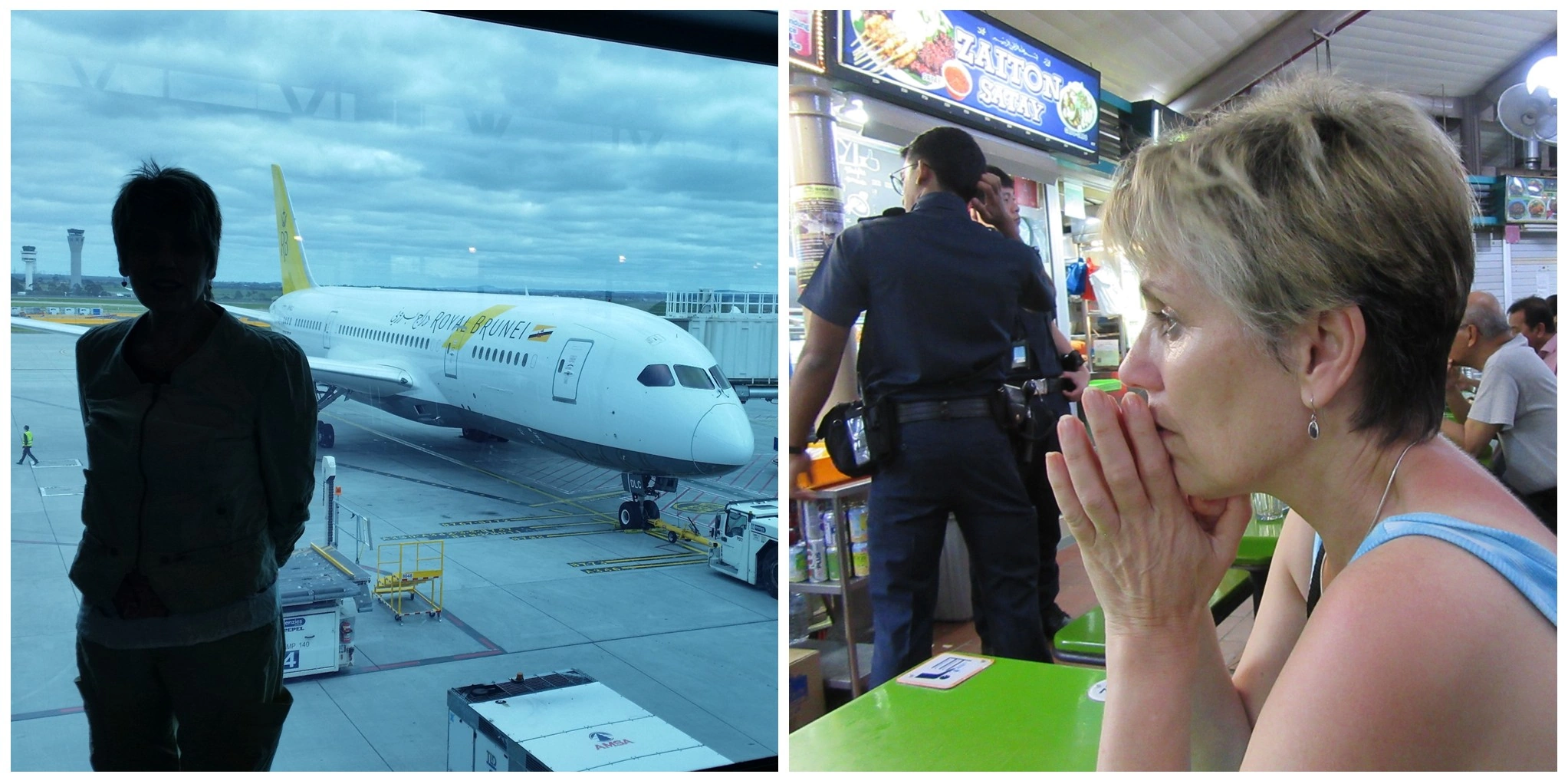
I was taking my Mum to the Baltic, flying from Melbourne to Stockholm, with stopovers in Singapore and Zurich.
Our SQ flight from Melbourne departed and arrived on schedule. As our bags were already checked through to Stockholm, at Changi Airport we had ample time to visit the famous Butterfly Gardens.
When we emerged, we found that our leg to Zurich, with SWISS, was delayed by around 2½ hours. That meant we should only have a short wait in Zurich before our final leg to Stockholm departed.
We eventually we departed Singapore almost 2ž hours late, but I wasnât too concerned because we were continuing on to Stockholm with SWISS. My expectation was that we would complete our immigration formalities in Stockholm, and would merely transit Zurich âairsideâ.
On arrival, I found that I was WRONG! Schengen Zone entry was required, even to transit Zurich airport.
We joined the queue, and waited our turn. I âwatch-watchedâ anxiously, as the minutes ticked by until our final check-in for Stockholm. In a strange airport, and feeling a bit jet-lagged, I was starting to stress â but I couldnât let Mum see this.
After an eternity, our immigration was completed, and we went in search of our SWISS Check-in. We now had less than 5 minutes remaining, and my stress levels were rocketing up the scale.
I said to my nearly eighty-year-old Mum âwe need to run!â Suddenly, she was off â running as if she was back in her school-girl days, at an athletics carnival. I struggled to keep up, but with adrenaline now surging through my system, I wasnât going to stop.
Mum spotted our SWISS Check-in, and led me in. Two other passengers were ahead of us in the queue â and we had perhaps a minute left. One of the SWISS Customer Service team glanced our way, and gave us a smile.
We had made it! Hallelujah!
Perhaps, because we were booked through to Stockholm on SWISS, we would have been given some grace if we had been late?
But, being so far from home, I was not going to risk it, even though the problem had been caused by our delayed departure from Singapore with SWISS.
By the time we boarded our flight to Stockholm, I was almost back to normal.
As for my Mum, after we buckled up for take-off, she said something like âThat was exciting! Is it always like that?â (Thatâs my Mum, not phased at all!)
Unpacking Travel Stress and Travel Anxiety
To be clear,
On the other hand,
Both stress and anxiety are
In the case of stress, our brain will release the hormones adrenaline and cortisol, to prepare our body for immediate action (fight or flight). As the external threat passes, this release stops.
Anxiety triggers the release of cortisol, which increases alertness and energy levels. However, persistent anxiety will cause the release of cortisol to continue, which can have both physical and psychological consequences.
Unpredictability Can Lead to Stress and/or Anxiety
Travel can be an exciting adventure, but it can also bring a certain amount of unpredictability, resulting in interesting (and sometimes unexpected) challenges, including situations beyond our control.
Along with this, travel also causes an immediate disconnect with our usual daily routine.
Because our brain has evolved to find safety in predictability and structure, this is one reason why most people can expect to feel at least some extent of stress and/or anxiety when travelling.
Most travel can be broken into four (or five) stages:
- planning and preparation (getting ready )
- departure and travel (the adventure begins )
- destination/s (where we go, what we see & do )
- return travel (heading our way home )
- recovery (cleaning, repacking, reviewing )
As we cycle through the array of activities in each of these stages, we may encounter unexpected or unpredictable situations (challenges, threats) which cause us some form of stress, or lead to anxiety.
These might even begin during planning and preparation, with information overload and decision fatigue (i.e. âoverwhelmâ).
Along the way we might encounter things outside of our control, such as changed or cancelled bookings, flight delays, missed connections, lost baggage, and even illness.
One of my techniques for countering travel stress and travel anxiety is to remind myself that I am not like the first person to walk on the moon. The paths that I am treading (or will be treading) have been walked (literally) by untold thousands before me. Any challenge or threat that I might face has already been overcome by many of those who have gone before me.
Countering Travel Stress and Anxiety
The secret to countering travel stress and travel anxiety lies in
For athletes, especially elite athletes, where physical capabilities are often almost equal, mental fitness (also known as âmental skillsâ) is the key to success.
Mental fitness helps athletes compartmentalise mistakes and avoid negative performance spirals; navigate any physical and/or psychological toll of setbacks; and adopt a “success mindset” during high-stakes moments by blocking out distractions.
As one of my Army Physical Training Instructors would often say when coaching sports teams to be focussed on their game: âLadies, you are only ever going to be as good as the muscle between your ears â all this physical stuff is useless if we donât also train your brain!â
The same applies for travellers. Our physical fitness gives us the endurance and strength that allows our body to perform tasks with ease, without becoming tired.
And our mental fitness gives us the skills and habits that determine our resilience, i.e. how well we handle stress, bounce back from setbacks, regulate our emotions, and adapt to change.
Developing Our Mental Fitness and Travel Resilience
Our Mental fitness is developed through repeated practice (not unlike physical strength training), and it is a predictor to how we’ll respond to future challenges, rather than just describing how we might feel today.
Preparing our mental fitness for travel is about being proactive, meaning that we take action to maintain and improve our mental wellbeing, training our mind to stay strong, adaptable, and sharp. While actual mental training methods may need to be individually tailored (similar to an elite athlete), they are likely to include:
- physical health
- mindfulness
- social connections
- sense of purpose
- mental stimulation
Our resilience describes how capable we are of handling the emotions of wherever we end up. Instead of panicking when things go wrong, the resilient traveller is able to stay calm, adapt, recover, and bounce back from any unexpected travel disruptions.
Each time we face a challenging encounter, we learn something. When we recover and bounce back, our self-confidence grows, which reinforces our resilience. Self-confidence and resilience fuel each other in a continuous loop.
The opposite of self-confidence is self-doubt. Action, even in the form of small steps, is the best antidote. Viewing obstacles or setbacks as stepping stones to learn and adapt encourages a âgrowth mindsetâ. Above all, treating any failures as learning opportunities strengthens self-confidence.
Mental Health Terminology
For clarity, it is worth noting the following terminology related to mental health:
Acquiring the skills and habits needed to build your inner strength, resilience, and adaptability to handle challenges
Your active pursuit of a healthy, balanced mind, bringing you a sense of peace, happiness, and equilibrium
A snapshot of your current quality of life â which is shaped by the fit between your brain and your environment
Your current psychological, emotional, and social state of being, covering how you think, feel, and act
At times, these four terms may be used as if they’re interchangeable; while they are related, each is distinctly different.
Stress and Anxiety are NOT a Sign of Weakness
As noted above, both stress and anxiety come the “fight-flight-freeze” survival instincts of our caveman ancestors, and even in the 21st Century are completely normal human emotions. They are NOT a sign of weakness, or of a mental health deficiency.
Each of us, when faced with a threat or a challenge, are likely to react slightly differently. This is because different brains may be âwiredâ differently â this may be because of our genetics, our life experiences, our age, our health, our wellbeing, or our environment (or, a combination of two or more).
In any given moment, whether travelling or not, when a threat or a challenge is perceived, our brain will send a surge of adrenaline into our bloodstream (which is why some people seek out thrilling, intense, or dangerous activities to trigger an adrenaline rush).
Because of this, the first time we encounter something that is unexpected or unpredictable, it can have a big impact. However, repeat occurrences of similar experiences are likely to have a lesser impact, perhaps even eventually becoming nothing to worry about (“no worries!”).
While our immediate instinctive response, which overrides any rational thoughts, is triggered automatically by our brain, our mental fitness can give us the resilience to manage our reaction, keeping it in balance with the threat or challenge. Our resilience also enables our recovery, so we move forward, rather than spiralling into a deep hole.
Identifying Triggers From Past Experiences
By reflecting on past experiences, we can identify and even understand what may induce stress or anxiety. This naming a specific worry or concern is called âtrigger-mappingâ. It will contribute to our mental fitness preparation and help to build our resilience.
Trigger-mapping involves:
- identifying a source (who, what, when, where, and how)
- noting our response (your emotional and physical sensations)
- tracking the prior event (what was happening right before)
- identifying our mind âspiralâ (your immediate automatic thoughts)
- developing a coping strategy (a calming technique you can use)
- recording results and outcomes (measuring successes)
Keeping a trigger-mapping record allows us to review successful coping strategies and to modify those that were less successful. It also provides a chart of our overall progress.
The Travel Resilience Solution
Want to go deeper into this subject, to develop your mental fitness and travel resilience?
My
To know more, follow this link:
Your Take-outs
The secret to countering travel stress and travel anxiety lies in mental fitness.
- Mental fitness enables athletes to stay focused under pressure, manage anxiety, recover from setbacks, and maintain consistent performance. As travellers, to counter the emotional and physical ravages of travel stress and travel anxiety, these are capabilities we should seek by preparing our mental fitness.
- Between 2 and 4 billion people worldwide (almost half of the global population) take at least one domestic trip in a typical year, while up to 350 million travel internationally.
- Surveys show that a significant portion of travellers report they experience some form of stress, or of anxiety, either before they travel, or/and when they are travelling.
- Stress is generally a short-term reaction, triggered by an identifiable external challenge or threat, while anxiety is an excessive and ongoing internal worry or fear that can even occur without an obvious trigger.
- Travel brings a certain amount of unpredictability into our lives, along with disrupting our usual daily routine. Because the human brain looks for predictability and structure, most travellers may experience some extent of stress and/or anxiety.
- Mental fitness develops our resilience, which helps us to manage our response to any stress and/or anxiety, and also enables our recovery as we adapt to the situation.
- Resilience and self-confidence fuel each other in a continuous loop. Each time we recover and bounce back, our self-confidence grows, which reinforces our resilience.
- Trigger-mapping is a useful technique to use past experience to discover causes of stress and/or anxiety, and to develop coping strategies to deal with these in the future.
Spotify: Afootwego, One Step at a Time
facebook: Marlene at afoot we go
Pinterest: afootwego
Instagram: afootwego
Your Feedback, pleaseâŚ
Firstly, my thanks to you, for reading my post.
Now, the really BIG question is:
“What value has this Post offered you? “
Has it helped you, or do you need more information?
If you wish to offer some feedback, or to read the feedback from others, please follow the link below to the Feedback Page:
Why Your Feedback is Important to Me
In real life, I am an agile Change Manager, so I know that feedback is an essential part of the improvement process.
Your feedback can help me improve both the content of this Post, and also of future Posts.
If you have a thought, or a question, about the post content, or if you would like to provide feedback about something else, please follow the link to the Feedback Page.
I do look forward to hearing from you, especially if we can make improvements that will help fellow travelers on the road.
Marlene
Please note, before any feedback is posted, it will be moderated. When I am moderating, I may need to contact you, which is why I ask for your email address.
Your email address will
Here is a link to the my afootwego.com CONDITIONS for POST FEEDBACK (2½ mins to read).
Should you wish to peruse them, here are links to my afootwego.com PRIVACY POLICY and Website TERMS and CONDITIONS of USE.
Building our mental fitness creates the personal resilience we need to overcome travel stress and anxiety…
- NOTE:
- This site is specifically designed for responsive display on a mobile device
On devices with wider screens, it will appear as a single, center-aligned column