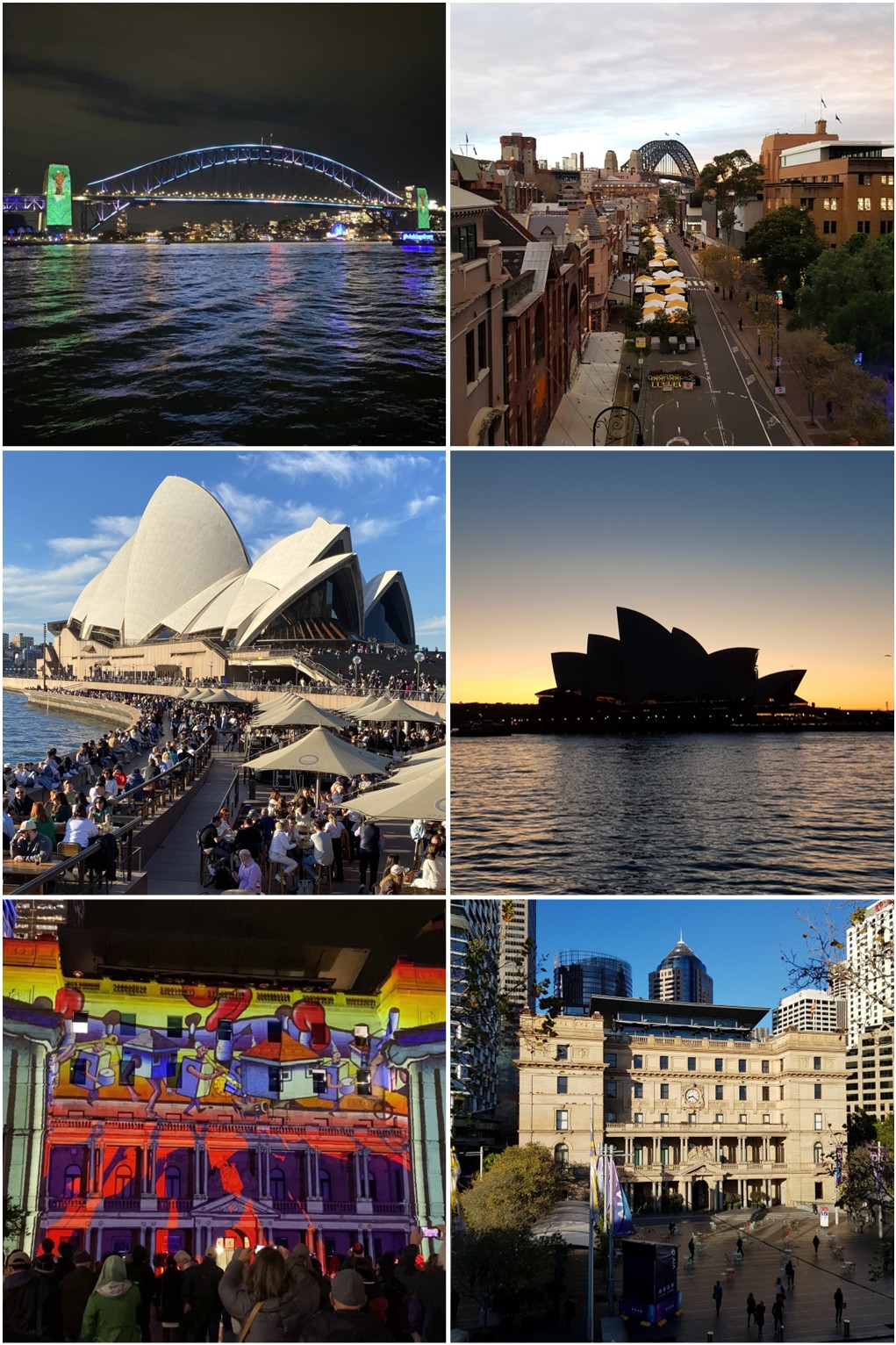
A collage of scenes of Sydney, all taken during winter:
① Sydney Harbour Bridge, Vivid Light Festival
② a view along George Street at The Rocks
③ Sydney Opera House, mid-winter weekend
④ Sydney Opera House, mid-winter sunrise
⑤ Vivid Light Festival display on Customs House
⑥ Customs House in the early morning sun
Sydney in Winter:
Best Free Things to Do
Why go to Sydney in winter?
Well, as one who has done exactly that, let me assure you there are many good reasons why it is worth going to Sydney in winter.
Since the covid pandemic ended, there has been on a steady increase in visitor numbers to Sydney each year during the winter months (June-July-August).
Sydney’s winter tourism is driven by a number of festival events, which are well supported by numerous indoor-based attractions, in the event of inclement weather (more about Sydney’s weather below).
Stealing some lines from my Post:
A Quick Taste of Sydney’s Amazing Attractions:
"Sydney is like an adventure wonderland, with year-round attractions, for all generations. Which is why I describe Sydney as a 'City in a Playground'.
And, Sydney’s sub-tropical climate allows Sydneysiders (and visitors) to take full advantage of these incredible opportunities and assets, all year round."
Important Note:
NSW Winter School Holidays 2026: Monday 6 – Friday 17 July – expect a significant surge (+20%) in Sydney accommodation costs
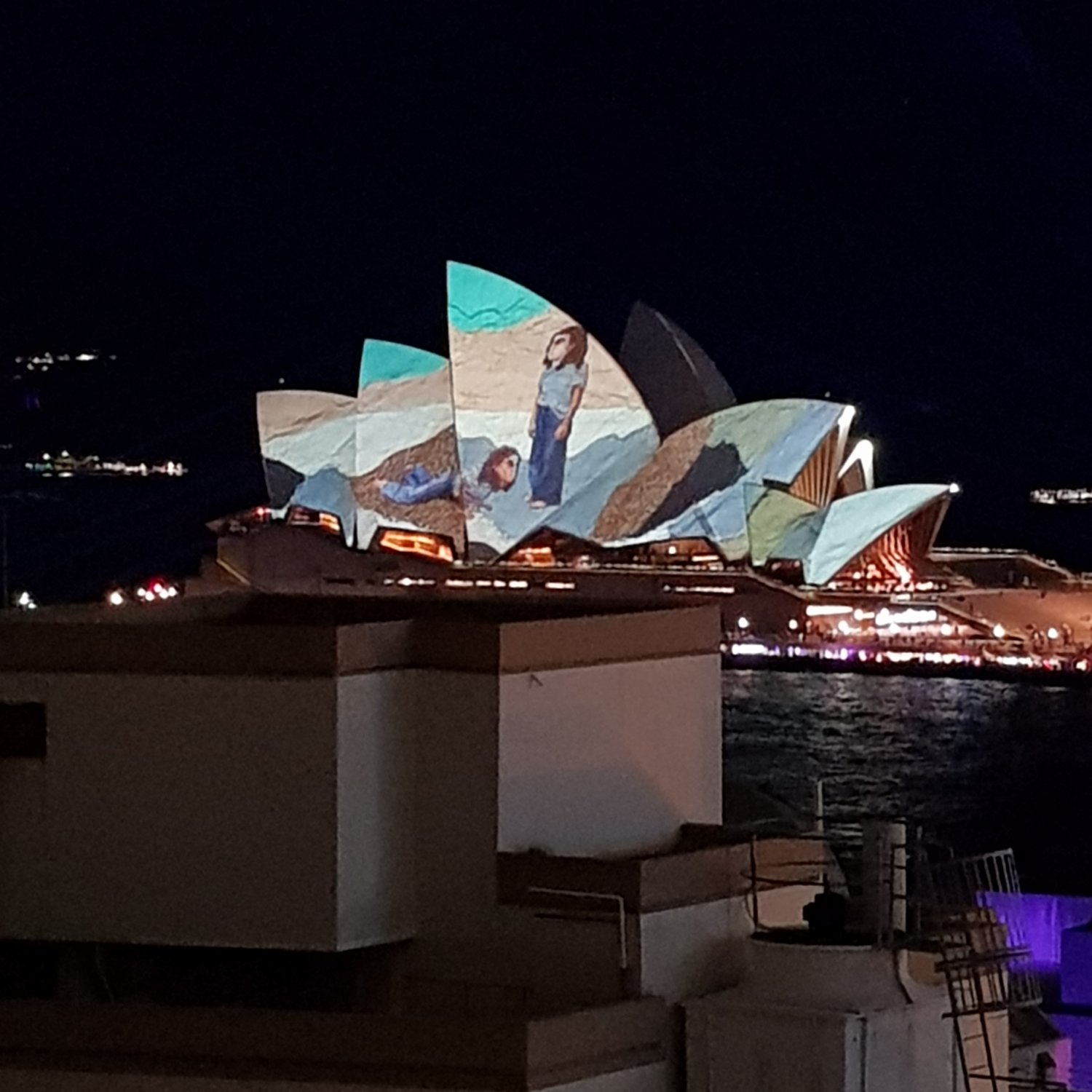
Light Show on the Opera House eastern Bennelong Sails, during Vivid Sydney Light Festival
A Quick Outline
In this Post, first we shall look at
21 Quick Ideas for Sydney in Winter, then consider the effects of Sydney’s winter weather, before exploring a number of FREE attractions in Sydney that are worth visiting in winter, with a focus on those within the CBD, or easily accessible by public transport from the CBD:
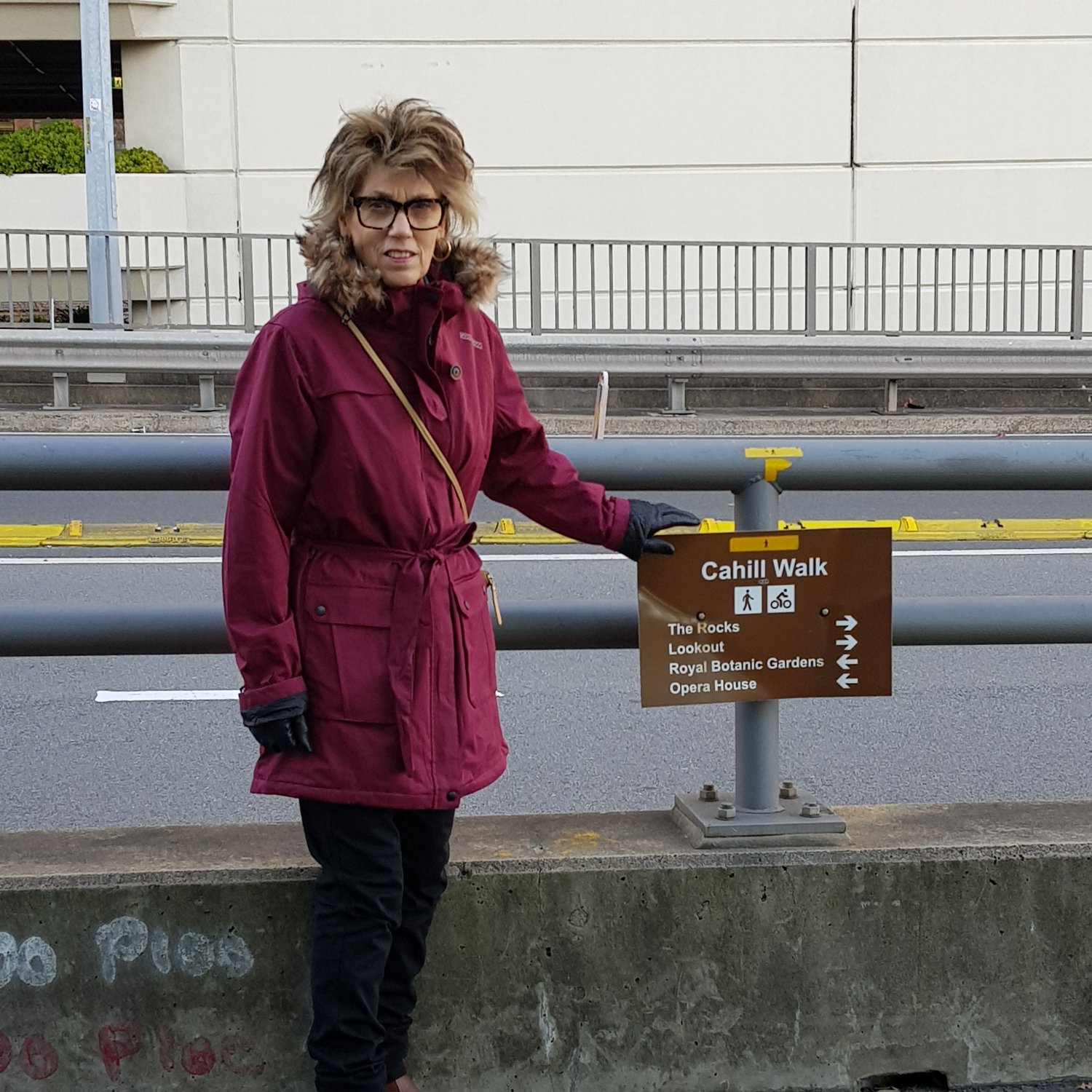
Winter in Sydney can be the time for wearing warmer attire – especially if you are outdoors
Acknowledgement of Country
Throughout the Sydney region, we acknowledge that we travel across the ancient landscapes of the Eora Nation.
These lands have been cared for and nurtured over tens of thousands of years by many First Peoples communities, and we respect the work of Traditional Custodians for their ongoing care and protection.
We recognise the past injustices against First Nations Peoples of this country. As our knowledge grows, we trust that we can learn from the resilience, creativity, and wisdom that has guided them for over 60,000 years.
As we encourage you to visit and explore parts of the Sydney region, we ask that alongside us, you also grow to respect the stories, living culture, and connection to Country of the Ancestors and Elders of Australia’s First Nations.
21 Quick Ideas for Sydney in Winter
11 Indoor Activities for Wet Weather
– All Free
1.
Experience a Free Tour of Old Sydney GPO (George Street) – the Fullerton Hotel began a restoration project of the former Sydney GPO in 2019, before opening in 2024. The Hotel conducts free guided 90-minute GPO Heritage Tours at 12:00 pm from Tuesday to Saturday, with a 6:00 pm tour on Thursdays. Tour bookings can be made online, or with the Fullerton Concierge.
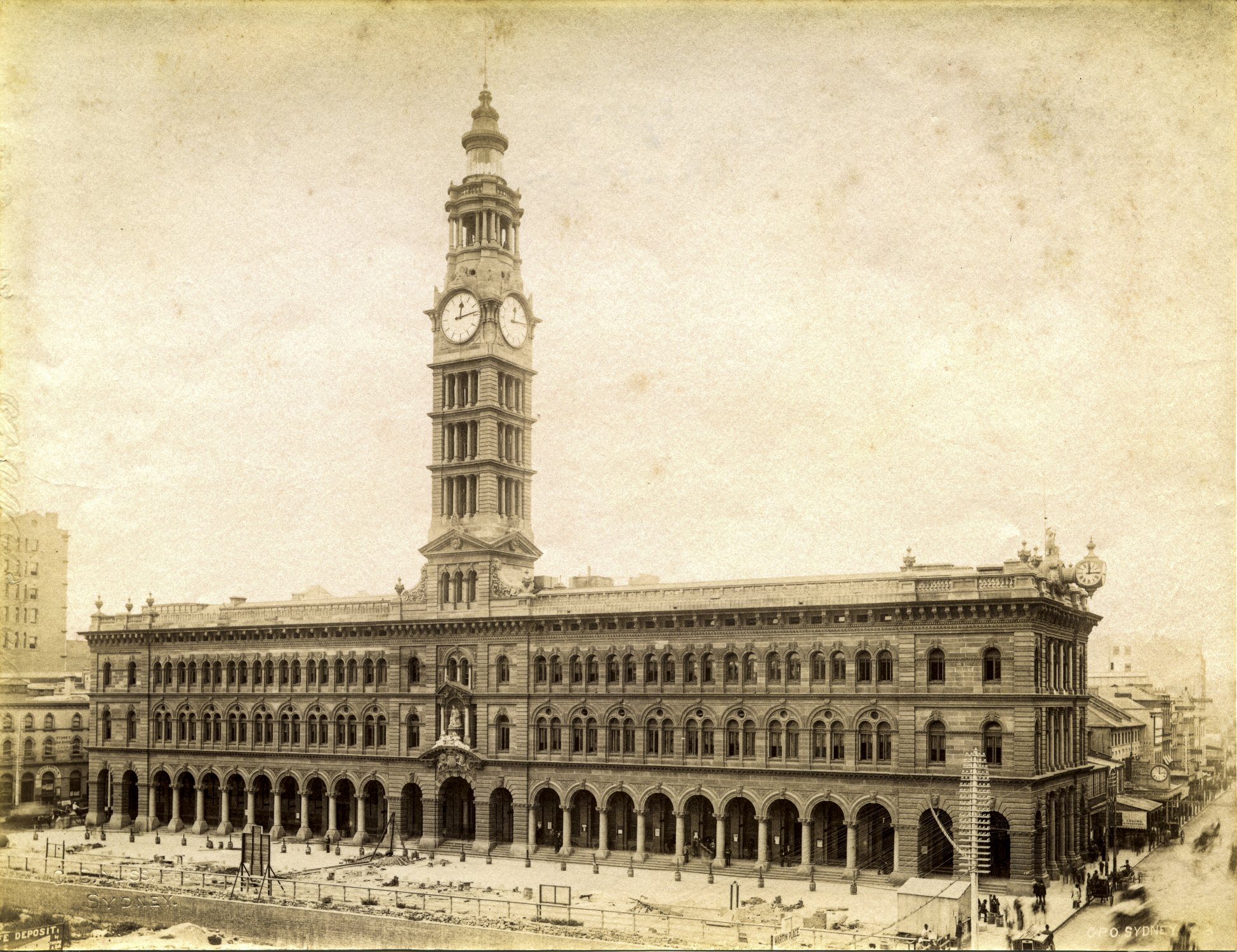
Sydney GPO 1892, corner of George Street and Martin Place. Looking south showing construction work, pedestrians, telegraph poles and clock tower.
Credit: City of Sydney Archives Unique ID A-00018972
2.
Visit the Victorian-era Strand Arcade (access from George and Pitt Streets) – the Strand Arcade is usually open for business from 9:30 am Monday to Saturday, and from 11:00 am on Sundays; Closing time is 5:30 pm Monday-Wednesday, Friday, Saturday, 9:00 pm Thursday, and 4:00 pm Sunday.
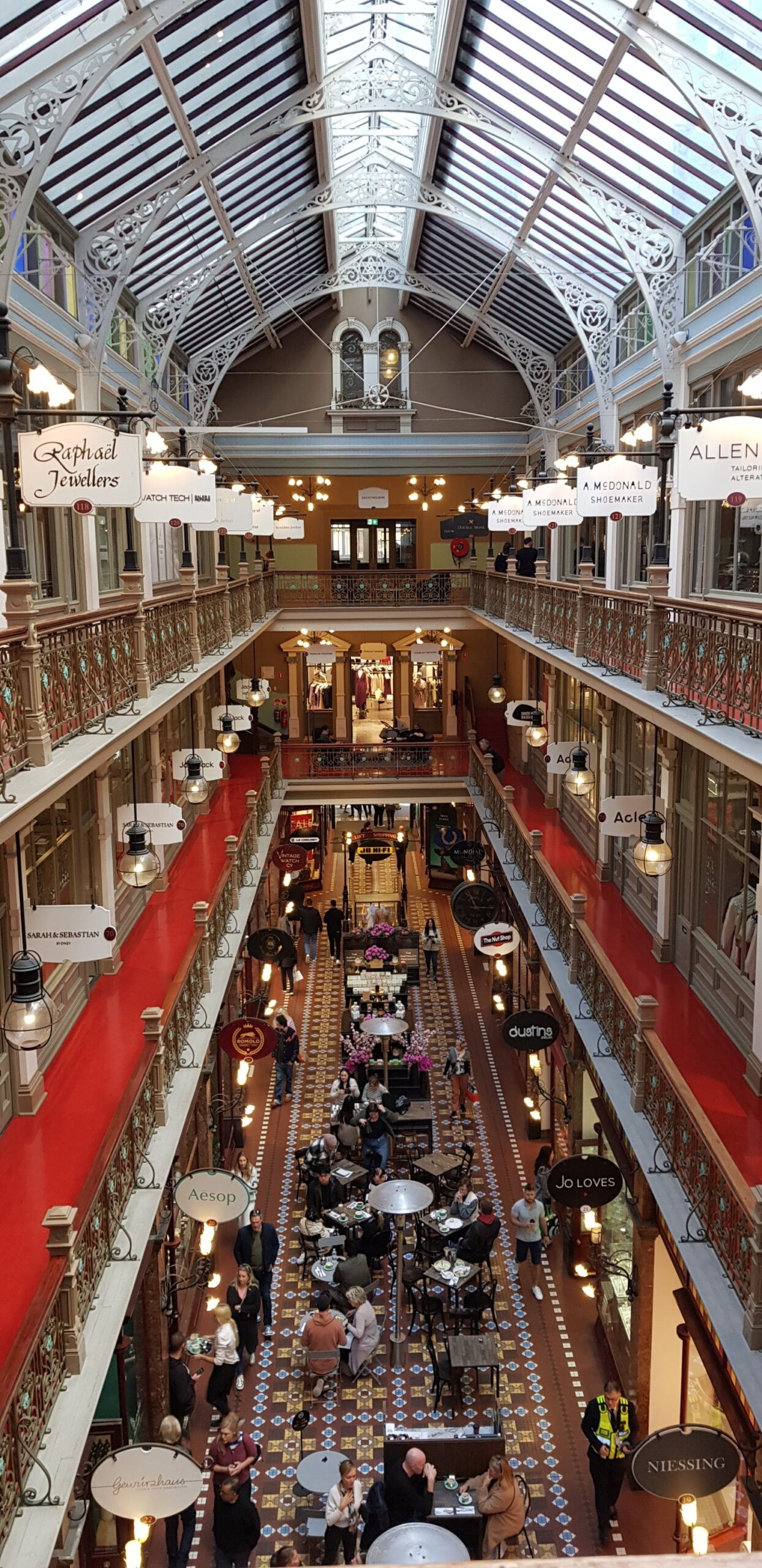
The Strand Arcade, running between the Pitt Street Mall and George Street, was one of five Victorian-era arcades in Sydney; today it is Sydney’s last surviving arcade dating from the late nineteenth century
3.
Wander the Iconic Queen Victoria Building (George Street) – while free tours are not available, the building can be explored freely from early morning to late night as it provides access to the Town Hall station concourse. QVB retailers generally open at 9:00 am.
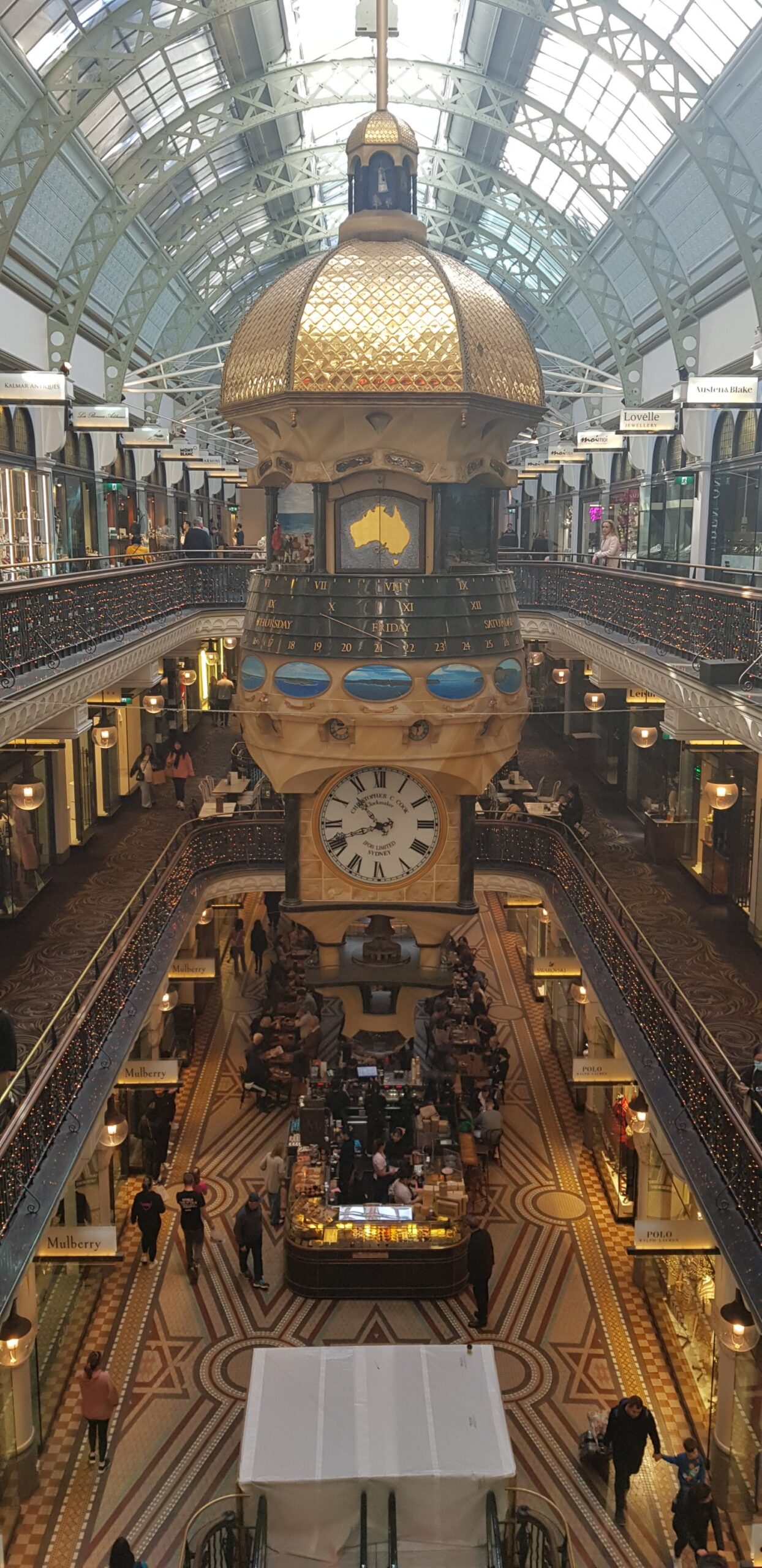
The Great Australian Clock, also the world’s largest turret clock, on the northern side of the Queen Victoria Building (QVB) dome, is 10 metres tall, weighs 4 tonnes, and depicts 33 scenes of Australian history
4.
Admire the Sydney Town Hall (George Street) – although guided tours are not available, the Sydney Town Hall is open weekdays for visitors to view its interior (Note that access to different areas of the building can be restricted by official events). The nearby Town Hall House, on Kent Street, has a detailed 1:500 scale model of the Sydney CBD on display on Level 2. A similar scale model of the city, illuminated at night, is on display at Customs House at Circular Quay.
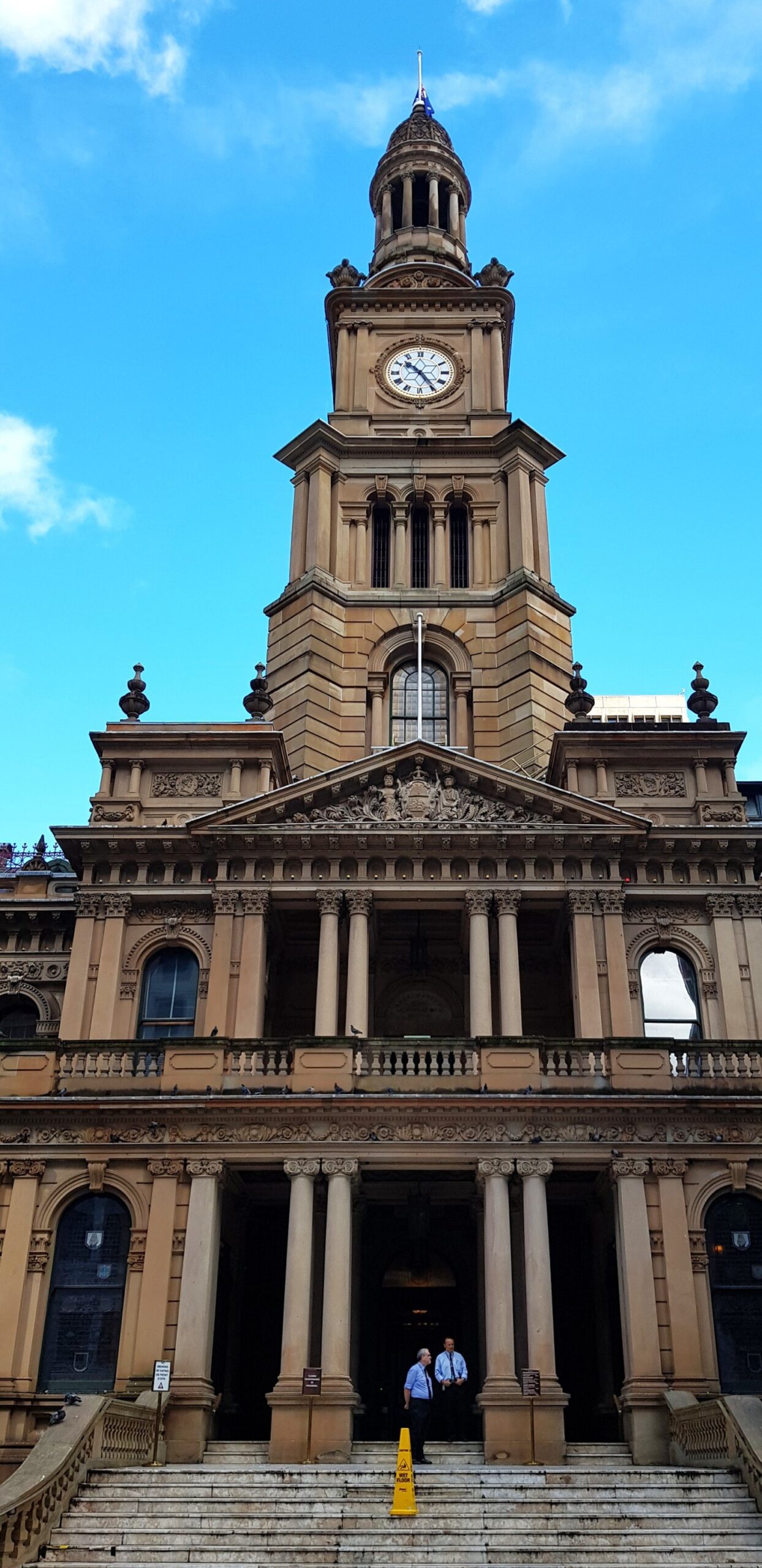
The Sydney Town Hall, viewed from George Street, was officially opened in 1889, over 100 years after the arrival of the First Fleet in 1788. The Town Hall stands on the site of Sydney’s first cemetery, know as The Burial Ground, which was extablished in 1792. Most remains were moved to Rookwood Necropolis, or to the Devonshire Street Cemetery (where Central Station now stands). However, excavations in 2008-9 identified 66 graves beneath the Town Hall – perhaps there are more?
5.
Investigate Museum & St James Stations (both on City Circle line, beneath Hyde Park) – for railway enthusiasts, these two heritage-listed stations, opened in December 1926, were part of the first stage of Sydney’s City Circle line. As Australia’s first underground stations, both were directly inspired by the London Underground. The concourse walls at both stations feature restored and replicated historic advertisements from the 1920s to 1950s, highlighting Australian commercial art.
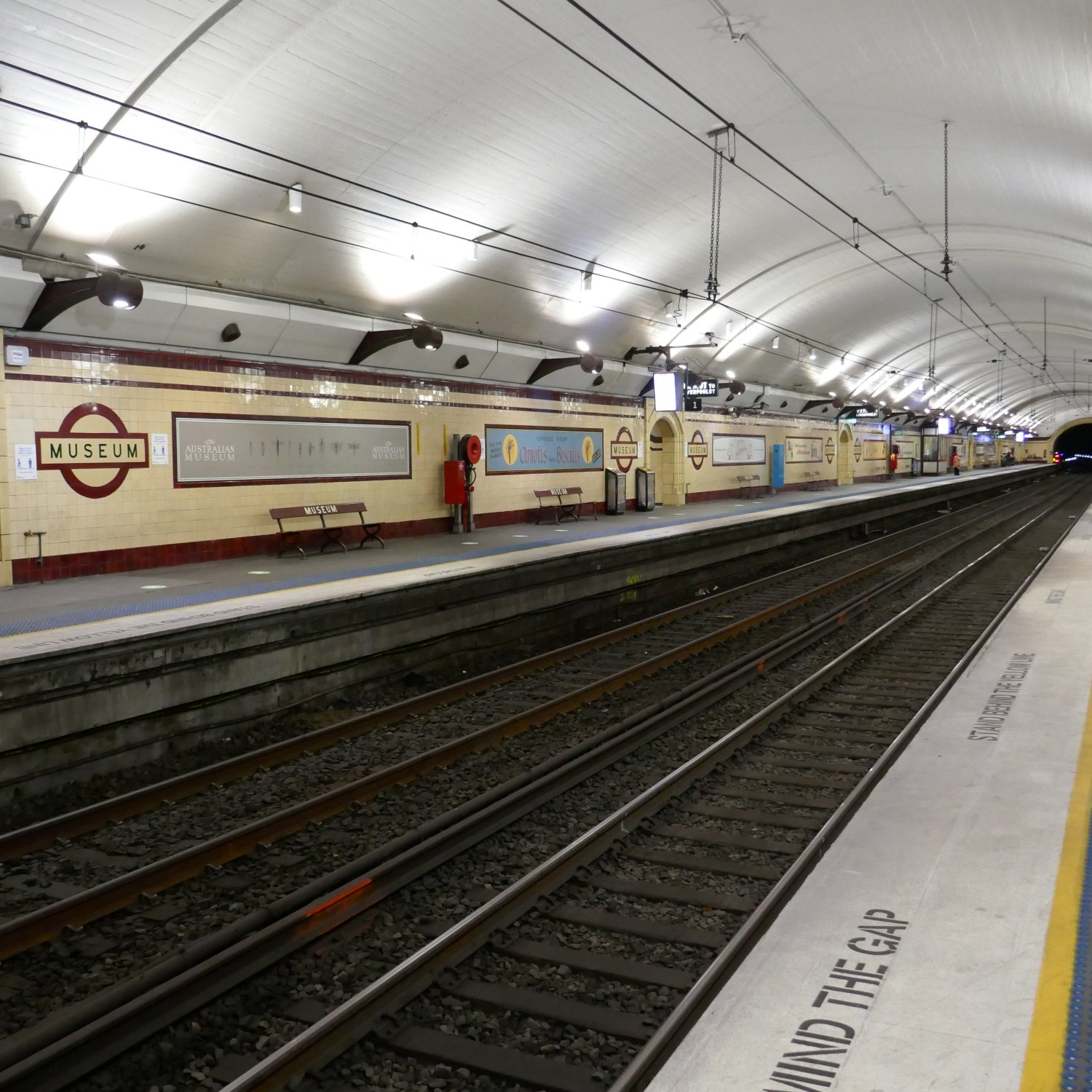
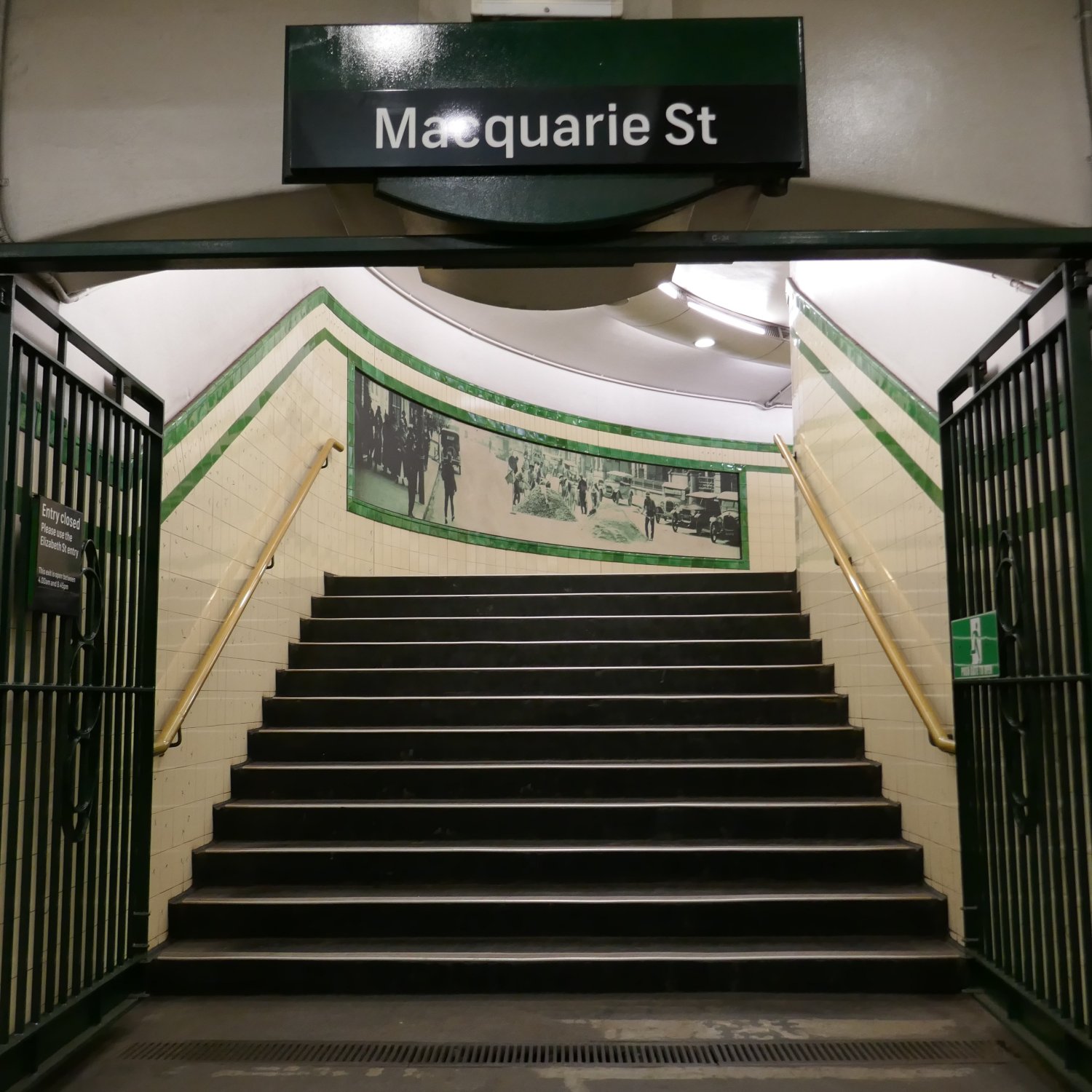
The platforms at Museum Station and St James Station offer a nostalgic trip down memory lane for many; the subtle difference between the two lies in the colour: Museum uses a dark red, while St James uses green
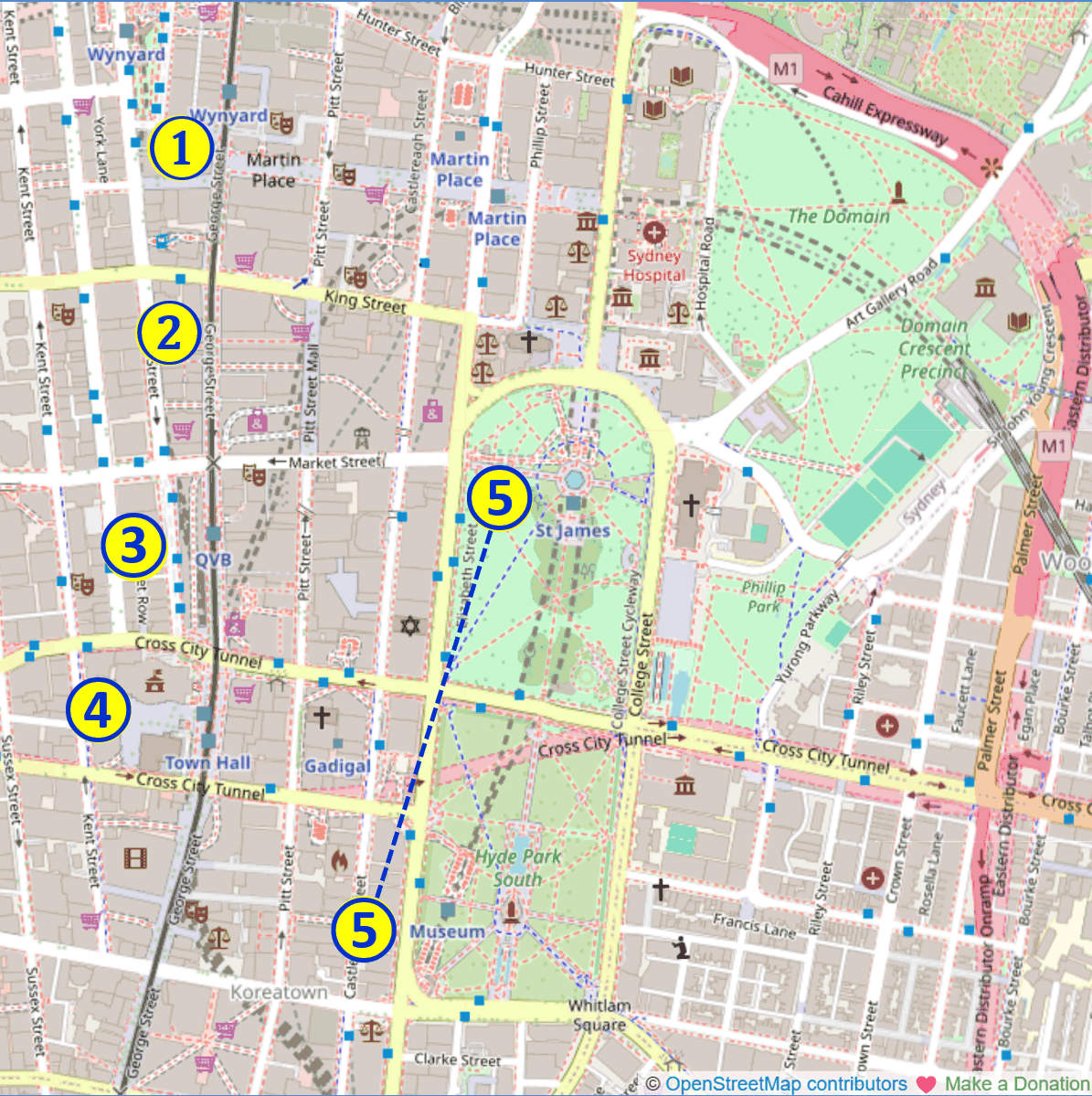
Showing the relative locations of Free Indoor Activities (wet weather) 1-5:
1. Old Sydney GPO
2. Strand Arcade
3. Queen Victoria Building
4. Sydney Town Hall
5. Museum & St James Stations
6.
Immerse Yourself in the Art Gallery of NSW (on Art Gallery Road, opposite The Domain) – The Art Gallery of NSW conducts a number of free guided tours at different times throughout the week (including language tours). These can all be found on the Art Gallery’s Scheduled Tours Page:
https://www.artgallery.nsw.gov.au/visit/tours-experiences/tours/
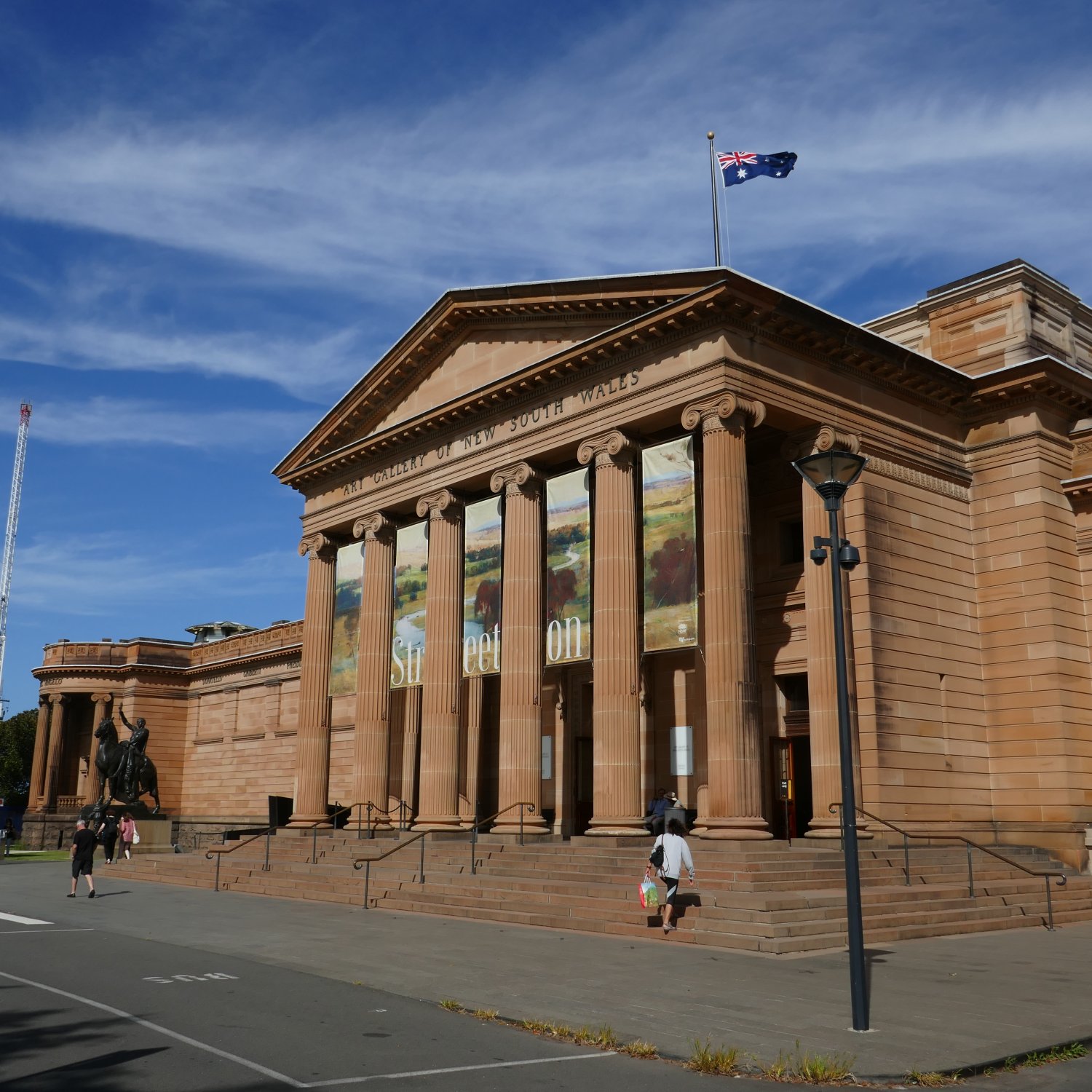
Known today as “Naala Nura” (‘seeing country’), the neo-classical ‘old’ wing of the Art Gallery of NSW was completed in 1909; the ‘Sydney Modern’ expansion wing, opened in 2022, is known as “Naala Badu” (‘seeing waters’); the Gallery holds extensive collections of Australian, European, Asian, and First Nations art
7.
Relive Convict Life at Hyde Park Barracks (Macquarie Street) – free self-guided tours (with audio devices) are available daily from 10:00 am to 4:30 pm. Allow 1-2 hours for your tour, which explores the lives of convicts, migrants and institutionalised women who once called the Hyde Park Barracks their home. Pre-booking of (free) tickets is recommended.
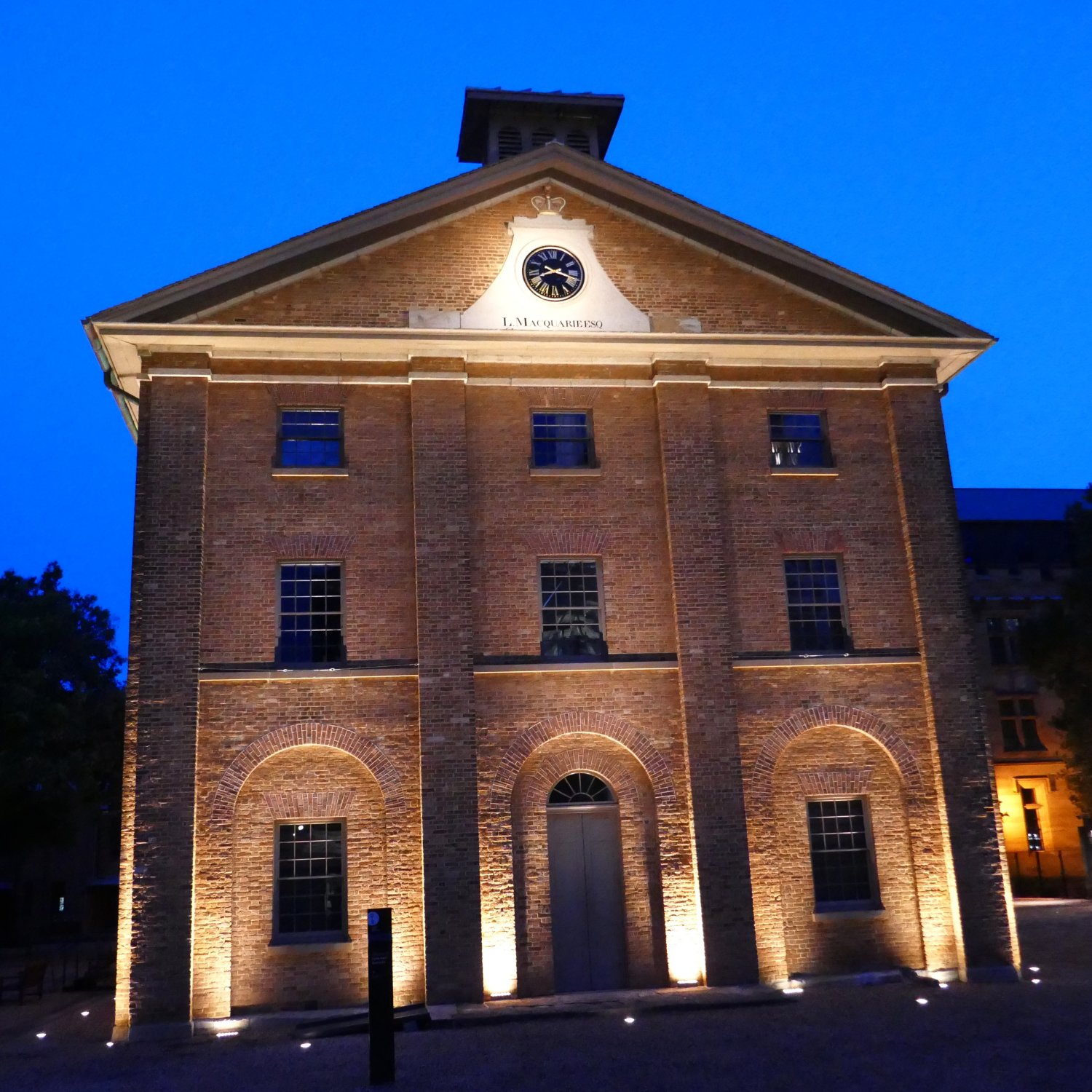
The Hyde Park Barracks was built on the instruction of Governor Macquarie, to house 600 male convicts; between 1819 and 1848, as many as 50,000 convicts passed through the gates of the Barracks – there were so many that up to 1400 men were housed in the Barracks at any one time; discipline was harsh and punishments for offenders were particularly brutal
8.
Discover the History of the NSW Parliament (Macquarie Street) – free 1-hour guided public tours are available of this original North Wing of Sydney’s former ‘Rum’ Hospital, Monday and Friday afternoons. The Rum Hospital was built during the era of Governor Macquarie. Advance bookings are recommended, especially if you have a preferred date and time slot.
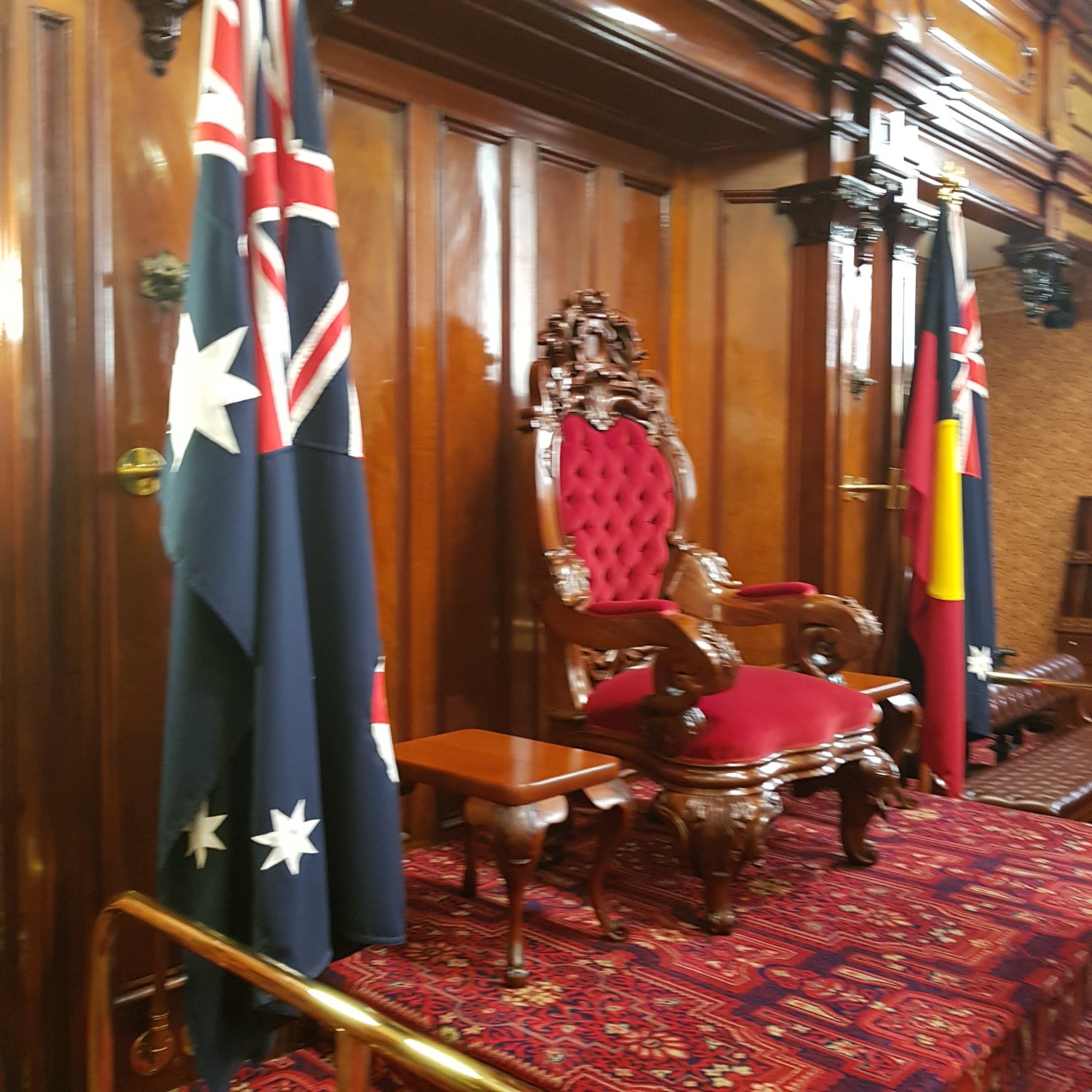
The Vice Regal Chair in the NSW Legislative Council Chamber. In 1811, Governor Macquarie awarded a contract to build a new hospital to a group of businessmen in exchange for exclusive rights to import and sell rum, leadng to the hospital becoming “the Rum Hospital”; eventually the northern wing became chambers for Judge Jeffery Hart Bent, the first Supreme Court Judge of NSW, before becoming home for the NSW Legislative Council (forerunner to NSW Parliament) in 1824
9.
Survey the State Library of NSW (Corner Shakespeare Place/Macquarie Street) – the State Library of NSW offers 45-minute free guided tours at 12:00 pm each Wednesday and Friday, on a first-come, first-served basis for up to 15 participants (no bookings are required). The Library also offers self-guided tours via Bloomberg Connects (the free arts and culture app), and via its own online gallery guides, covering the Objects Gallery, Paintings from the Collection gallery, and items from the Map Rooms.
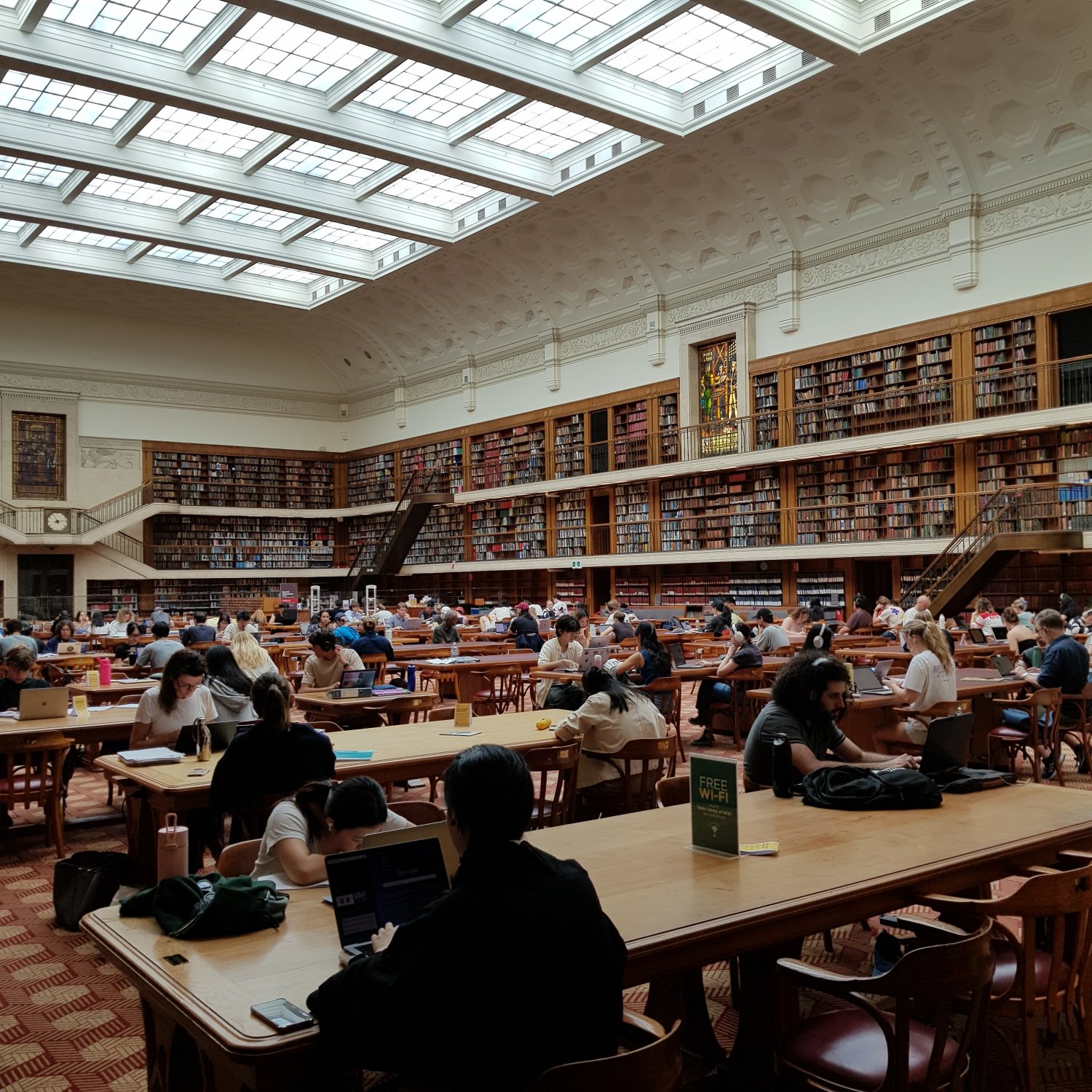
Mitchell Library Reading Room of the NSW State Library; the first Sydney library, then known as the Australian Subscription Library, was established in 1827, on the ground floor at “No. 1 Terry’s Buildings” in Pitt Street; this was a private library, with membership costing a £5 admission fee and a further £2 fee per year; new members had to be proposed by existing members, and needed three-quarters of the existing members to agree on their appointment; women were excluded from becoming members until 1846. It was not until 1869 that the library became the Sydney Free Public Library
10.
Enjoy the Conservatorium of Music (Macquarie Street) – access is available to the historical architectural exhibits in the three-story foyer during business hours Monday-Friday, and on Saturdays. During semesters, free one-hour public concerts, known as Rising Stars, are presented by the students on Saturdays at 11am, 2pm, and 3pm, in the auditoriums of the Sydney Conservatorium of Music (Dates for Winter 2026: 13, 20 June; 1, 8, 15, 22, 29 August).
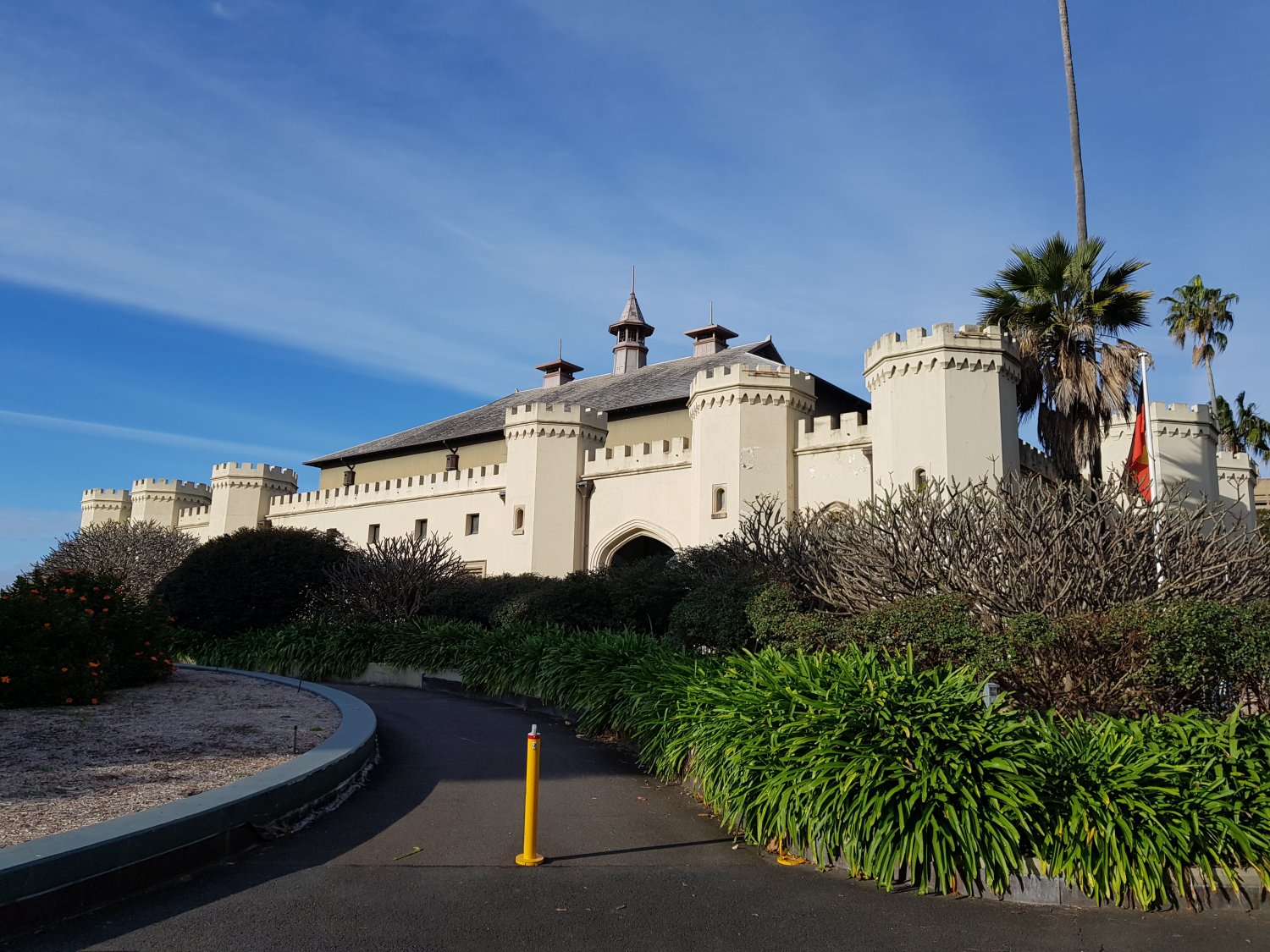
The Conservatorium of Music occupies the former Government House Stables, intended by Governor Macquarie to be part of the new Government House that he hoped to build. While under construction in 1819, the Stables became a key part of the criticism of Governor Macquarie’s “extravagence” and “wastfulness” by Commissioner John Bigge in his 1822 report to the British Colonial Office. It seems likely that this criticism contributed to the 15-year delay in building the new Government House (started in 1837)
11.
Take a Guided Tour of Government House (inside the Royal Botanic Garden, access from Macquarie Street) – free 45-minute guided tours are available Fridays, Saturdays, Sundays, Public Holidays, from 10:30 am to 3:00 pm. Entry is via the Ticket Office at the main gate, with tickets allocated on a ‘first come first served’ basis. Note that a ‘valid ID’ is required.
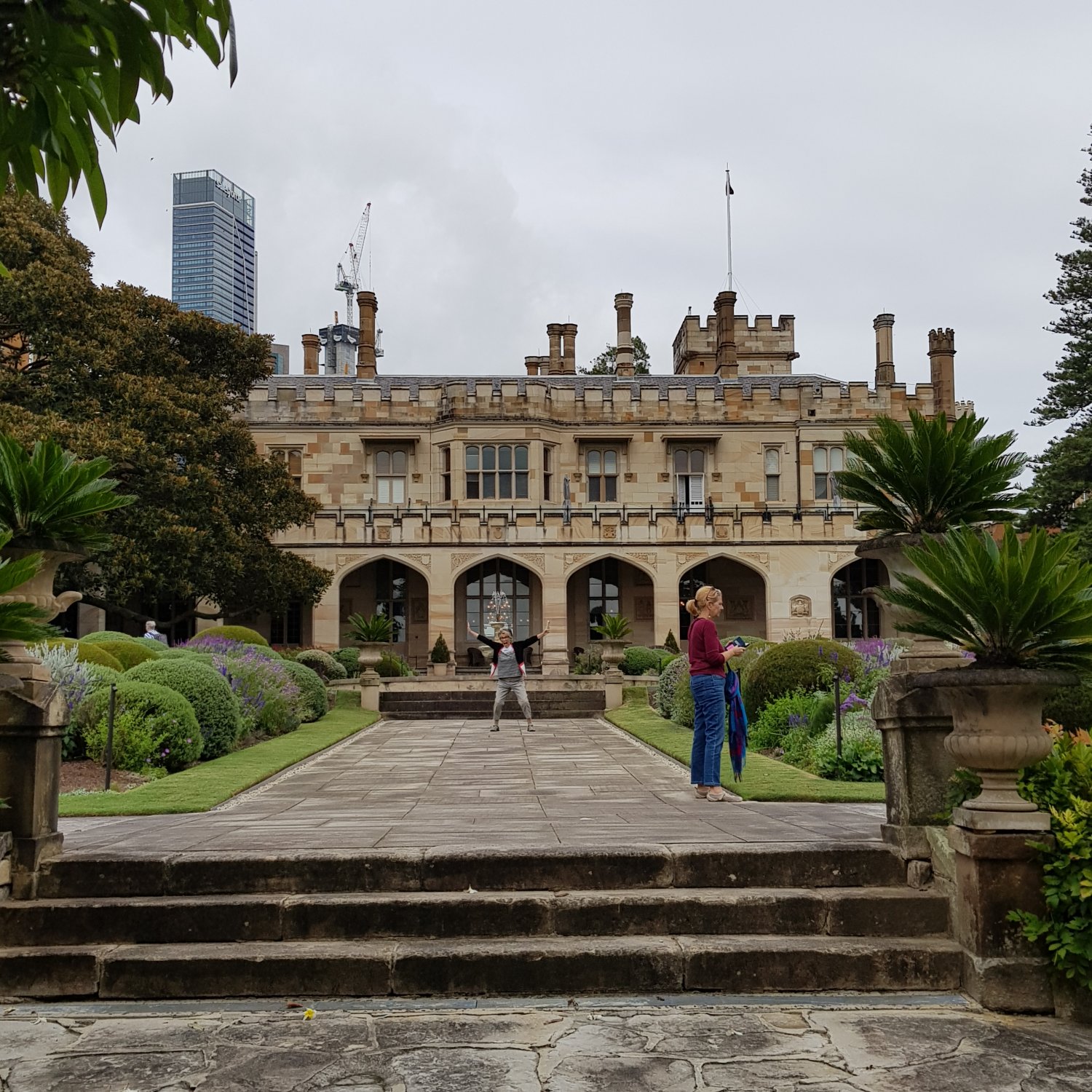
A view of Sydney’s Government House, taken from within the grounds (during a tour); in 1996 the then NSW State Premier, Bob Carr, ejected the State Governor from Government House, as part of a campaign towards Australia becoming a republic; in 2011 the Governor was returned to the residence at Government House
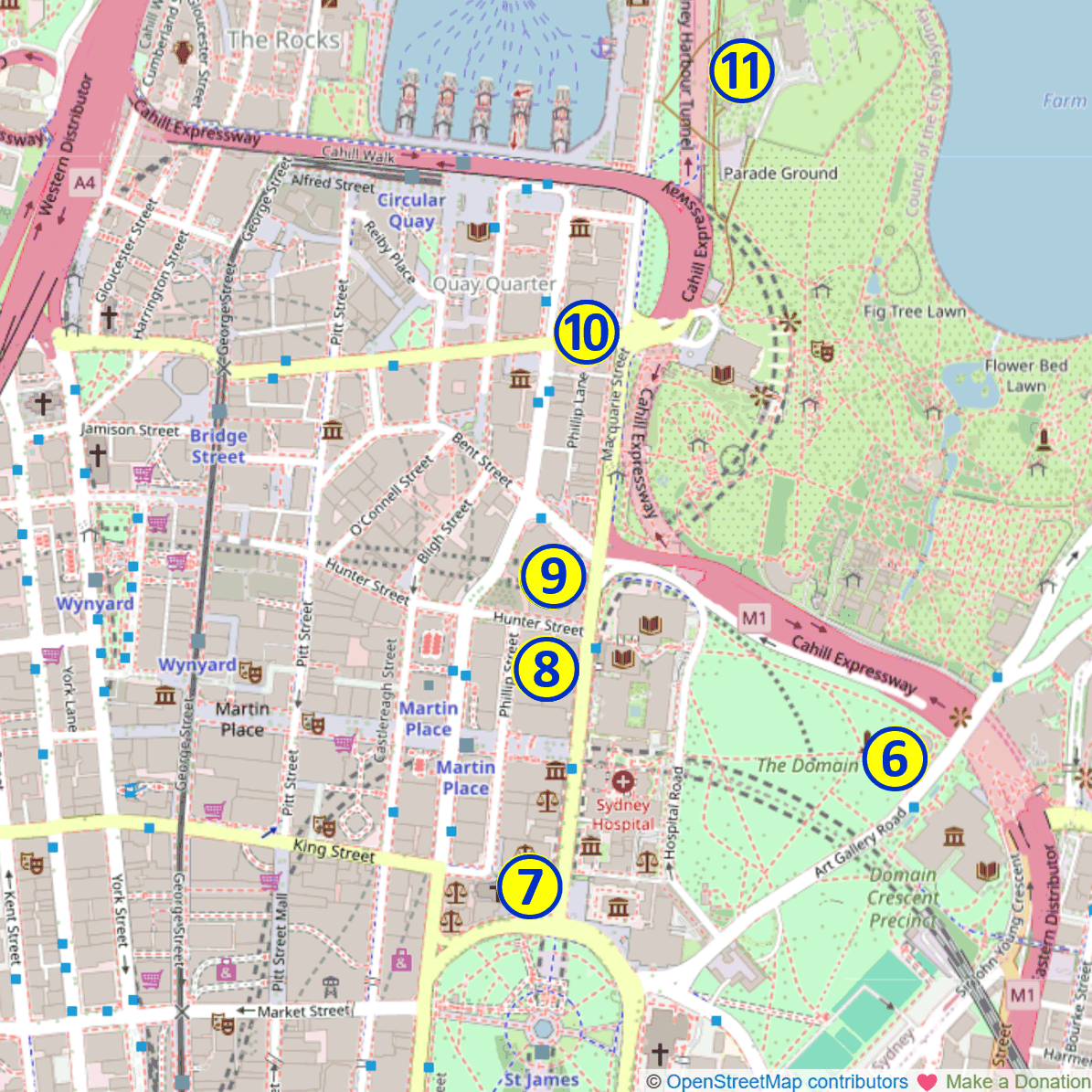
Showing the relative locations of Free Indoor Activities (wet weather) 6-11 (numbered in the order from above):
6. Art Gallery of NSW
7. Hyde Park Barracks
8. NSW Parliament
9. State Library of NSW
10. Conservatorium of Music
11. Government House
Hi there!
I’m Marlene.
And here’s my special offer to you…
Get your Free Travel Starter Kit – 4 essential tools that make travel planning easier!
- Budget estimator – know what your trip will actually cost
- Funding strategies – afford travel without killing your credit card
- Packing type – know your personal packing style and pack smarter
- Home Security checklist – be sure your homebase is safe and sound
These are yours, FREE , when you join my twice-monthly newsletter, afootwego, In The Loop!
In The Loop! brings you up-to-date international travel information, insider tips, and practical advice – delivered straight to your inbox every 2nd and 4th Friday.
10 Outdoor Activities for Better Weather
– All Free
1.
Take in the Sydney Opera House (Bennelong Point) – perhaps Sydney’s most photographed icon (from all angles – inside and out, close-up and faraway), exploring the foyer, northern boardwalk, and exterior steps of the Opera House is free. Daily after sunset (except during Vivid), Badu Gili (Water Light), a 6-minute projection celebrating First Nations stories is shown on the eastern Bennelong Sails, which face towards the Sydney Harbour Bridge.
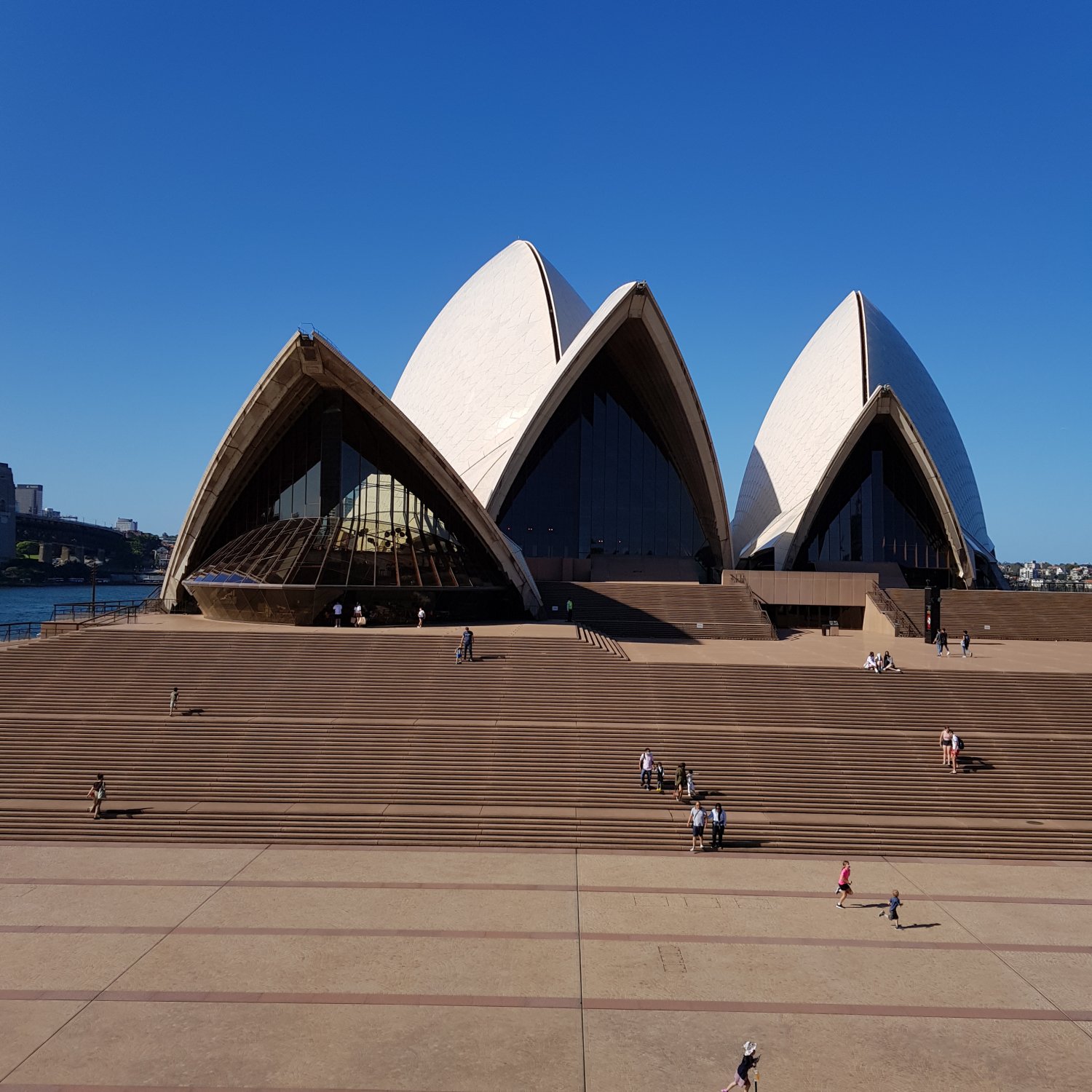
At the Sydney Opera House, climb the Monumental Steps (300 in number) from the forecourt to the podium to get up close and personal to the ’shells’ or ‘sails’ (architect Jørn Utzon usually referred to the roof structures as shells); if you have the time, a walk around the outside of the entire complex can be worthwhile
2.
Explore Sydney’s Royal Botanic Garden (access is available from Macquarie Street, Bennelong Point, Art Gallery Road, Mrs Macquarie’s Road) – covering 30 hectares (74 acres), the Sydney Royal Botanic Garden is the size of a small farm. The Garden is criss-crossed by a number of well-maintained paved paths, making exploring very easy. 1-hour guided tours for small groups are conducted daily, on a donation basis (bookings are required). During Winter, the Garden is closed at 5:00 pm (May-Jun) and 5:30 pm (July).
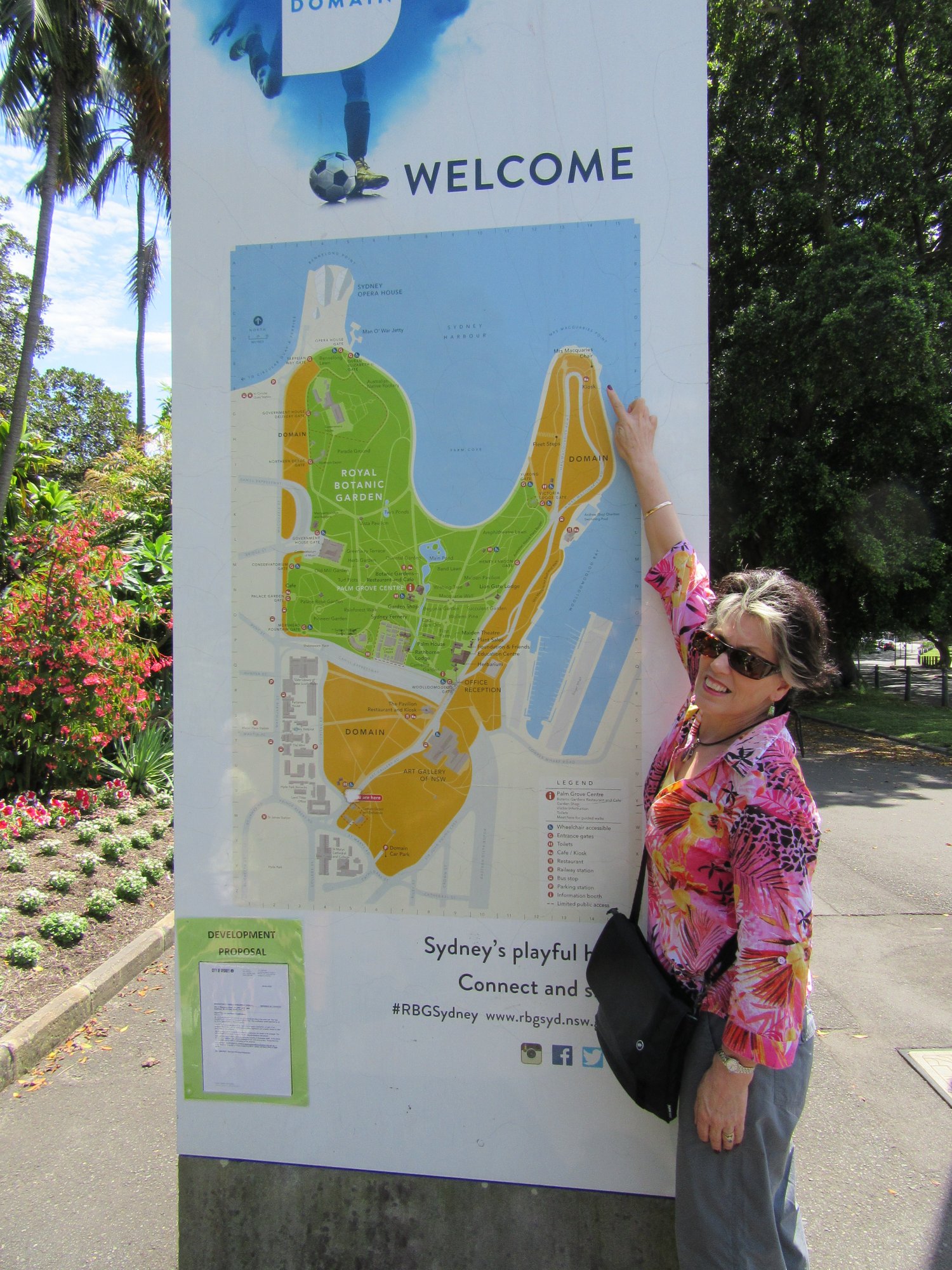
Sydney’s Royal Botanic Garden contains over 15 km (9+ miles) of sealed pathways, much of which are either flat or gently undulating; while there are some paths which contain steps or steeper sections, the downloadable map does clearly show the accessible paths
A downloadable map is available.
The Sydney Royal Botanic Garden also offers a free app for audio tours and maps; however, my Chrome browser advises of "security issues" when I try to download this.
3.
Stroll Your Way to Mrs Macquarie’s Chair (at Mrs Macquarie’s Point, aka Yurong Point) – this gentle route from Bennelong Point (i.e. the Opera House) is around 1½ km each way following a pathway along the harbour shoreline, via Farm Cove to Mrs Macquarie’s Point, before ascending a section of steps to Mrs Macquarie’s Chair (Note: during Autumn [March-April] the shoreline pathway may be blocked near the Fleet Steps by Handa Opera on Sydney Harbour).
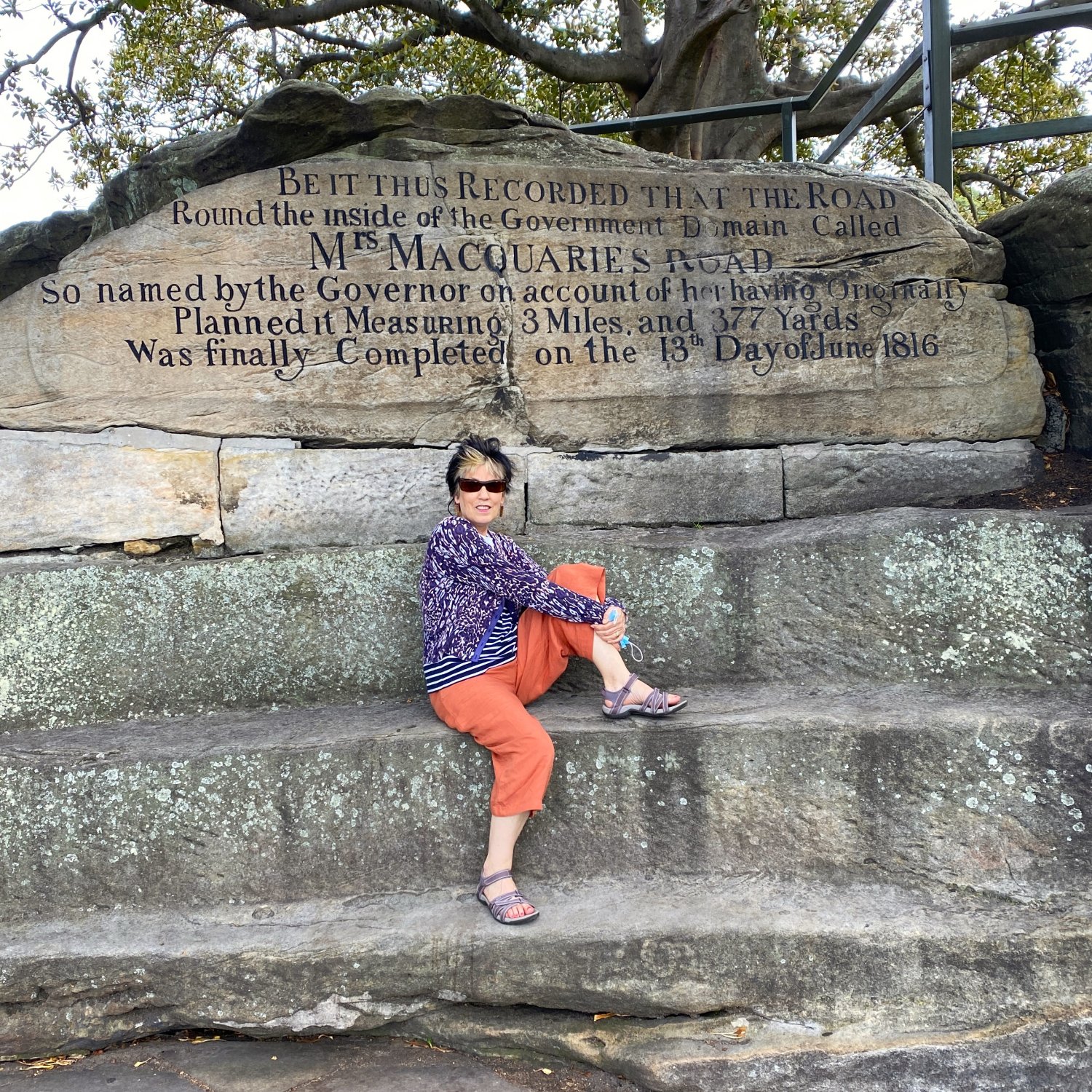
The inscription reads: “Be it thus Recorded that the Road Round the inside of the Government Domain Called Mrs. Macquarie’s Road So named by the Governor on account of her having Originally Planned it Measuring 3 Miles, and 377 Yards Was finally Completed on the 13th Day of June 1816”.
Folklore says that the ‘chair’ was carved for Mrs Macquarie in 1810, by convicts; this seems improbable as 1810 was her first year in Sydney, she lived over 1 mile away (beside today’s Sydney Museum), and work on Mrs Macquarie’s Road did not begin until 1813 (that said, why let the truth get in the road of a good story?)
4.
Ramble About in Hyde Park (Elizabeth Street) – Hyde Park was named as such in 1810 by Governor Macquarie, although the land had been reserved by the first British Governor of New South Wales, Captain Arthur Phillip, in 1792. Named after the famous park in London, today it’s a peaceful green space in a very busy city, with beautiful gardens and hundreds of trees. At its southern end is the ANZAC World War 1 Memorial, while a number of artworks and memorials are scattered around the Park. The Museum and St James train stations are found respectively at the southern and northern ends of Hyde Park.
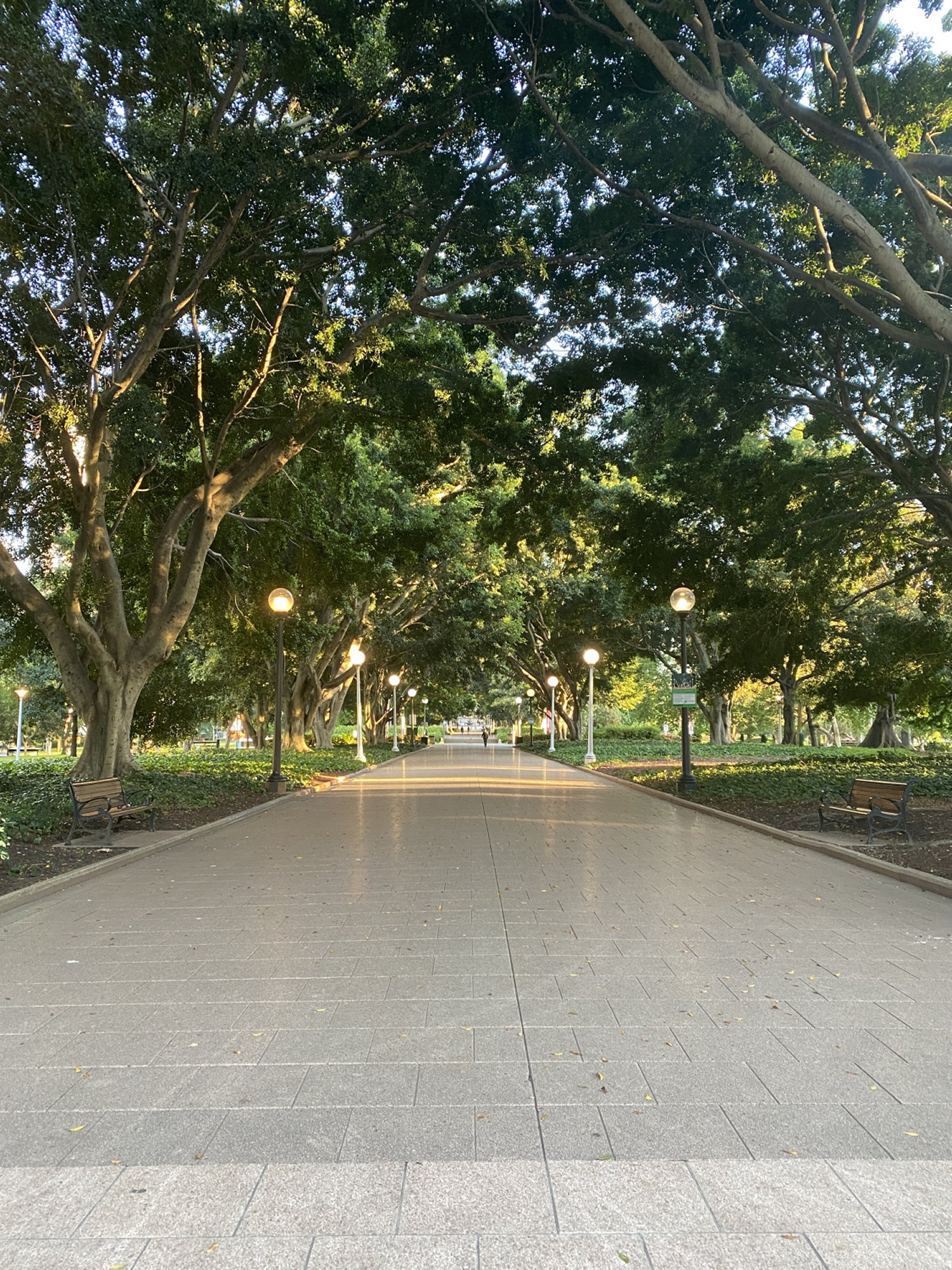
The central paved promenade runs under the avenue of weeping fig trees through the full length of Hyde Park. In the early colonial period, Hyde Park was used for playing games of cricket and as a racecourse; landscaping began in the mid-1850s, but in the 1920s large sections were excavated for construction of the underground City Circle railway. Monuments such as the Archibald Fountain and the ANZAC War Memorial were added during the 1930s. In pre-European times, the First Nations clans used it as a hunting ground for ducks, which lived in the swampy marshes that were the source of the early colony’s “Tank Stream”
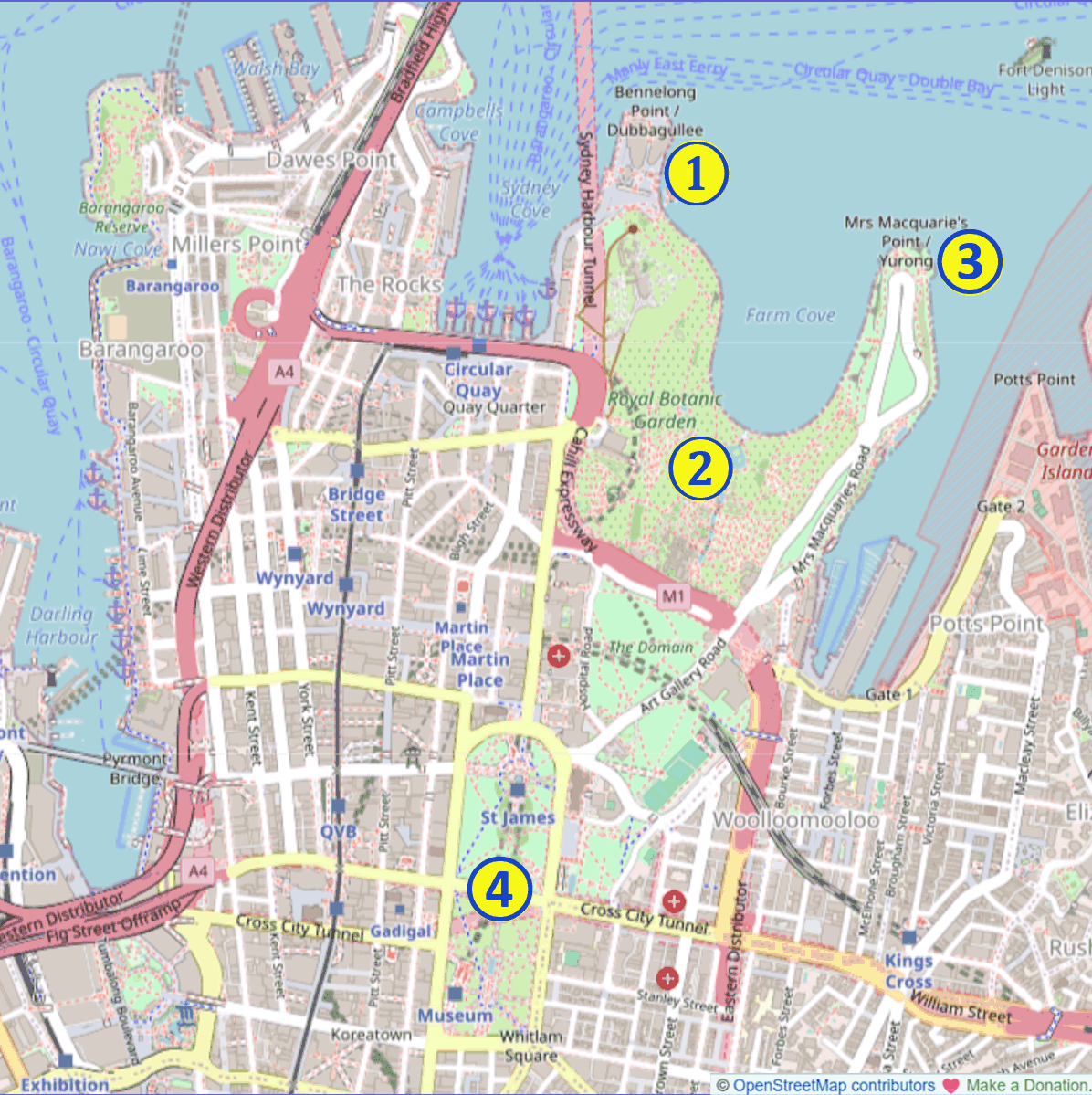
Showing the relative locations of Free Outdoor Activities 1-4 (numbered in the order from above):
1. Sydney Opera House:
2. Sydney Royal Botanic Garden;
3. Mrs Macquarie’s Chair;
4. Hyde Park
5.
Check out Selfies at Circular Quay – Circular Quay was the actual ‘gateway’ through which the first British colonists arrived in Sydney, in January 1788. Originally, it had been Warrane, home to members of the Gadigal clan of the Eora Nation. For those who seek selfies, Circular Quay offers numerous opportunities with two of Australia’s icons – the Sydney Harbour Bridge, and the Sydney Opera House. Just walk around the Quay, and find your best spots (don’t forget to take a look from the Overseas Passenger Terminal, if it is accessible).
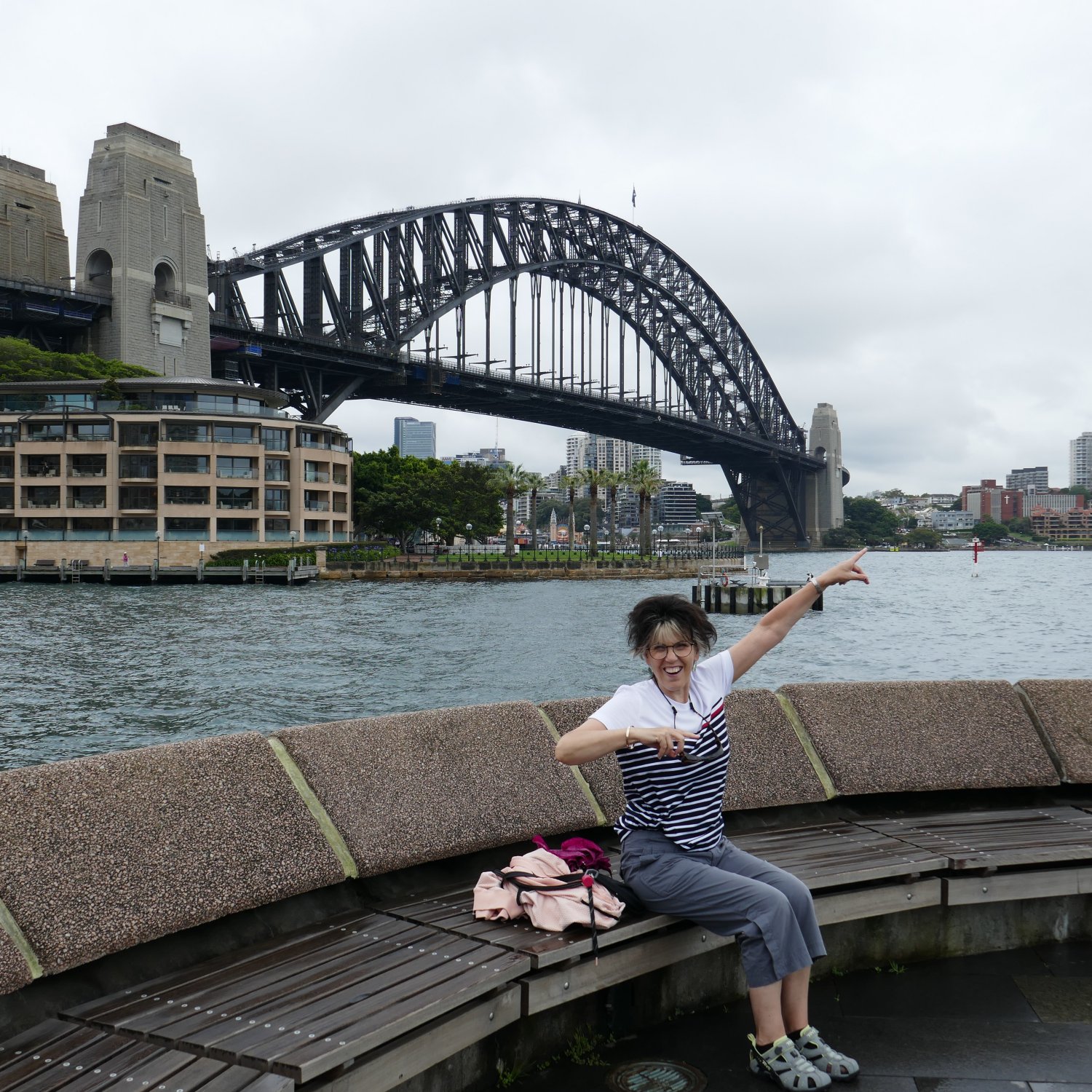
For some of the best ‘selfies’ in Sydney, find the Circular Quay Harbour Lookout, beside the Overseas Passenger Terminal, on the corner of the Quay and Campbell’s Cove – when there are no cruise ships docked at the OPT, the views towards both the Sydney Harbour Bridge and the Sydney Opera House are just brilliant – and especially so in the evening, when both are lit up
6.
Walk Across the Sydney Harbour Bridge – also known as the “coat hanger”, the Sydney Harbour Bridge can offer stunning elevated views across the inner harbour, towards the Sydney Opera House and also towards the harbour entrance. The walk from the Bridge Stairs at The Rocks, to the Bridge Stairs at Milson’s Point on the North Shore is just over 1½ km. From the North Shore, you can return by train, or descend to the ferry terminal, near to Luna Park, or retrace your steps across the Harbour Bridge walkway.
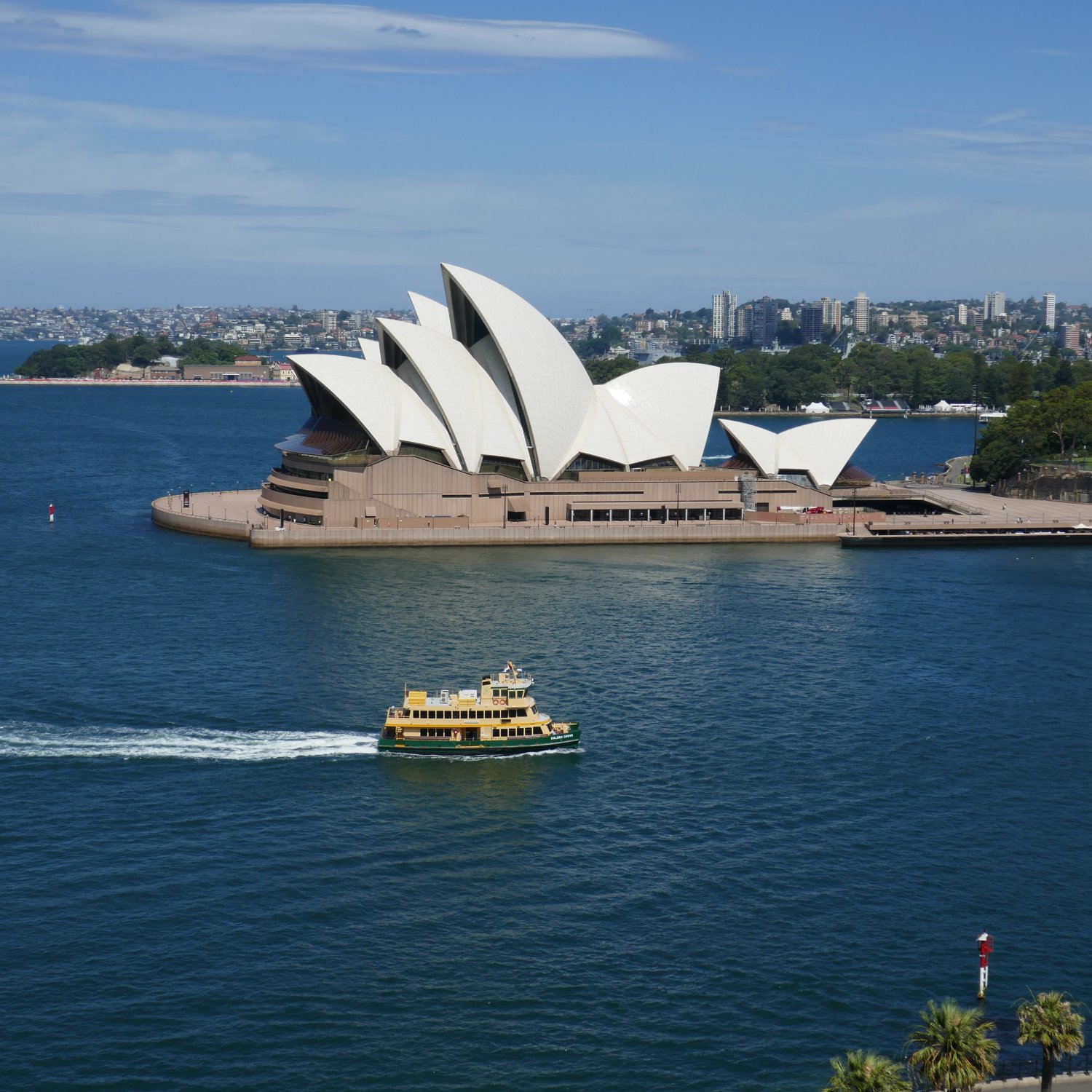
An elevated view of the Sydney Opera House, taken from the walkway on the Sydney Harbour Bridge. The ferry in the foreground belongs to the First Fleet class, which are 25 metres long; the flagship of the First Fleet, HMS Sirius, was ±34 metres long, while the smallest ship of the First Fleet, HMAT (His Majesty’s Armed Tender) Supply, was ±24 metres in length
7.
Experience the Atmosphere at Luna Park (Milson’s Point) – the famous smiling face of Luna Park is like a beacon, calling you to come and explore. Entry to the Park is free during regular operating hours, allowing visitors to enjoy the atmosphere, explore the themed areas and take photographs. The entrance to Luna Park is a 1-minute walk from the Milsons Point Ferry Wharf.
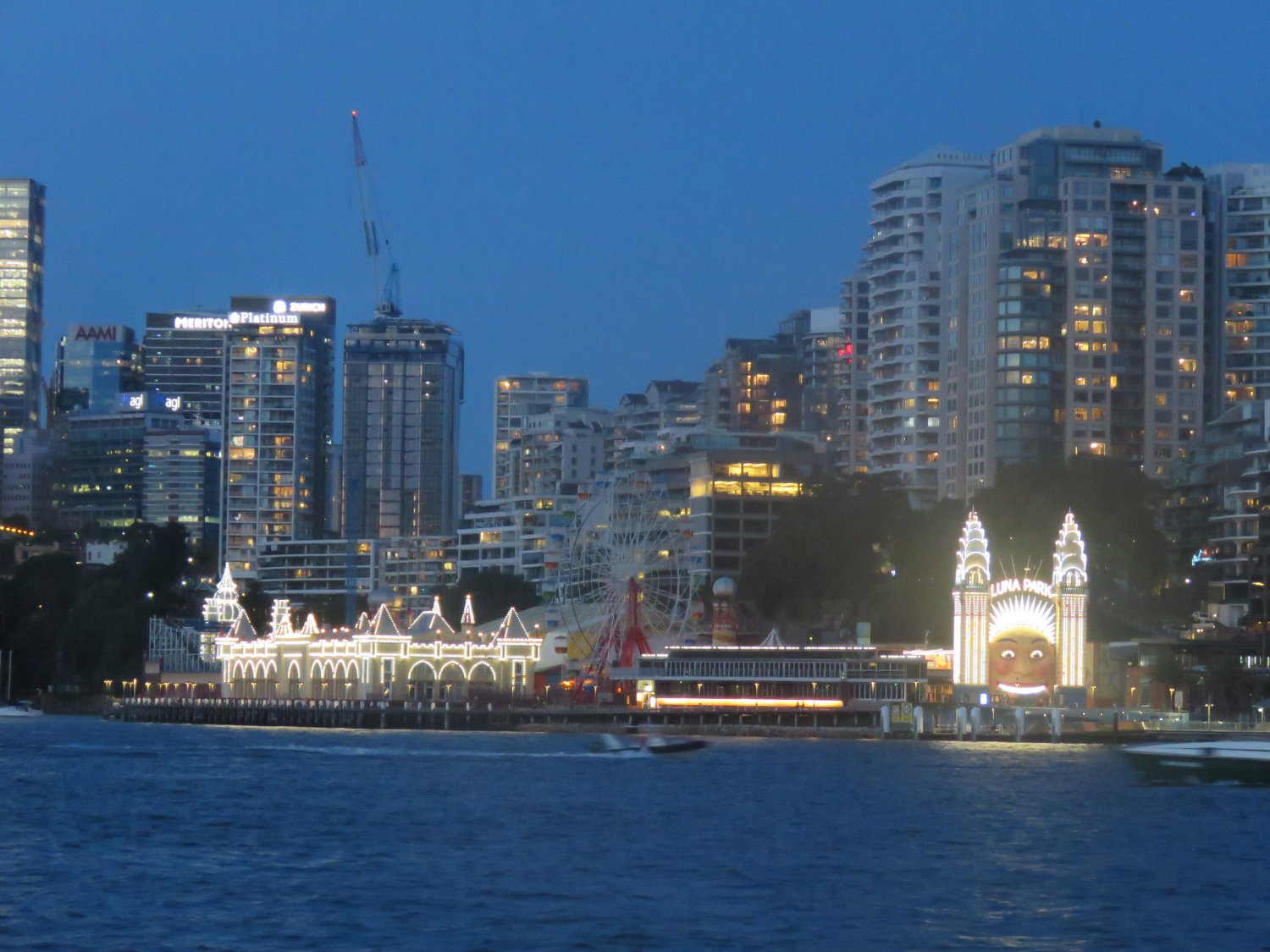
By night, the attraction of Luna Park is on display to anyone on a harbour ferry passing under the Harbour Bridge, or to observers from Circular Quay to Millers Point. Luna Park was built on the former site of the Dorman Long and Co.workshops, where 80% of the steel for the Sydney Habour Bridge was assembled from 1925 to 1932; Luna Park began operating on this site in October 1935. For daily opening hours during the winter months, checkout the Luna Park Sydney website
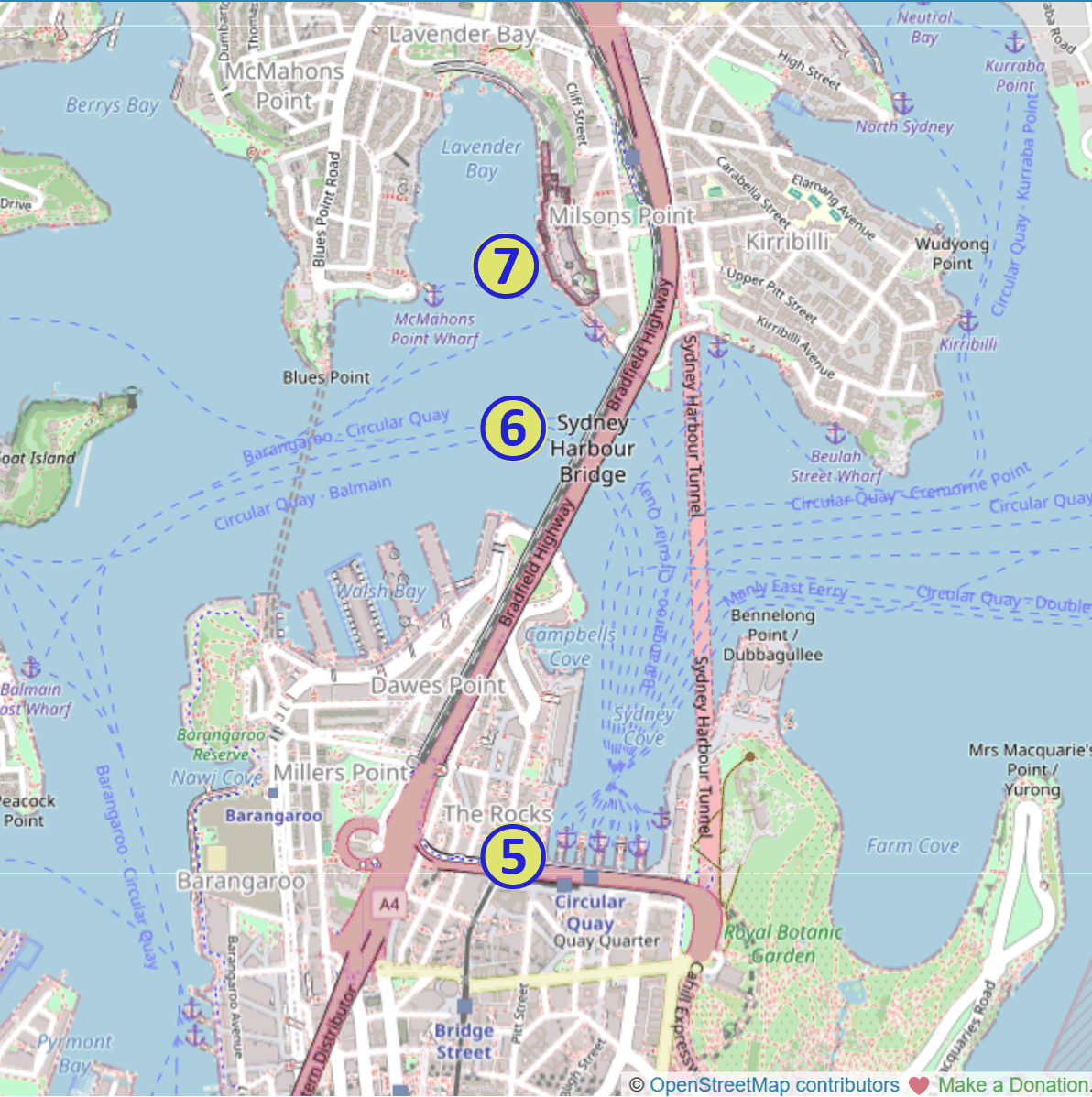
Showing the relative locations of Free Outdoor Activities 5-7:
5. Circular Quay
6. Sydney Harbour Bridge
7. Luna Park
8.
Find Street Art in Newtown – four kilometres south-west of the Sydney CBD lies Newtown, once the home of pioneer businesswoman Mary Reibey. A diverse and rather quirky suburb, Newtown is well known for food, and also for street art. A large mural on the corner of Enmore Road and Simmons Street celebrates Mary Reibey’s life. Newtown is readily accessed by train from Circular Quay (±15 min).
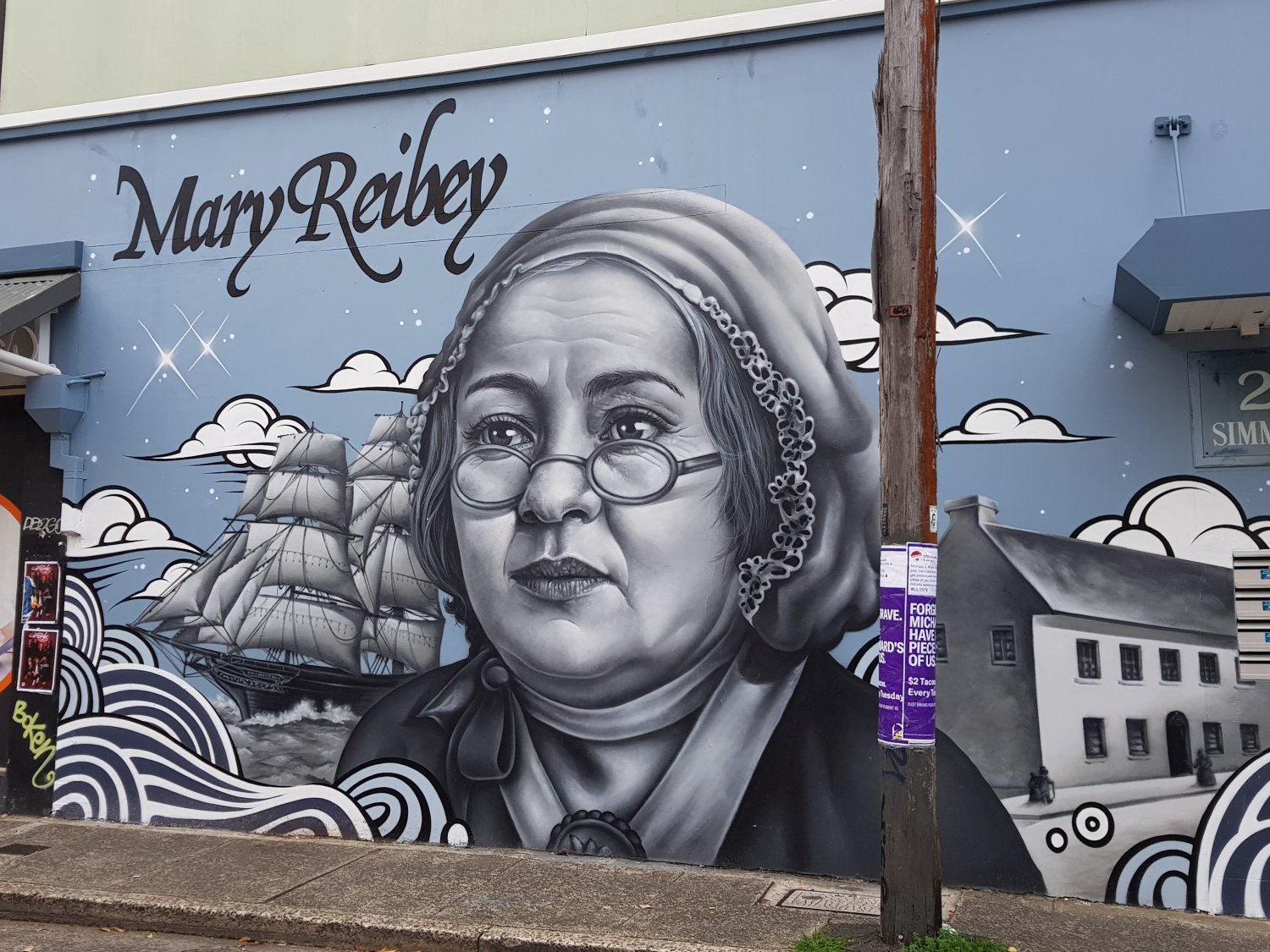
On the 24th of August 1790, at Stafford, in the West Midlands of England, a 13-year boy named James Burrows was convicted of horse stealing, and was sentenced to death. The sentence was later commuted to seven years transportation to Botany Bay. In October 1792, a 15-year old girl named Mary Haydock came ashore in Sydney, where she was assigned as a nursemaid in the household of Major Francis Grose, the colony’s Lieutenant-Governor; James Burrows and Mary Haydock were actually the same person. This is the beginning of the story of Mary Reibey, who would become one of Australia’s most successful business pioneers. Over the next 35 years, she amassed a business empire ranging from farms, to residential and commercial properties, to shipping interests. After retiring, Mary lived at Reibey House, Station Street, Newtown, until her death in 1855, aged 78
9.
Swim at One of Sydney’s Ocean Pools Bronte Baths, Giles Baths (Coogee) –
while Sydney has a number of ocean pools, only the Bronte Baths ocean pool and the Giles Baths rockpool offer free public access. Bronte Baths is located at the south end of Bronte Beach. Giles Baths rockpool is at the north end of Coogee Beach, near to the Bali Memorial. Public buses from Circular Quay service Bondi and Coogee; for Bronte, make a transfer at Bondi Junction; trains run between Bondi Junction and Sydney’s CBD.
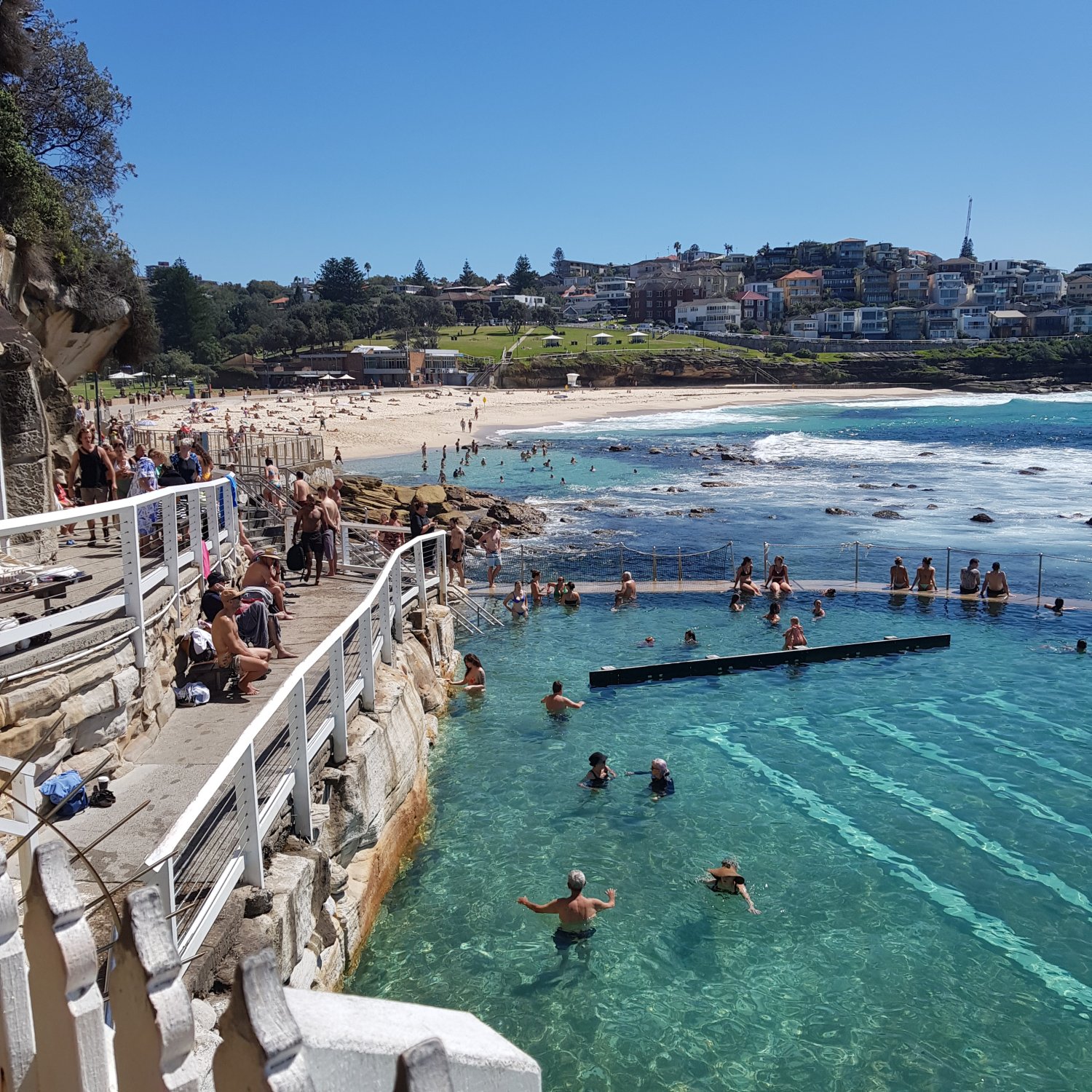
View from the coastal pathway alongside the Bronte Baths, looking back towards Bronte Beach [March 2025]
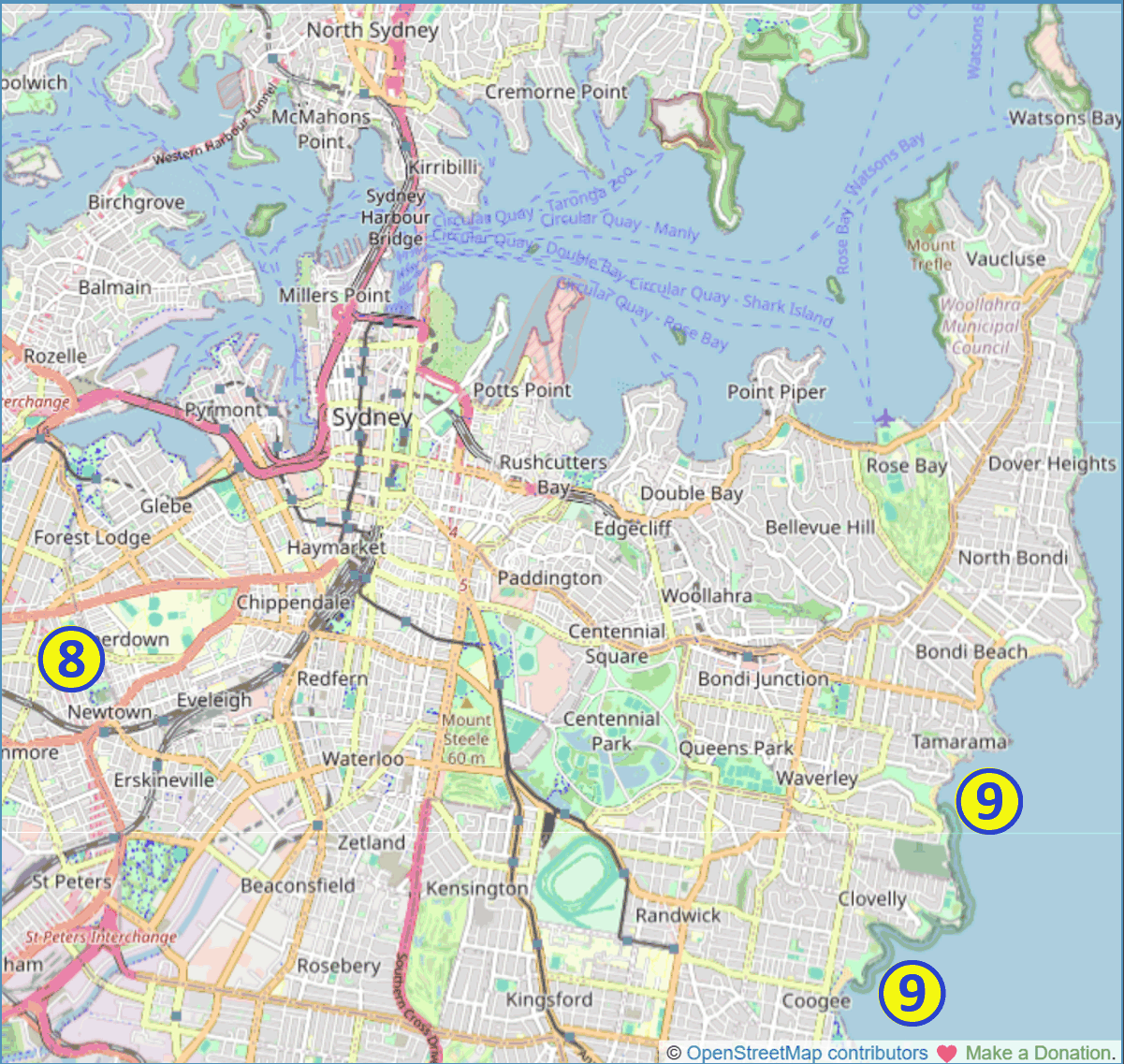
Showing the relative locations of Free Outdoor Activities 8, 9:
8. Street Art in Newtown
9 (upper). Bronte Baths ocean pool,
9 (lower). Giles Baths rockpool
10.
Tackle a Coastal or Harbour Foreshore Walk – a number of coastal and harbour foreshore walks are outlined below under:
Nature, Outdoors, Recreation
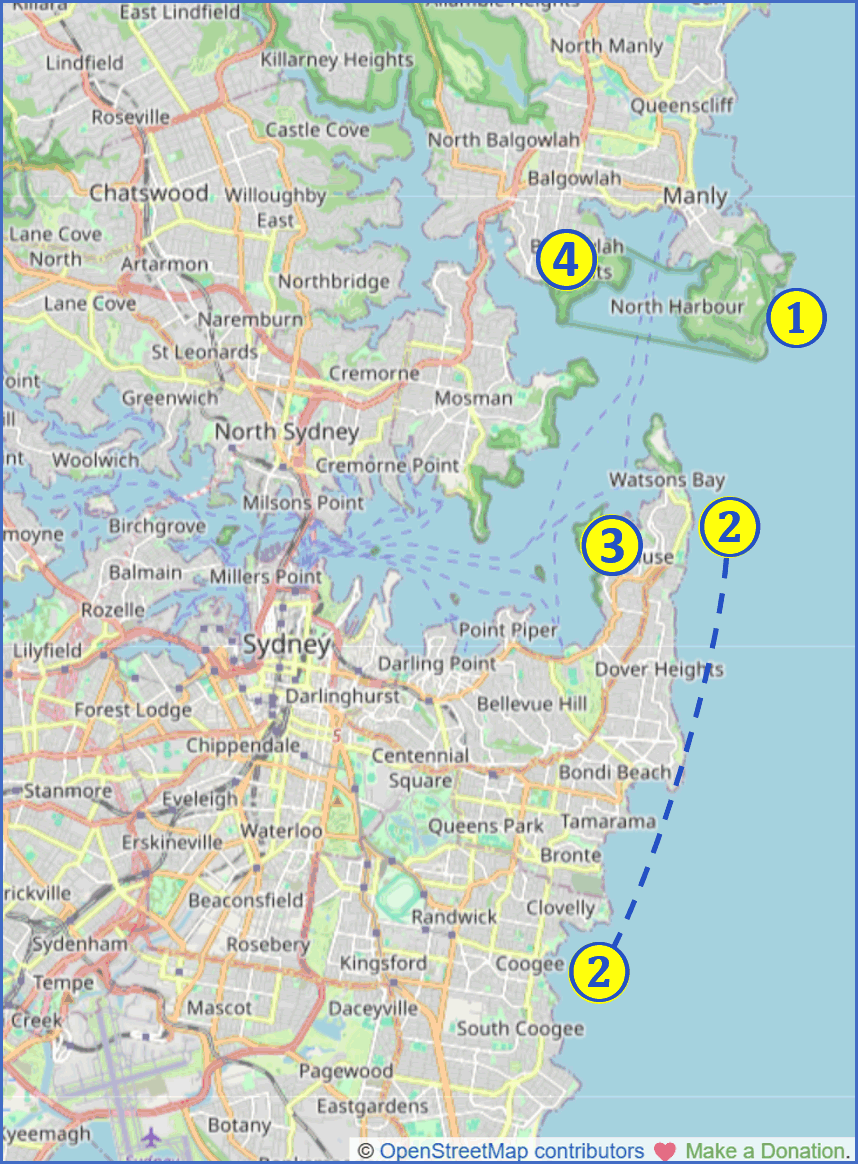
Showing the relative locations of Coastal and Harbour Foreshore walks (numbered in the order from above):
1. between Manly and North Head
2. between South Head and Coogee
3. between Rose Bay and South Head
4. between Spit Bridge and Manly
Many of the coastal and harbour foreshore walkways across Sydney are well-maintained by local councils, or by the Sydney Harbour National Park, with numerous signs and map boards being displayed along the trails, as illustrated by the next four images.
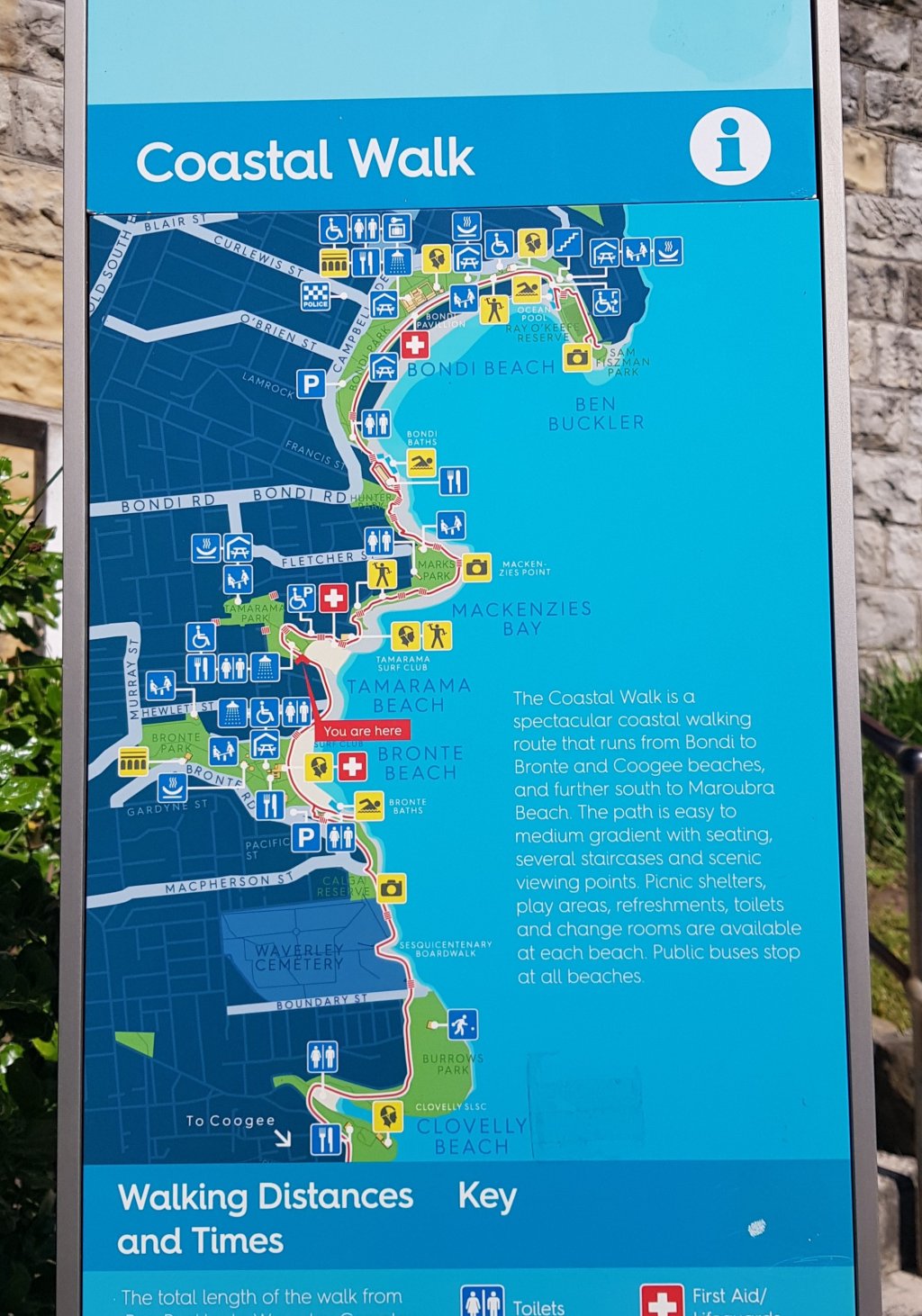
East Coast Bays walkways – Waverley Council
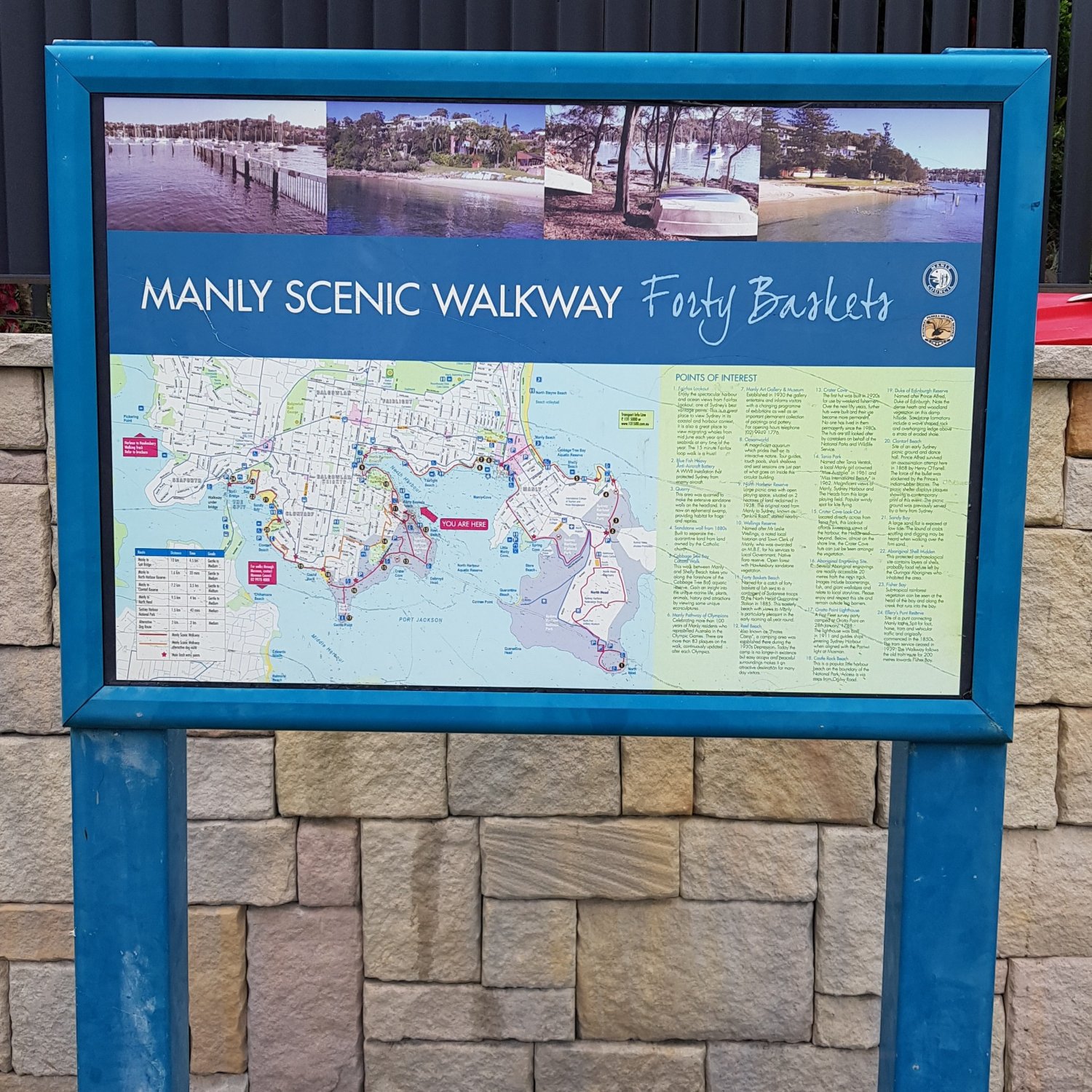
Manly Scenic Walkways – Manly Council
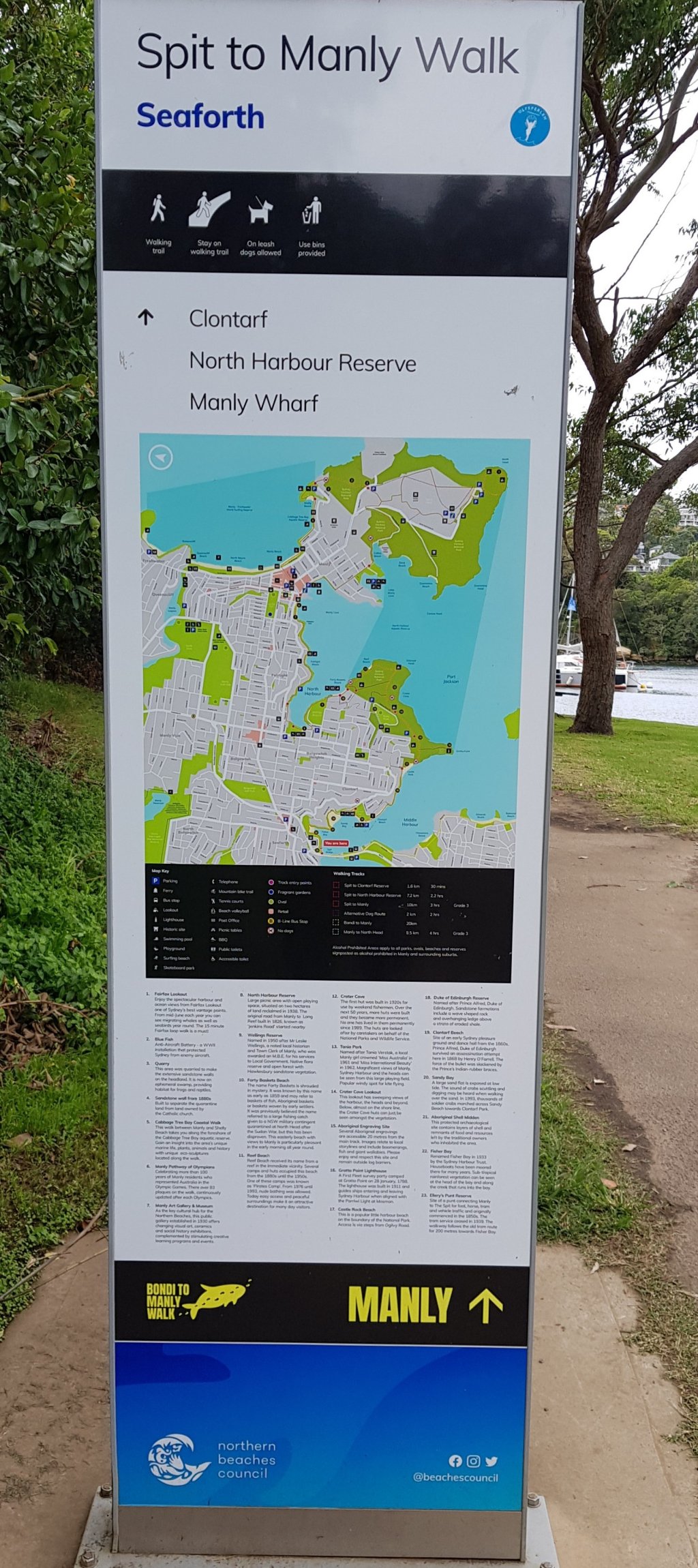
Spit to Manly Walk – Northern Beaches Council
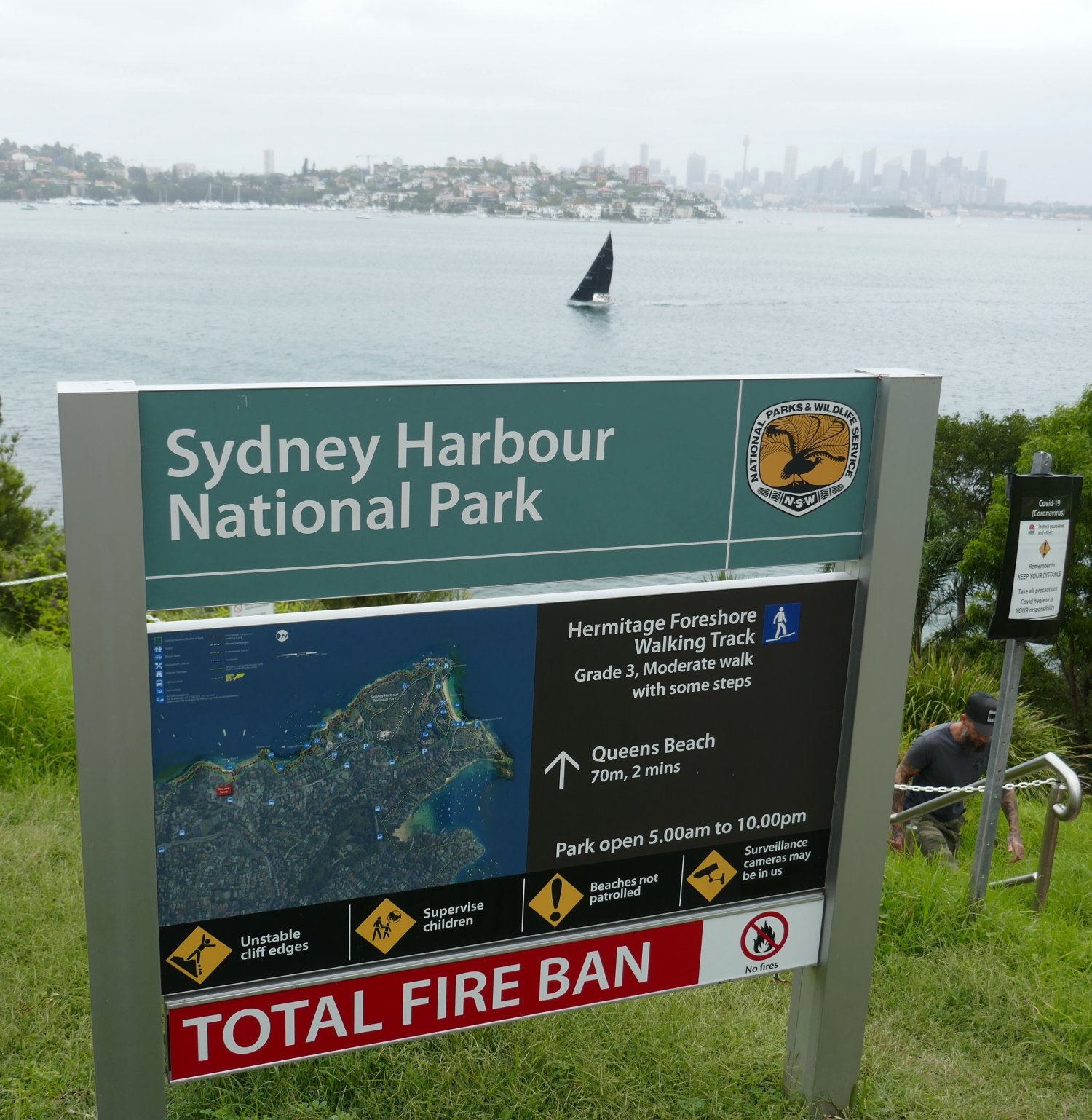
Part of the Hermitage Foreshore Track walk – Sydney Harbour National Park. Note : the top of this map points to the west (rather than to the north)
Note : The above 21 Quick Ideas are a 'starter'; further below you will find several more possibilities, under:
Free Attractions in Winter – Lots to See and Do
Have You Noticed….
No Commercial Ads !!
That’s right!
NO Commercial Ads on afootwego.com!!
Why You Won’t See Ads Here
I have an intense dislike of having Ads poked in front of me as I am reading and studying something. While I understand the need for this sort of intrusive content on many websites, that is not happening at afootwego.com.
My intention is for your reading experiences to be uncluttered with such distractions. That said, on my pages you will encounter invitations to join my Newsletter, afootwego, In The Loop!
On most Posts, you will also see an invitation: "If you have found this Post useful, would you like to buy me a small treat ?" This is an alternative to running Ads on the site, and will help me to cover my hosting and other operating costs.
From time to time, you may also encounter an invitation to purchase a downloadable (such as an eBook, or a tool). The downloadable will be related to the content you are reading.
When someone opts to purchase one of my downloadable offers, they will receive something worthwhile, and the payment will help me with my costs.
Sydney by Seasons – a Quick Review
Peak season for visitor numbers to Sydney is summer (December-January-February), with January being the most expensive month, because of summer holidays.
The traditional ‘shoulder seasons’ of Spring (September-October-November) and Autumn (March-April-May) are more pleasant than the heat of summer, and Sydney’s attractions are less crowded. Remember, the days of Spring are becoming warmer and longer, while the days of Autumn are cooling, and becoming shorter.
Winter (June-July-August) is supposedly Sydney’s “off-season”, with shorter days (especially in June), cooler temperatures, fewer visitors, and generally cheaper rates.
It is worth noting that some of Sydney’s top attractions are available only during the winter months, e.g. whale watching, Vivid Sydney Light Festival, winter festivals.
Let’s now explore more about what to expect from Sydney’s coming winter season of 2026.
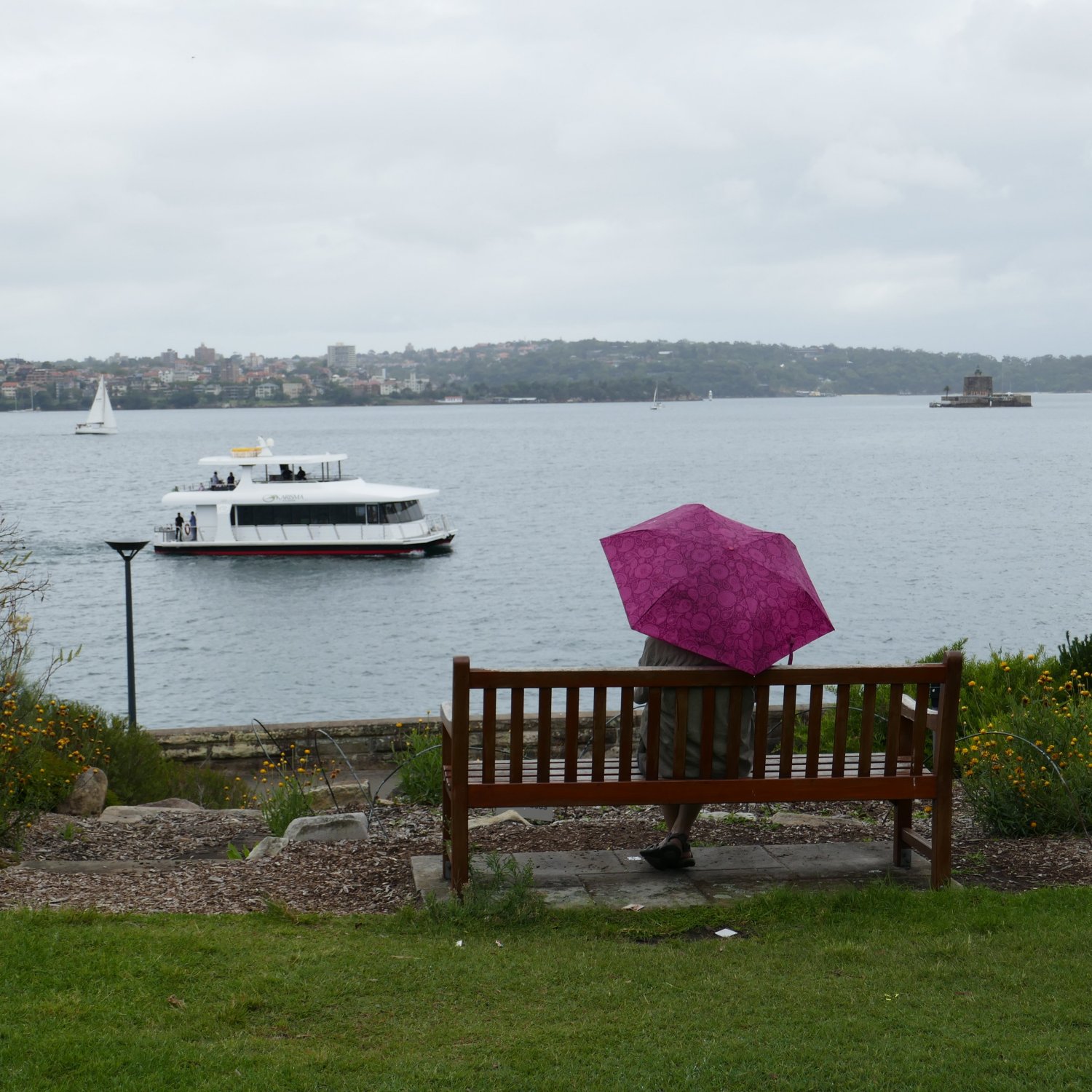
Rainy days in Sydney can happen at any time of the year – be prepared!
Projections for Winter 2026 in Sydney
Looking ahead to winter 2026 in Sydney, early forecasts suggest warmer than average temperatures and a high likelihood of below-average rainfall.
Mid-Winter 2026 Update
Bureau of Meteorology (BoM) statistics show Sydney’s total rainfall of 42.6 mm in June 2026 was significantly below the historic average of about 132 mm.
This was also Sydney’s warmest June overall since 1859.
Across all of NSW, the June averaged rainfall was 39.8 mm, which is 14% above the historic average.
The +60% probability of development of El Niño is projected to drive drier conditions in eastern Australia, resulting in higher-than-usual daytime temperatures and potential for a warmer-than-average winter season.
Temperature: Temperatures are projected to be warmer than average for most of Australia (including NSW) during the autumn-winter transition, with a strong likelihood of over 80% chance of above-average temperatures in many areas.
Rainfall: The BoM hints at below-average rainfall for the second half of 2026, driven by a potential El Niño event.
Climate Drivers: Strong signs indicate an El Niño phase will develop by winter or early spring 2026, which typically brings warmer and drier weather to eastern Australia.
Note : Projections for Autumn 2026 are for warmer, drier weather, with an increased fire risk likely in NSW.
For more about Sydney’s winter weather, see the following sections (below):
Winter Weather is Changing for Sydney
Recent Sydney Winter Weather Patterns
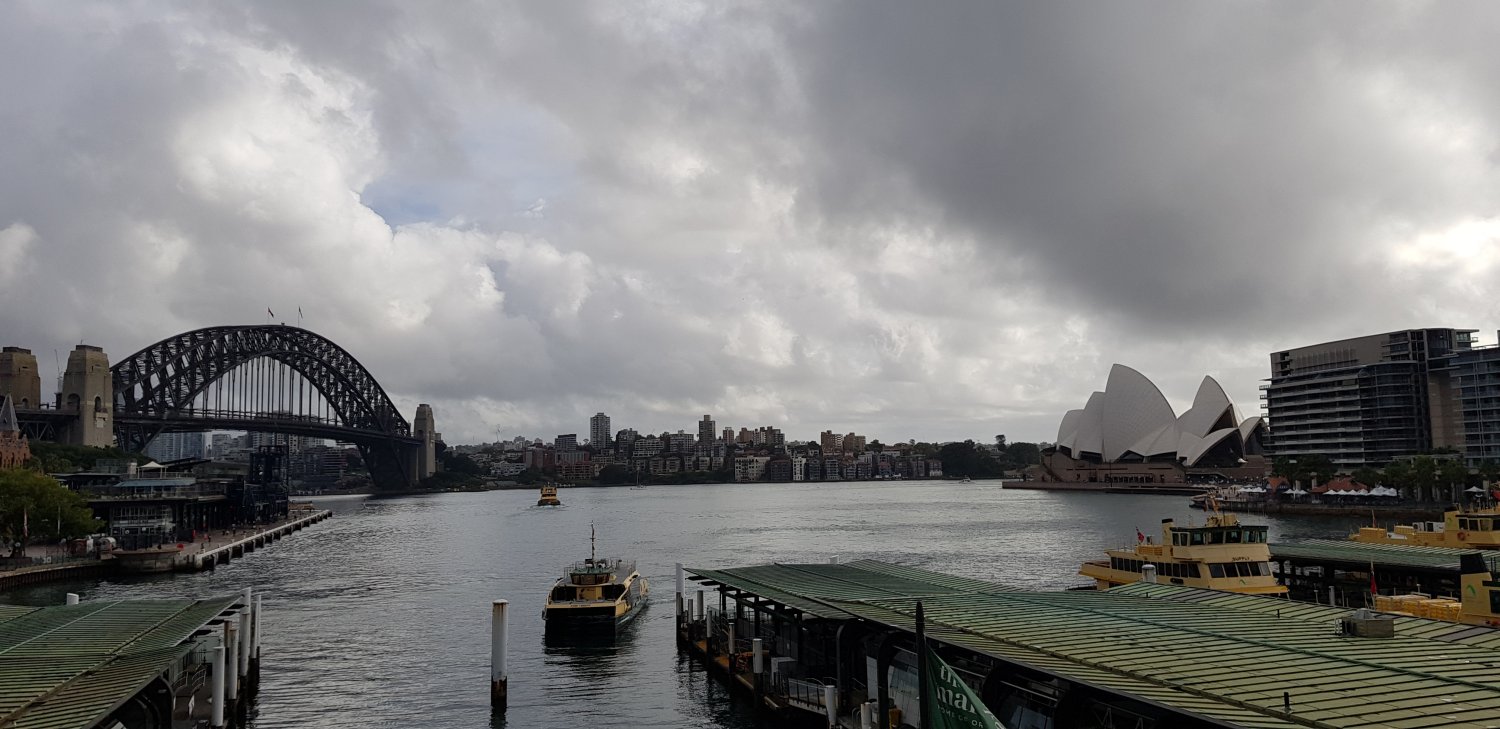
A view across Circular Quay (aka Sydney Cove) as storm clouds gather in the sky – this can happen at any time of the year, not just in winter
Free Attractions in Winter – Lots to See and Do
As noted above, we will focus on Free attractions that are within the CBD, or are easily accessible by public transport from the CBD (i.e. in around 45 minutes or less on a ferry, train, or bus).
I have organised these attractions into six ‘interest areas’, which will allow you to locate those that may attract your attention, and to skip those that do not:
1. Food, Art, Culture
The culture of a destination is reflected in its food and art, including street art.
2. History & Architecture
For most destinations, architecture is a visible reflection of history.
3. Nature, Outdoors, Recreation
Parks, gardens, reserves, beaches, and walking/biking trails suitable for various types of outdoor activities bathing [Note: the cross-over between recreation and leisure lies around the amount of ‘activity’ involved].
4. Shopping & Leisure
Retail therapy in all of its forms, wellbeing, health and beauty sessions, plus free-time interests, e.g. sun-bathing.
5. Sports & Events
Organised sports, festivals, exhibitions, and other events.
6. Weird & Wonderful
Every destination has some things that are unique, the trick is to be able to find them!
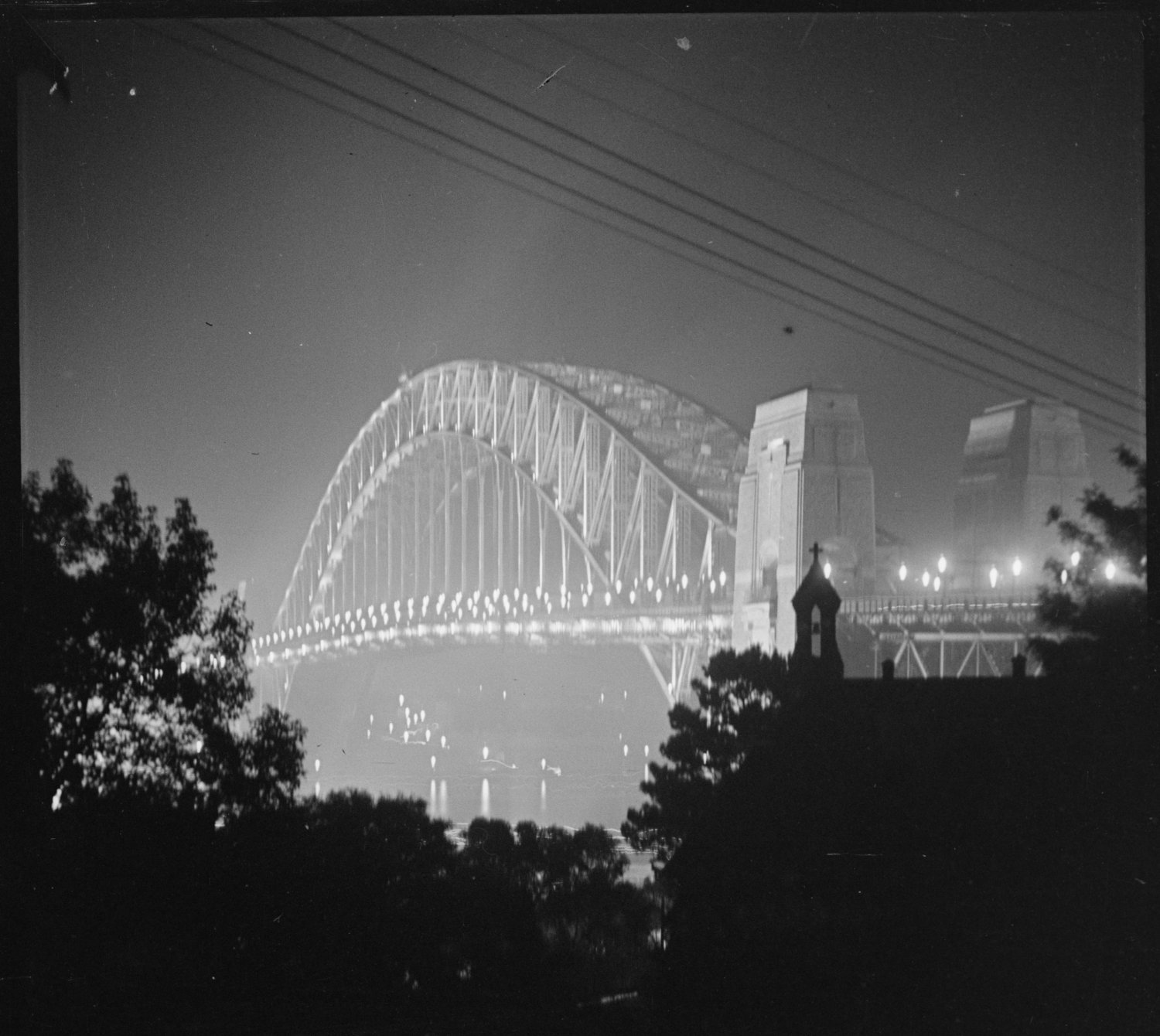
Night view of an illuminated Sydney Harbour Bridge, from Upper Pitt Street, Kirribilli, 1938. When opened in 1932, the Sydney Harbour Bridge began a transformation of Sydney, linking the CBD with the North Shore, and beginning the modern, industrialised city.
Credit: City of Sydney Archives Unique ID: A-01142036
I see you’re still here – well done!
A quick reminder about my special offer to you…
Your Free Travel Starter Kit is waiting for you.
Join afootwego, In The Loop!, and the Kit is yours, FREE !
Public Transport in Sydney
Sydney is well served with a network of transport options, from harbour ferries, to light rail (trams), buses, and metro trains.
The following connections can be made on public transport from Circular Quay in the heart of Sydney’s CBD (I regard Circular Quay as the Gateway to Sydney) in around 45 minutes or less:
- Manly: by ferry
- Bondi Beach: by train & bus, or by bus
- Coogee Beach/Bronte Beach: by bus, or by train & bus
- Parramatta: by train
Public transport fare calculations are based on a number of things, e.g. the mode of transport (bus vs train), the distance you travel between tap on and tap off, and how you pay. Also, during weekends, and on public holidays, a fare cap is applied.
Visit Transport NSW to see the different transport options available in Sydney:
https://transportnsw.info/travel-info/ways-to-get-around
Online journey planners are available at:
https://transportnsw.info/
and:
https://transportnsw.info/trip-planner
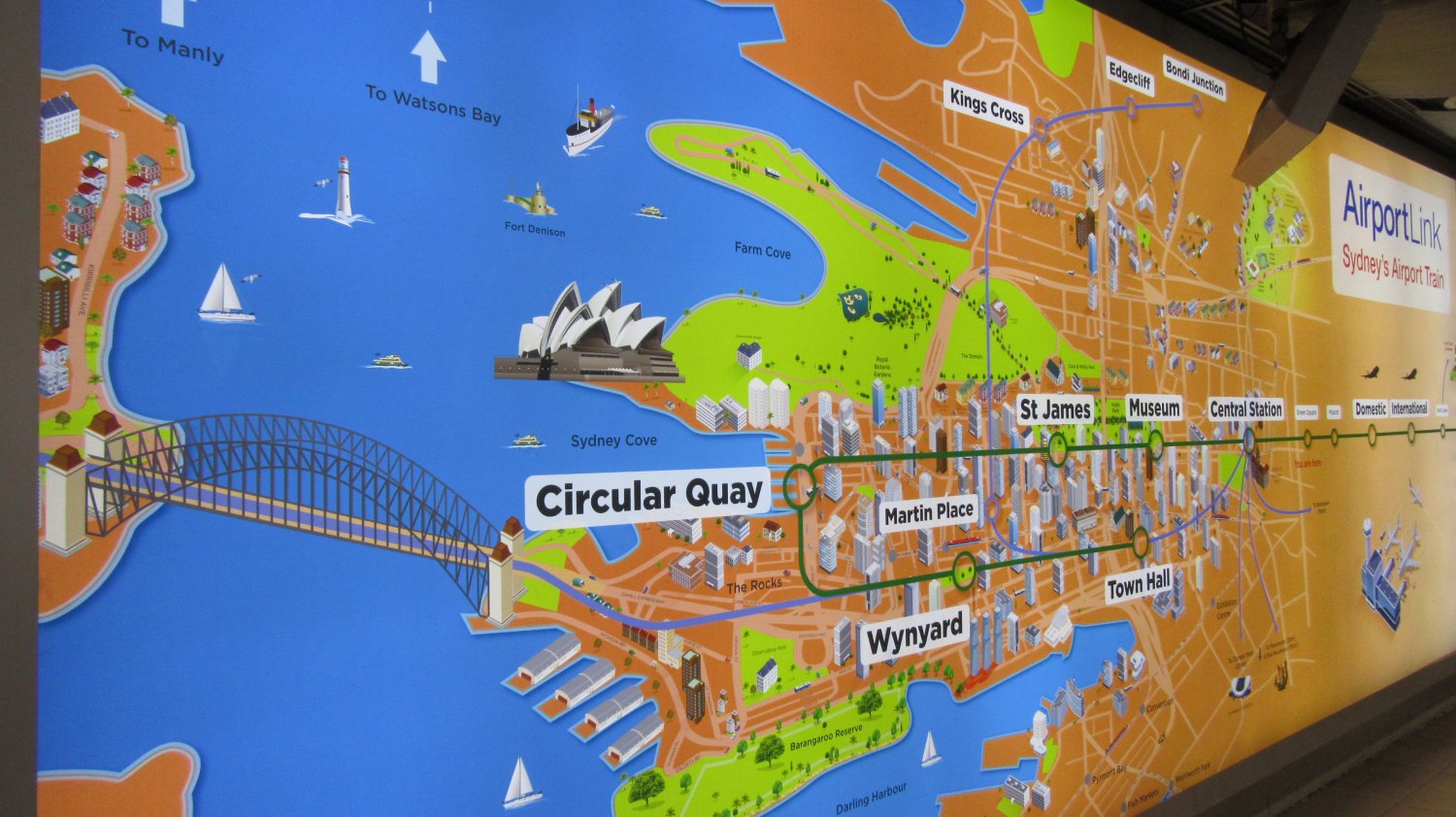
Sydney and its surrounds are well-served with a modern public transport network
Food, Art, Culture
The culture of a destination is reflected in its food and art, including street art.
In this section we cover:
- Sydney Cuisine
- Art Galleries
- Public Art
- First Nations Art
- Heritage Pubs in Sydney
Sydney Cuisine
While food is seldom ‘free’, Sydney’s cuisine scene reflects the diversity of its people.
For many restaurants, the winter season is usually the quietest and least expensive for patrons.
Amongst the winter events, the Bastille Festival Sydney (16-19 July 2026) is promoted as an extravaganza of French food, wine, and art.
Many of the regular markets also feature numerous food stalls, offering a range of delicious and distinctive cuisines.
Art Galleries
Sydney art galleries offering free entry include:
- Museum of Contemporary Art (Circular Quay)
- Art Gallery of NSW (opposite The Domain, on Art Gallery Road)
The State Library of New South Wales (Macquarie Street) also offers an impressive art collection.
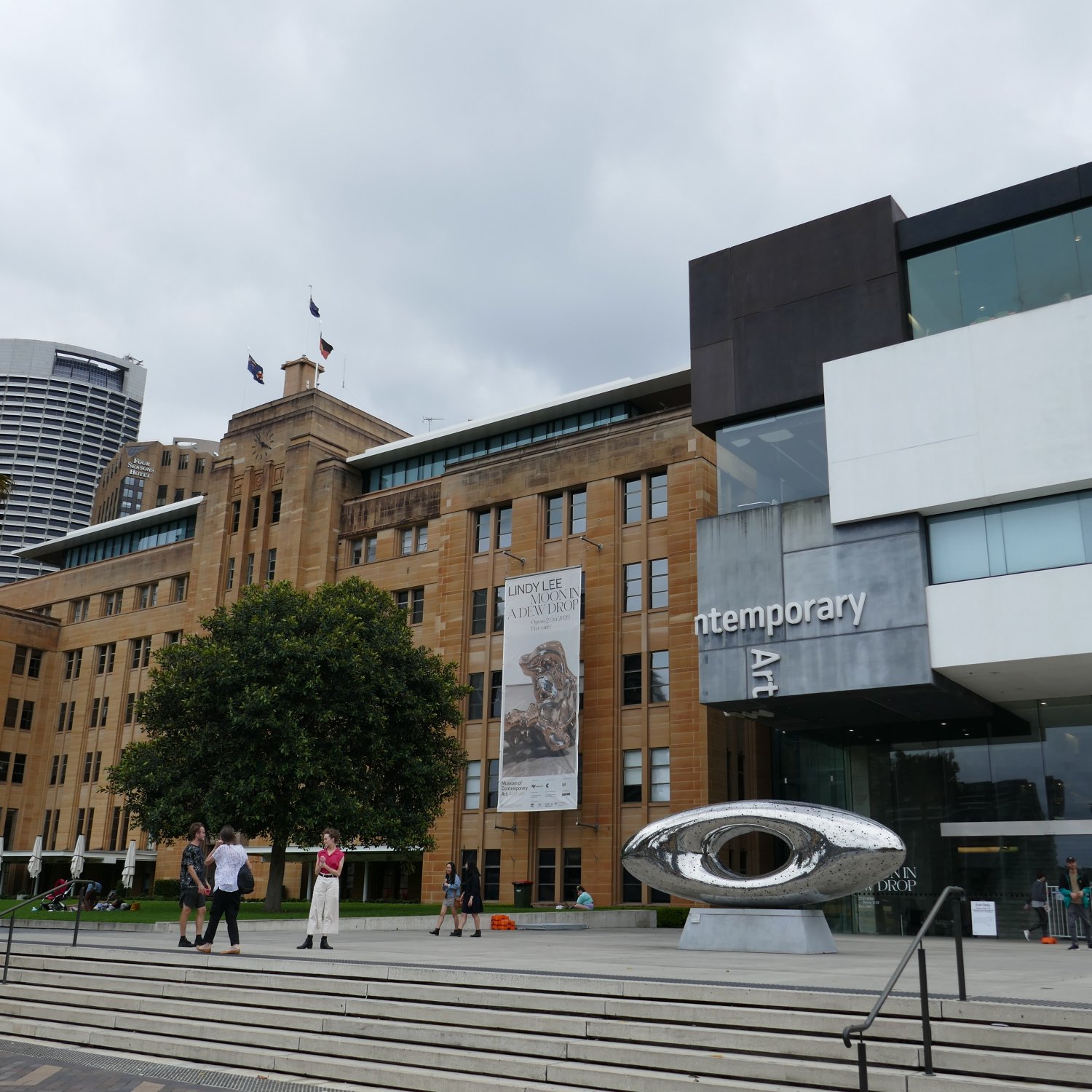
The Museum of Contemporary Art (MCA) is located on the site once occuped by the early colonial-era Naval Dockyard, established in 1797; the sandstone building, constructed for the Maritime Services Board (MSB), was opened in 1952; this building replaced the Sydney Commissariat Stores, which dated from 1809 and 1812, with their demolition in 1939 resulting in an increase in public awareness of the loss of colonial-era heritage.
The MCA moved into the MSB building in 1991, while the newer section of the MCA was opened in 2012
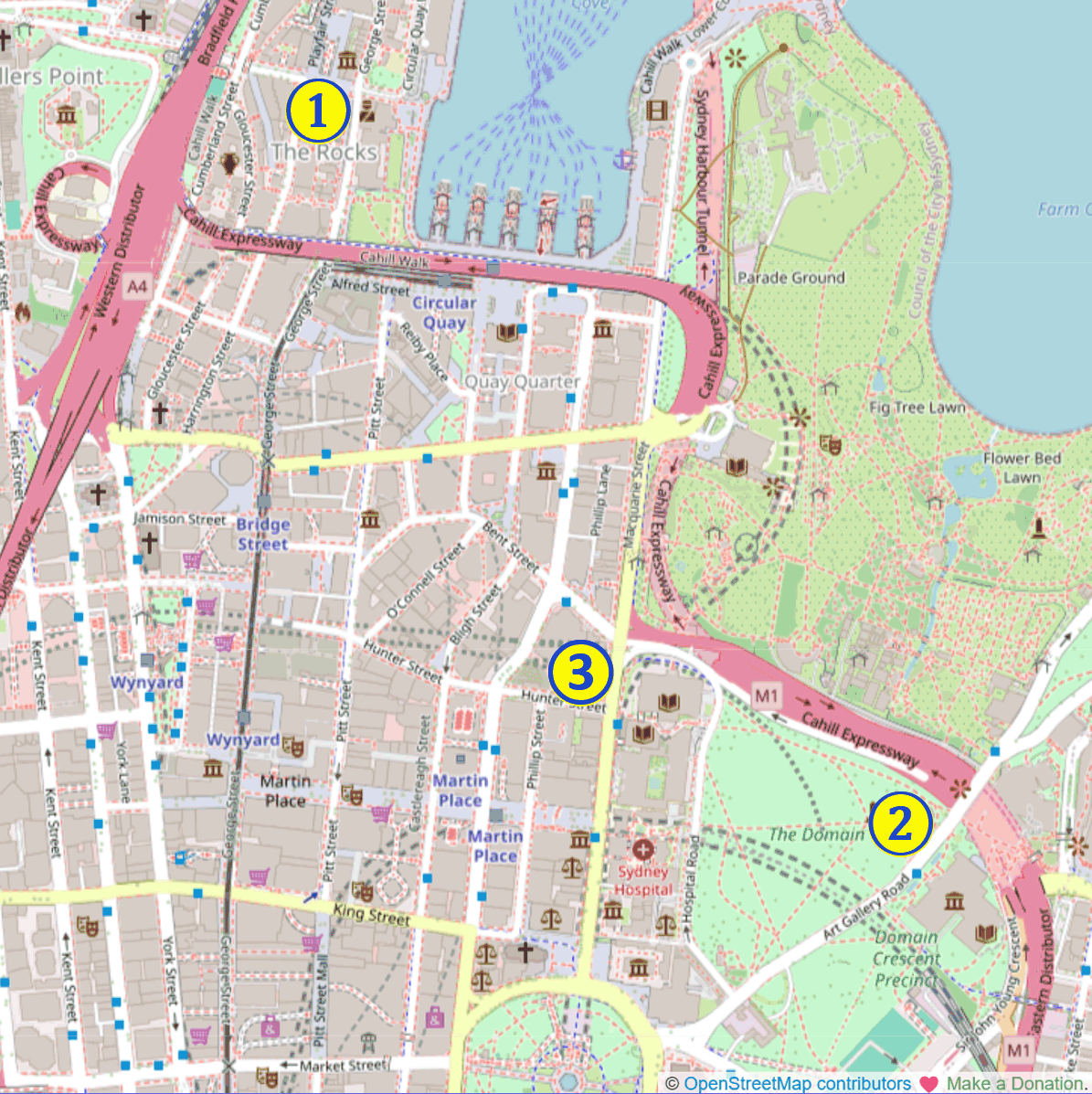
Showing the relative locations of free Art Galleries in Sydney’s CBD (numbered in the order from above):
1. Museum of Contemporary Art (MCA)
2. Art Gallery of NSW
3. State Library of NSW (extensive Art Collection)
Public Art
Sydney also offers numerous examples of public art, in the form of sculptures, murals, displays, and street art. Many of these can be found in the CBD, and in surrounding suburbs.
The City of Sydney offers information about public art on the following links:
First Nations Art
Free access to First Nations art in Sydney is available at the Art Gallery of NSW (Yiribana Gallery), the Australian Museum, and in public installations in Barangaroo.
Ancient rock engravings can be found at Bondi Beach, and at Grotto Point (near Manly).
Notes :
1. Several of Sydney’s museums offer cultural displays and information – see Free Museums in History & Architecture
2. Public Libraries in Sydney offer cultural information – see Public Libraries in History & Architecture
Heritage Pubs in Sydney
We have saved the best of this category ’til last – Sydney’s Oldtime Pubs!
Early-colonial-era Sydney had a huge number of pubs – almost one on every corner of today’s CBD.
While few remain, the following venues at The Rocks or nearby Miller’s Point can offer a taste of the atmosphere found in a colonial pub, and the culture of the local community.
- The Lord Nelson Brewery Hotel – 1842 (Kent Street, Millers Point)
- The Hero of Waterloo – 1845 (Lower Fort Street, Millers Point)
- The Fortune of War – Est 1828, rebuilt 1922 (George Street, The Rocks)
- The Australian Heritage Hotel – rebuilt 1914 (Cumberland Street, The Rocks) – the Australian Hotel’s license history can be traced back to 1824, in the former house of Isaac Nichols, the remnants of which lie somewhere beneath the First Fleet Park today.
While the Fortune of War claims to be “Sydney’s Oldest Pub”, it is apparent The Lord Nelson is a particularly well-credentialed challenger for that title!
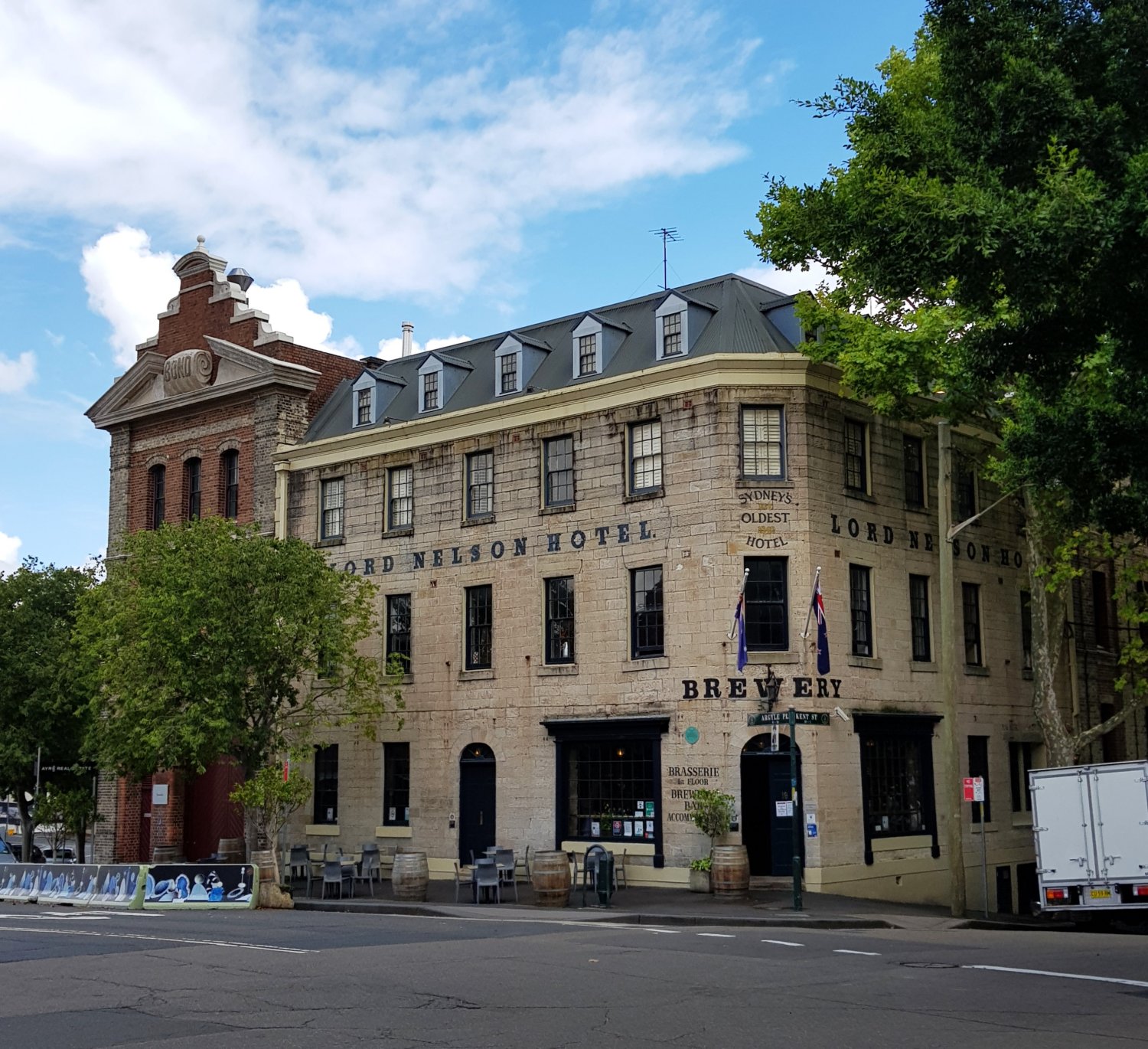
If you want to experience an authentic Sydney pub, that’s still in its ‘original skin’, then make your way to The Lord Nelson Brewery Hotel at 19 Kent Street, Millers Point (on the hill above the Barangaroo Train Station).
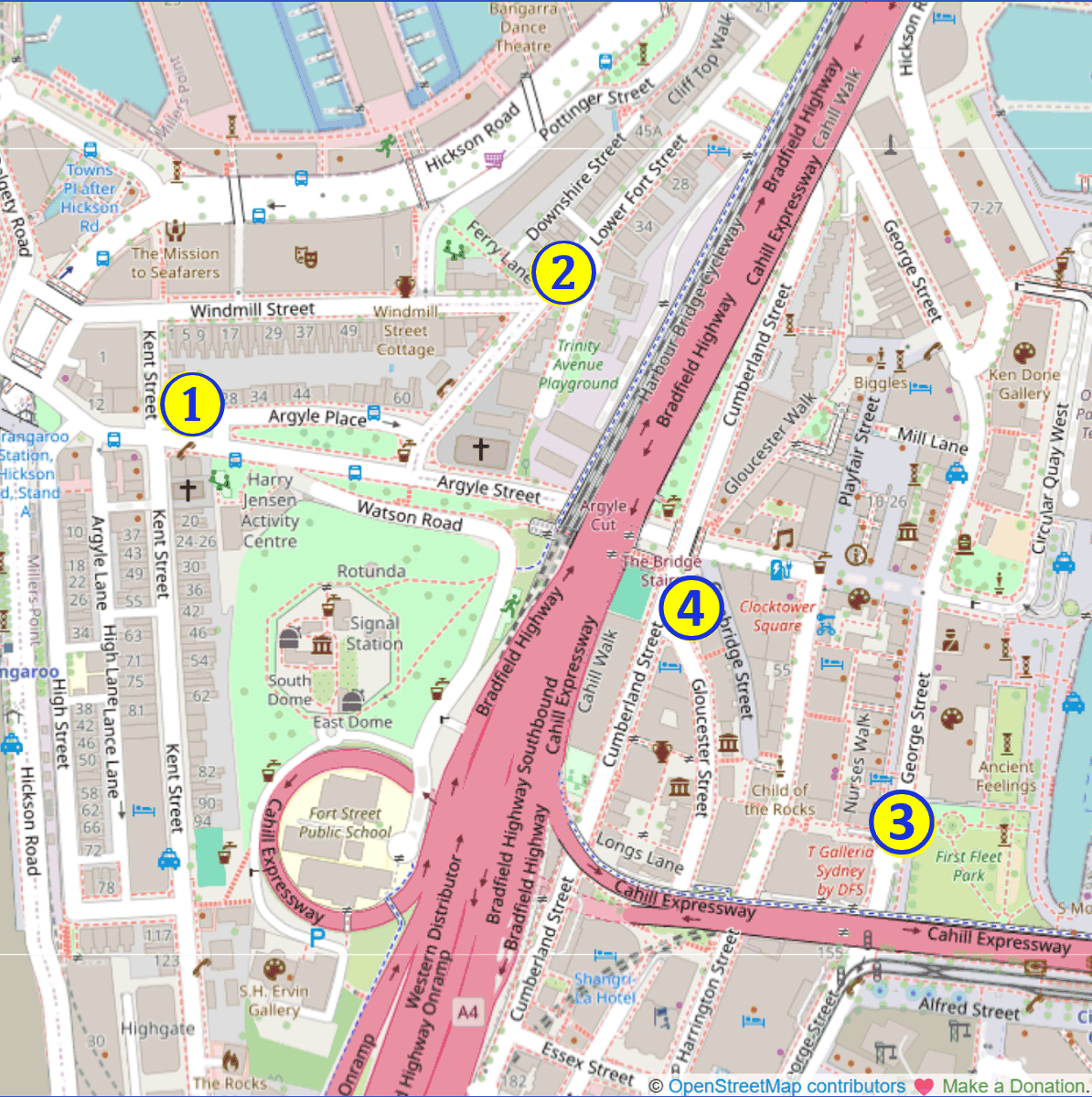
Showing the relative locations of four remaining colonial-era pubs (numbered in the order from above):
1. The Lord Nelson Brewery Hotel
2. The Hero of Waterloo
3. The Fortune of War
4. Australian Heritage Hotel
Invitation to Buy Me a Small Treat
If you have found this Post useful, would you like to buy me a small treat?
This is an alternative to running Ads on the site, and will help me to cover my hosting and other operating costs.
IF you would like to buy me a small treat, please follow this link:
Surprise Marlene with a treat!
Thank You!
History & Architecture
For most destinations, architecture is a visible reflection of history.
In this section we cover:
- CBD Architecture
- Heritage Architecture
- Modern Architecture
- Free Museums
- Public Libraries
CBD Architecture
Within Sydney’s central city area, a range of architectural styles can be found that illustrate its more than 230 years of European history. Included are several well-preserved examples from the early 19th century colonial period.
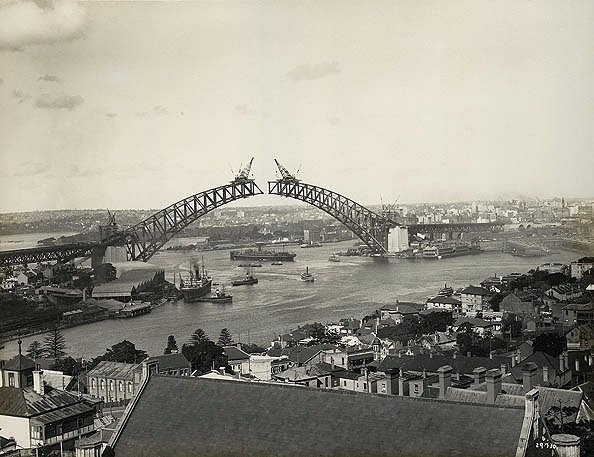
Sydney Harbour Bridge under construction 29 July 1930; The two halves of the Sydney Harbour Bridge were joined together on 19 August 1930 at 10pm; the two half arches had been fabricated in workshops at Milson’s Point, before being loaded onto barges and towed into position; the arches were lifted up by two 580 tonne creeper cranes, and steel decking was then hung from the arches over the next nine months; the arch spans 503m and the summit is 134m above sea level; the bridge was officially opened on 19 March 1932.
Credit: Museums of History NSW (MHNSW)
Sydney’s architectural showpiece is clearly the Opera House, opened in 1973. The Sydney Harbour Bridge, opened in 1932, is also a Sydney icon.
Over recent times the city has also acquired a number of impressive pieces of modern architecture, many of these are prominent around the waterfront.
While there are no examples of traditional First Nations architecture to be found, a sandstone rock shelter at Yurong Point (near to Mrs Macquarie’s Chair) shows evidence of use by First Nations people (Gadigal clan of the Eora Nation).
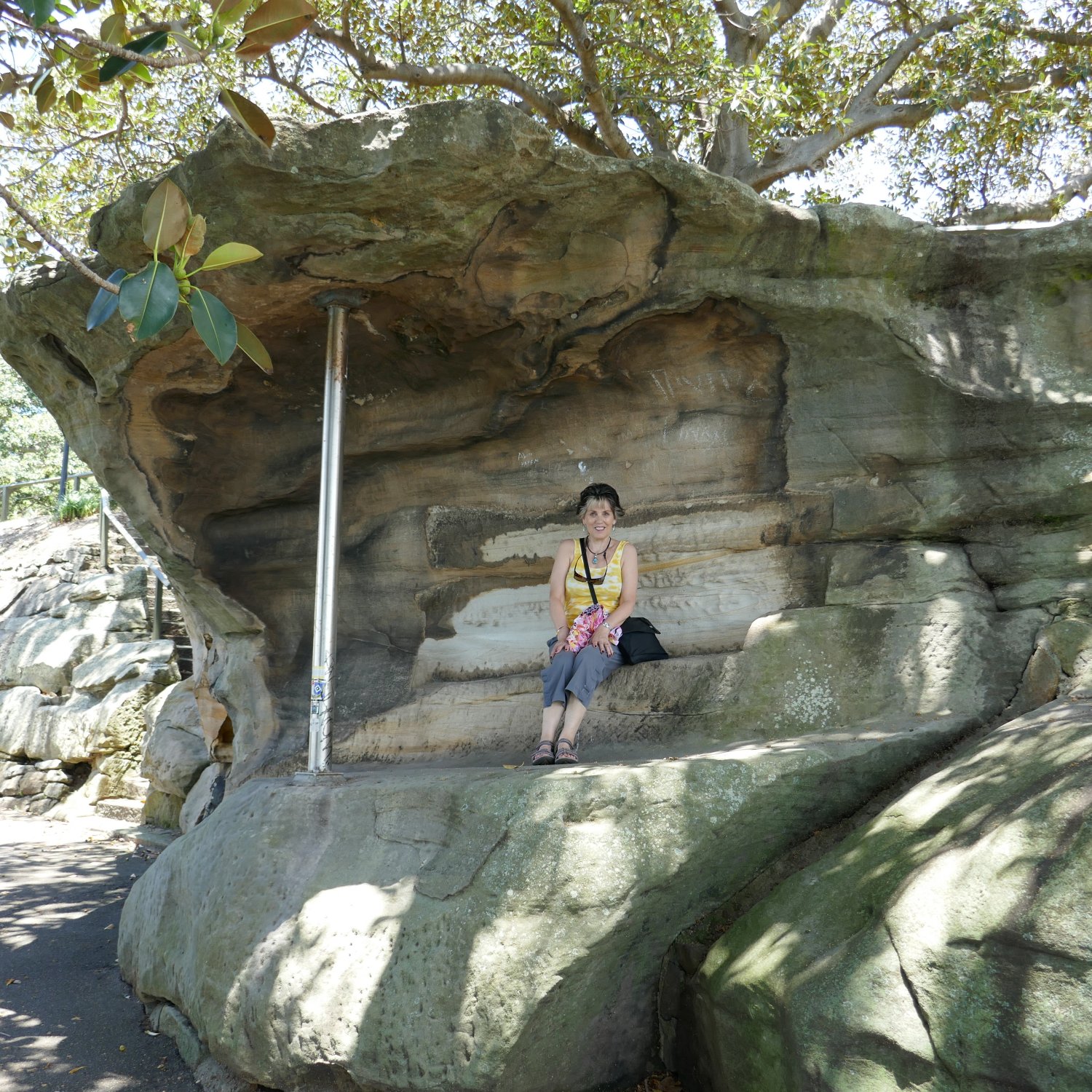
An example of a rock shelter (or overhang) near to Mrs Macquarie’s Chair – another overhanging shelter is found at the shoreline level of Yurong Point
Heritage Architecture
Sydney’s architecture from its early-colonial and Victorian eras reflects the abundant wealth of NSW during these times. A number of examples of early-colonial and Victorian-era heritage architecture can be found throughout the CBD.
Circular Quay:
- Old Customs House;
- Cadman’s Cottage;
- ASN Co Building;
- Campbell’s Stores
The Rocks:
- Russell Hotel
- English, Scottish and Australian Chartered Bank;
- Old Police Station;
- Unwin’s Stores;
- Mariners’ Church;
- Sailors Home;
- Discovery Museum;
- Playfair Street Terraces;
- Foundation Park;
- Argyle Stores;
- Susannah Place;
Macquarie Street:
- Government House;
- former Treasury Building (InterContinental Sydney);
- Chief Secretary’s Building;
- Conservatorium of Music;
- NSW Parliament;
- Sydney Hospital
(and Nightingale Wing);
- The Mint;
- Hyde Park Barracks;
- St James Church
- (St Mary’s Cathedral is nearby)
Bridge Street:
- remains of Sydney’s First Government House;
- former Department of Lands Building;
- Burns Philp Building
George Street:
- former General Post Office;
- Strand Arcade;
- Queen Victoria Building;
- Sydney Town Hall;
- St Andrew’s Cathedral
Heritage Churches:
- St James Church (Anglican);
- St Mary’s Cathedral (Catholic);
- St Philip’s Church (Anglican);
- The Garrison Church (Anglican);
- St Patrick’s Church (Catholic);
- St Andrew’s Cathedral (Anglican)
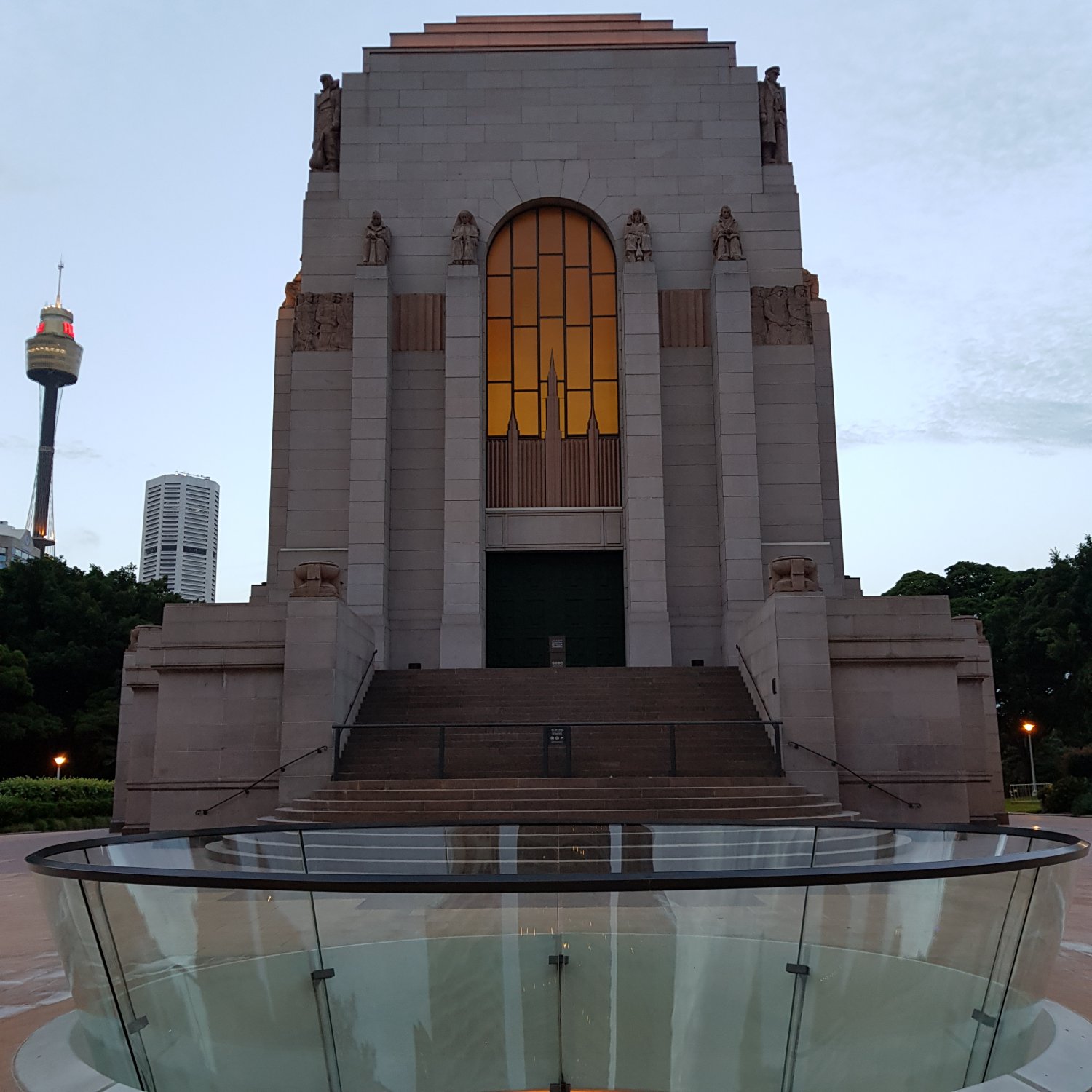
The ANZAC Memorial, viewed from the Liverpool Street side; the Oculus in the foregound is an inverted skylight, added during the 2016 ANZAC Memorial Centenary Project; the Memorial’s full redevelopment to fulfill the original design is due for completion in 2028
ANZAC World War 1 Memorial: for those with a military connection, the Hyde Park ANZAC War Memorial is the principal war memorial of New South Wales. It was opened in November 1934. In 2016 work began on an enhancement, to mark the 100th anniversary of the ending of the First World War. Free guided tours are available for small groups, with pre-bookings recommended.
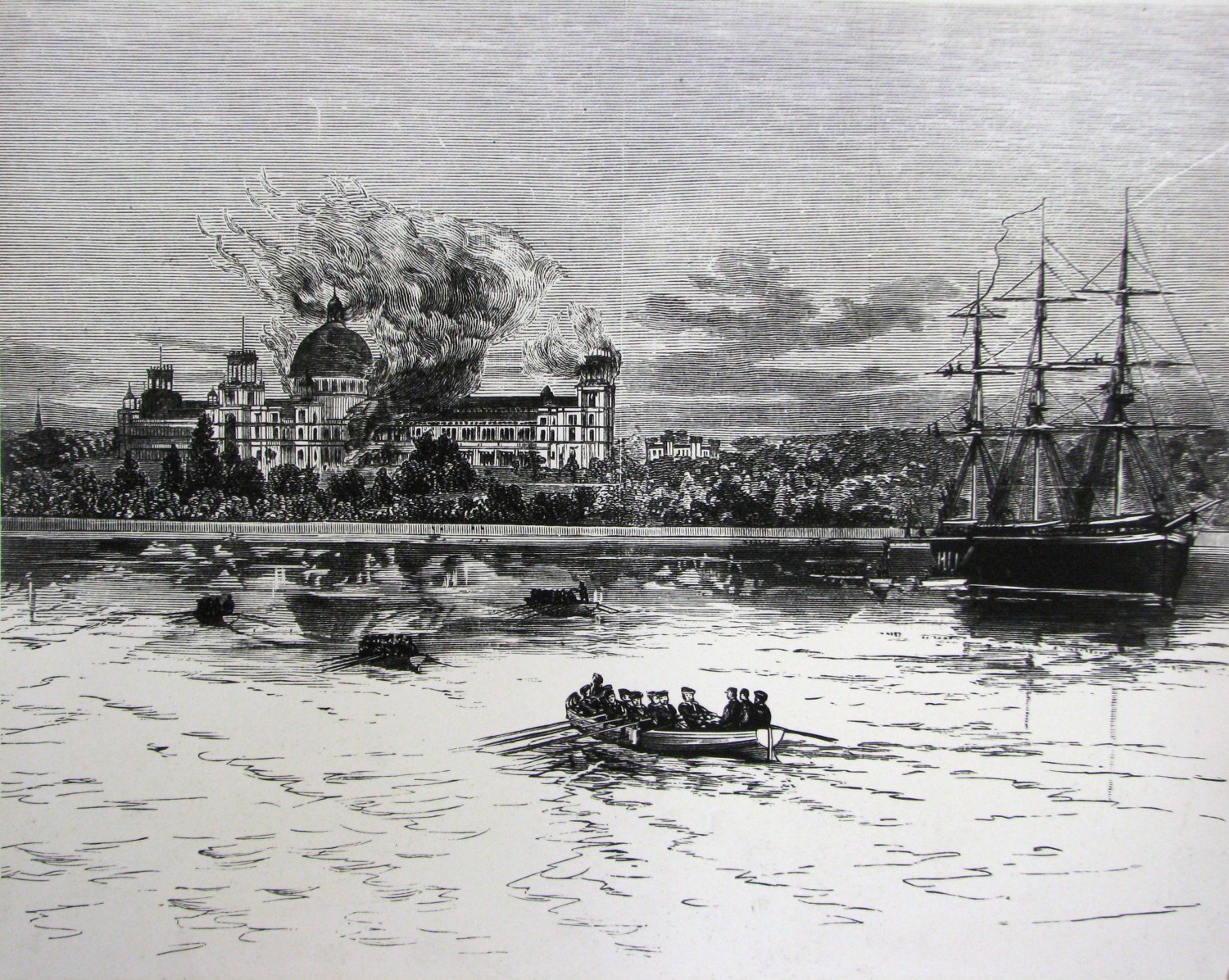
Garden Palace consumed by fire, Royal Botanic Gardens Sydney, 1882 (this view is from Farm Cove)
Credit: City of Sydney Archives [Unique ID A-00029575]
Lost ‘Gems’: While a number of architectural heritage ‘gems’ have been lost over the years, perhaps the most impressive was the Garden Palace. Standing on Macquarie Street, and built for the Sydney International Exhibition in 1879, this grand building was constructed primarily of timber, iron, and glass. It was destroyed by fire only a few years later. The carved sandstone gateposts and wrought iron gates to the Palace remain on Macquarie Street, while within the Royal Botanic Garden, the location of the original dome is marked by a sunken garden with a fountain and Cupid statue.
Modern Architecture
Sydney’s more recent architectural gems include:
- Australia Square Tower on George Street, Sydney’s first-ever skyscraper, completed in 1967
- The 1980 Sirius Building at The Rocks, Australia’s most famous example of example of Brutalist architecture; this was refurbished into a luxury residential complex 2022-2024
- The Sydney Tower Eye on Market Street, Sydney’s tallest structure, completed in 1981
- The 2012 extension of the Museum of Contemporary Art (MCA), at Circular Quay
- The 2015 ‘Brown Paper Bag’ Chau Chak Wing Building, at the University of Technology Sydney city campus, Ultimo
- The spiralling hive-shaped Darling Exchange Building in Haymarket (near Darling Harbour), opened in 2020
- The 2020 James Packer inspired Crown Towers at Barangaroo, on Darling Harbour
- The 2022 repurposed (upcycled) skyscraper Quay Quarter Tower at Circular Quay
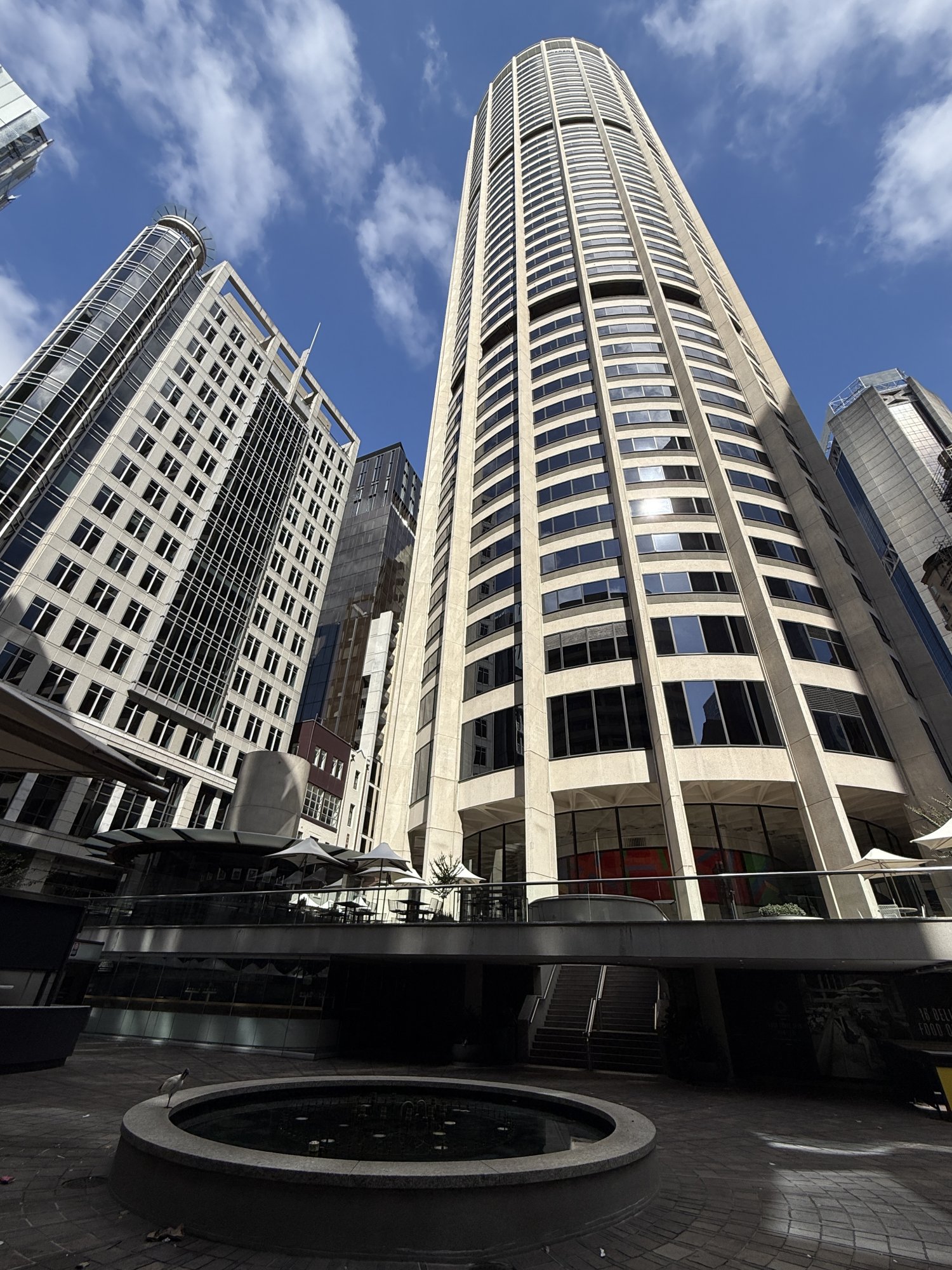
Australia Square Tower, viewed from beside the fountain above the old Tank Stream (now completely buried underground as a stormwater drain); amongst the buildings demolished to build Australia Square was the ornate sandstone AMP Society Head Office, at 87 Pitt Street; this is regarded as being one of Sydney’s most significant ‘lost’ buildings of the colonial-era
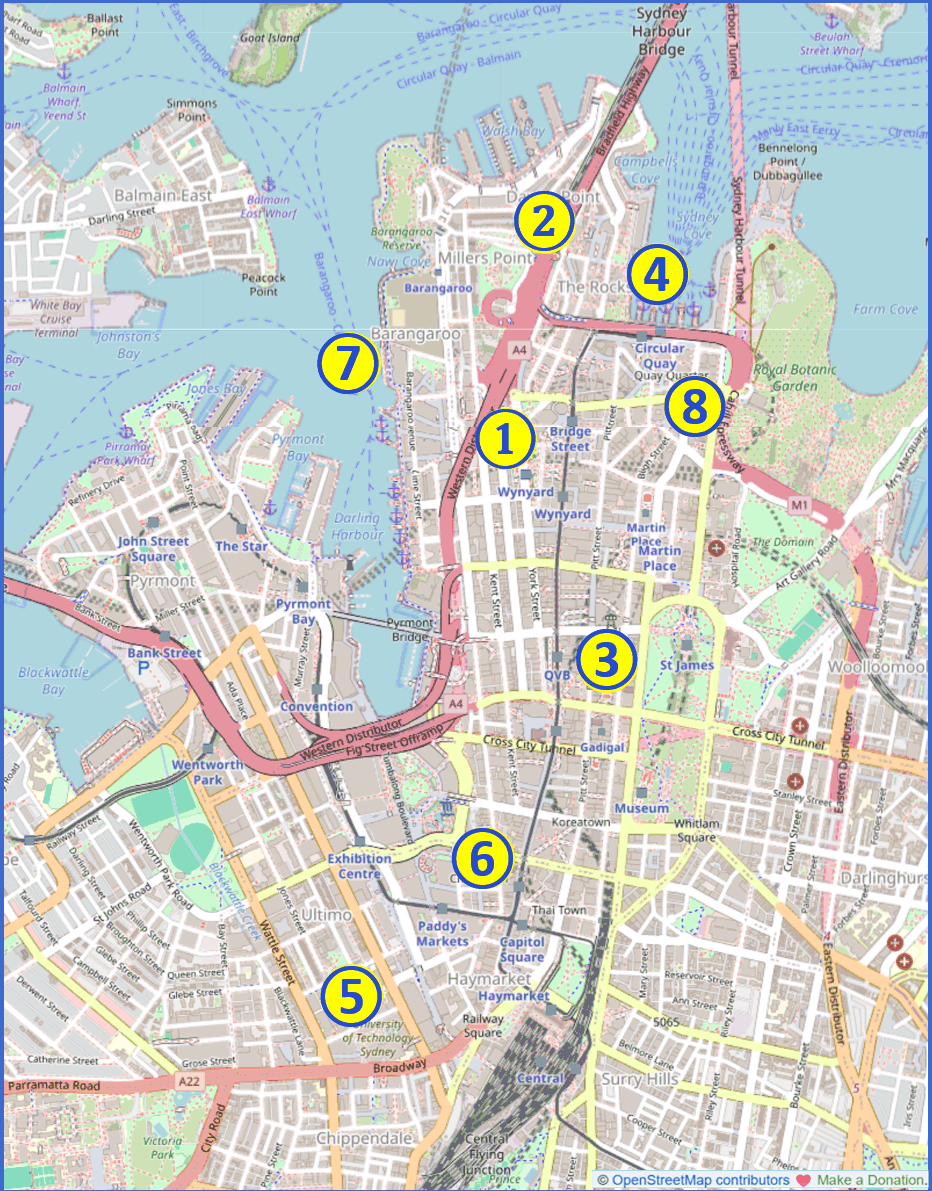
Showing the relative locations of Sydney’s modern architecture (numbered in the order from above):
1. Australia Square Tower
2. Sirius Building
3. Sydney Tower Eye
4. Museum of Contemporary Art (MCA)
5. Chau Chak Wing Building
6. Darling Exchange Building
7. Crown Towers
8. Quay Quarter Tower
Note :
All of these venues can be viewed from outside; some offer free access to parts of the building, while others have no public access, or charge an entry fee
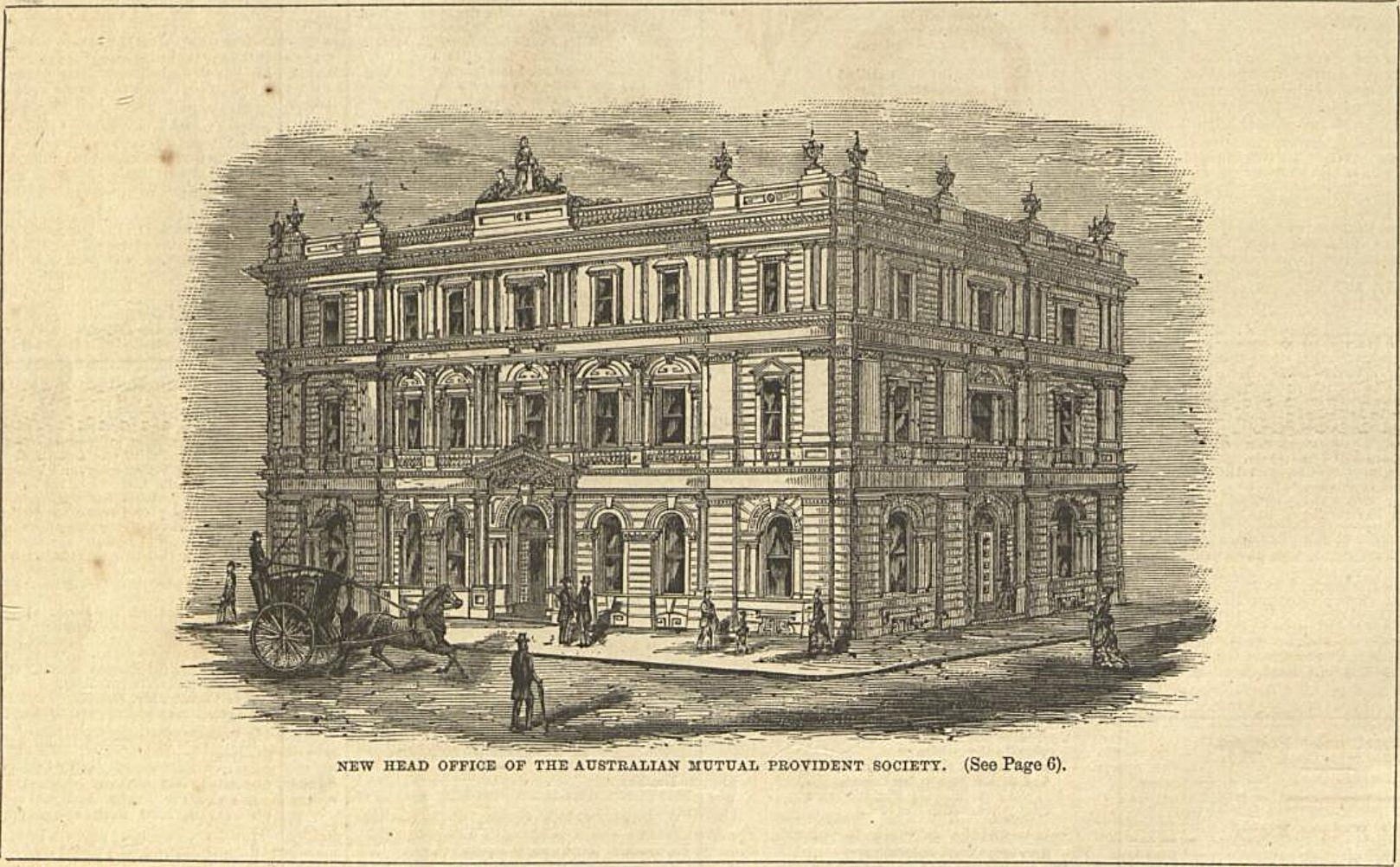
Extract from Trove – The Bulletin-No 5 (28 Feb 1880)
NEW HEAD OFFICE OF THE AUSTRALIAN MUTUAL PROVIDENT SOCIETY shows the 1878 building, at 87 Pitt Street (where the fountain is today in Australia Square); the AMP Society was founded in 1849 to provide life assurance,particulalry for widows and their children, in the often hazardous colonial environment where there was no government social security; under that ‘mutual’ model, the company was structured so profits returned to policyholders, rather than shareholders. In 2018, AMP announced the sale of its life insurance business.
Free Museums
Museums offering free access in Sydney include:
- Sydney Observatory (Millers Point)
Note: free access to daytime exhibitions; a fee is charged for night viewing tours;
- Susannah Place corner shop (Gloucester St, The Rocks);
- The Rocks Discovery Museum (Kendall Lane, The Rocks);
- Justice & Police Museum (corner Albert/Phillip Streets);
- Museum of Sydney (corner Bridge/Phillip Streets);
- Lucy Osburn-Nightingale Museum (Macquarie Street);
- The Mint (Macquarie Street);
- Hyde Park Barracks (Macquarie Street);
- Australian Museum (corner William/College Streets);
- Chau Chak Wing Museum (Camperdown);
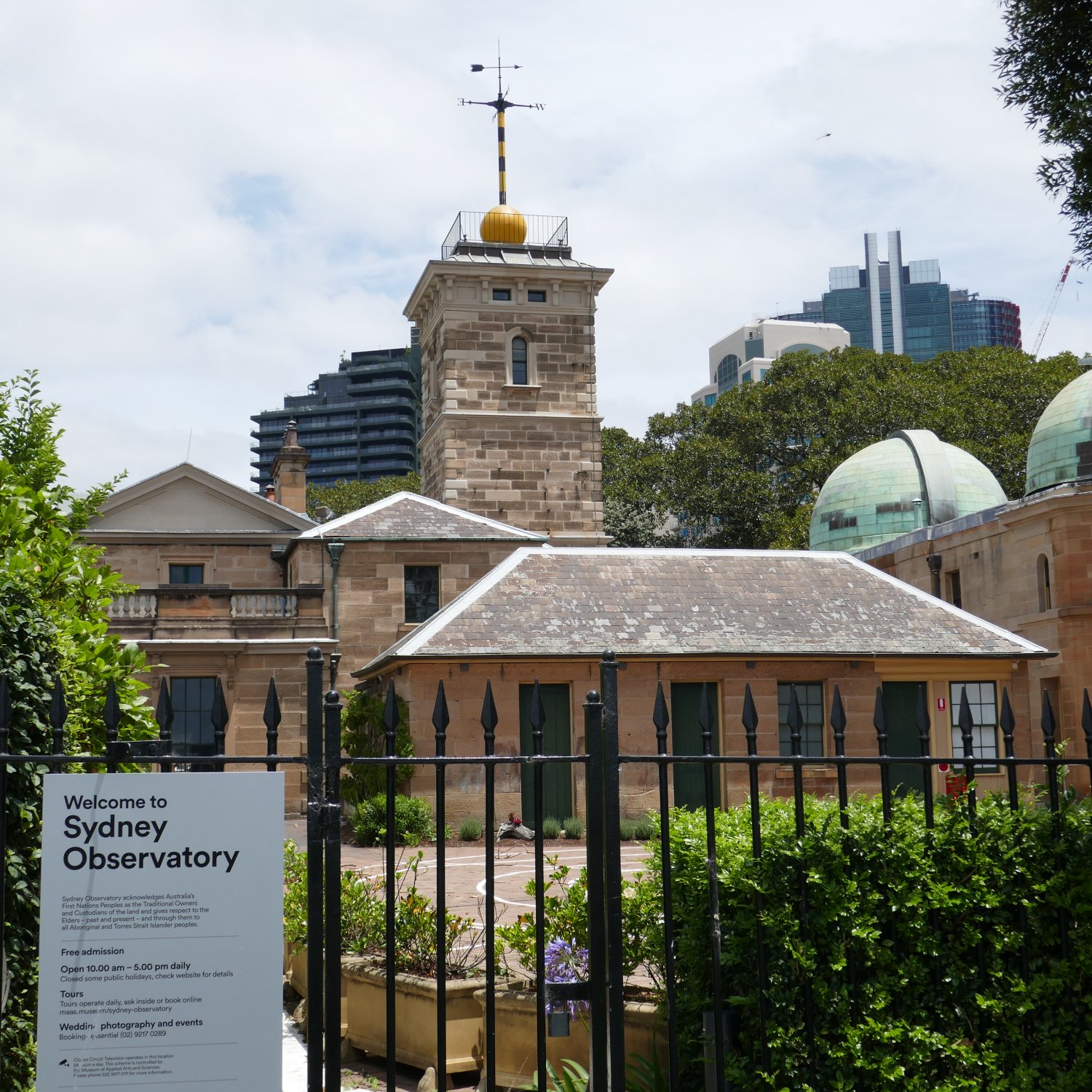
For many thousands of years (perhaps 65,000), the First Nations peoples of Australia have used the night sky as a map, calendar, and guide for safe travel. Sydney’s first observatory was sited at Dawes Point, in 1788; in the early colonial days, Observatory Hill was occupied by a windmill, and later by a fort; the Observatory was opened in 1858, and remained in use until 1982, when it became a Museum, under the Powerhouse Museums
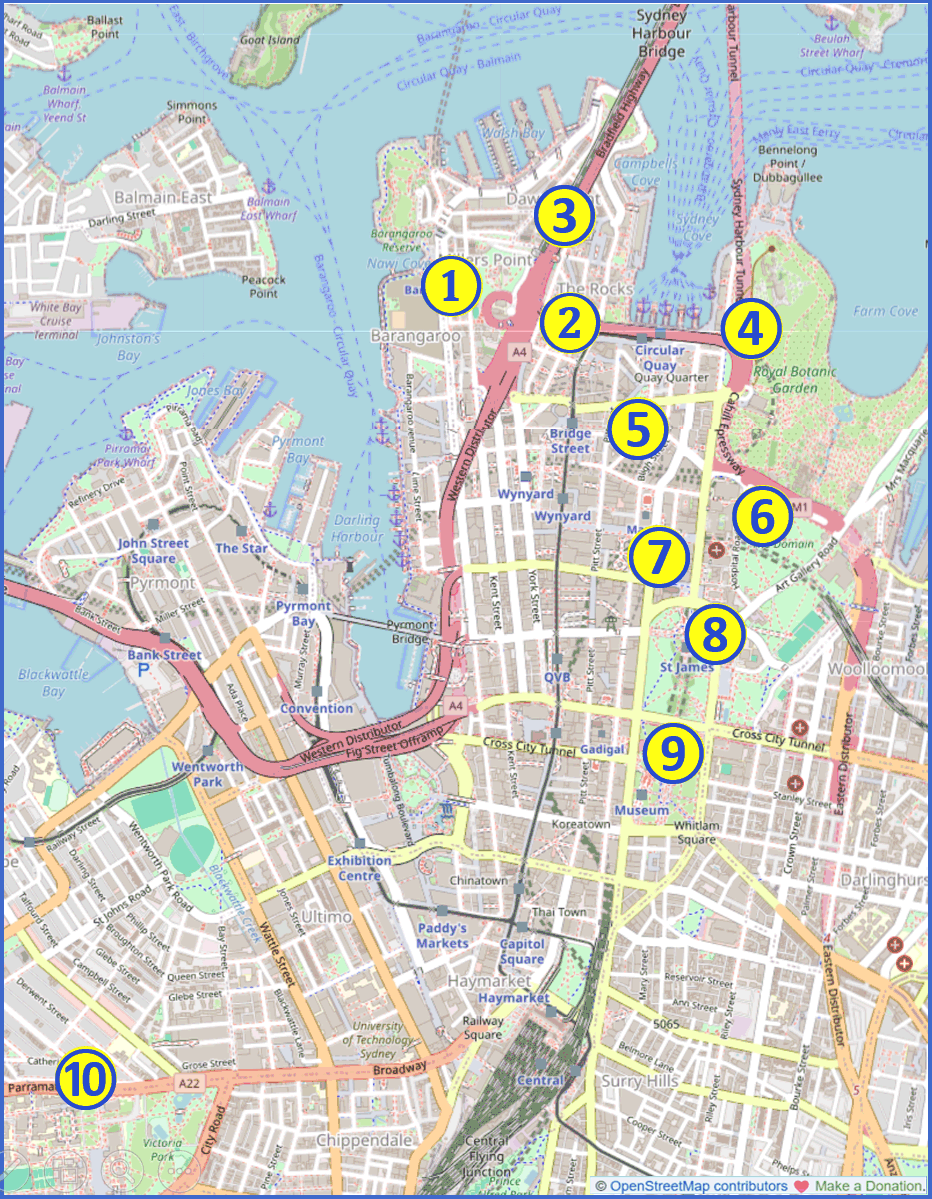
Showing the relative locations of Free museums in Sydney (numbered in the order from above):
1. Sydney Observatory
2. Susannah Place corner shop
3. The Rocks Discovery Museum
4. Justice & Police Museum
5. Museum of Sydney
6. Lucy Osburn-Nightingale Museum
7. The Mint
8. Hyde Park Barracks
9. Australian Museum
10. Chau Chak Wing Museum
Powerhouse Museums (also known as the Museum of Applied Arts and Sciences or MAAS) may appear in search results for Free museums:
- Powerhouse Museum Ultimo (under refurbishment – reopens late 2025 ±3 years);
- Powerhouse Parramatta (opening Spring 2026)
Public Libraries
Within Sydney’s CBD, public libraries include:
- The State Library of NSW (corner Shakespeare Place/Macquarie Street)
- Customs House Library – City of Sydney (Circular Quay)
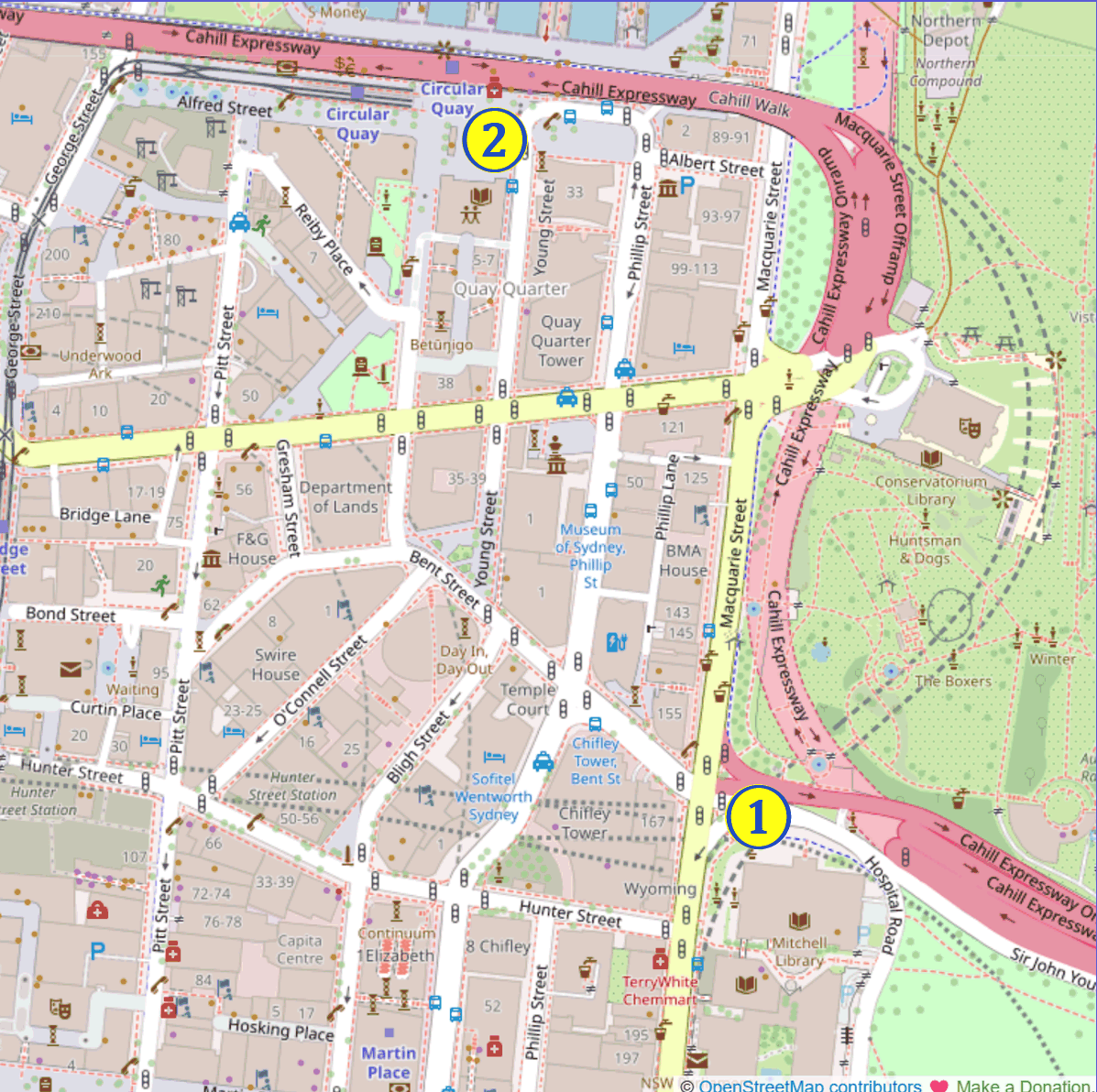
Showing the relative locations of Public Libraries within Sydney’s CBD:
1. State Library of NSW
2. Customs House Library – City of Sydney
Nature, Outdoors, Recreation
Parks, gardens, reserves, beaches, and walking/biking trails suitable for various types of outdoor activities bathing [Note: the cross-over between recreation and leisure lies around the amount of ‘activity’ involved].
Even during the winter months, Sydney offers a range of outdoor activities – provided the weather is not extreme.
In this section we cover:
- Whale Watching
- Coastal Walking
- Harbour Foreshore Walks
Whale Watching
The winter months are also prime time for whale watching.
In Sydney, whale watching runs from mid-May to November, with the peak migrations occurring in June-July (northwards) and again in August-September (southwards, with calves).
During the Whale Watching Season, information about sightings is regularly shown at:
https://www.whalewatchingsydney.com.au/whale-sightings/
Prime spots for whale watching along the Sydney coastline are:
- North Head, 3½ km from Manly ferry wharf
- South Head, 1½ km from Watsons Bay ferry wharf
- The Gap, ½ km from Watsons Bay ferry wharf
- Ben Buckler Point, ½ km from North Bondi bus terminal
- Bondi-Coogee coastal walkway, serviced by buses at each end
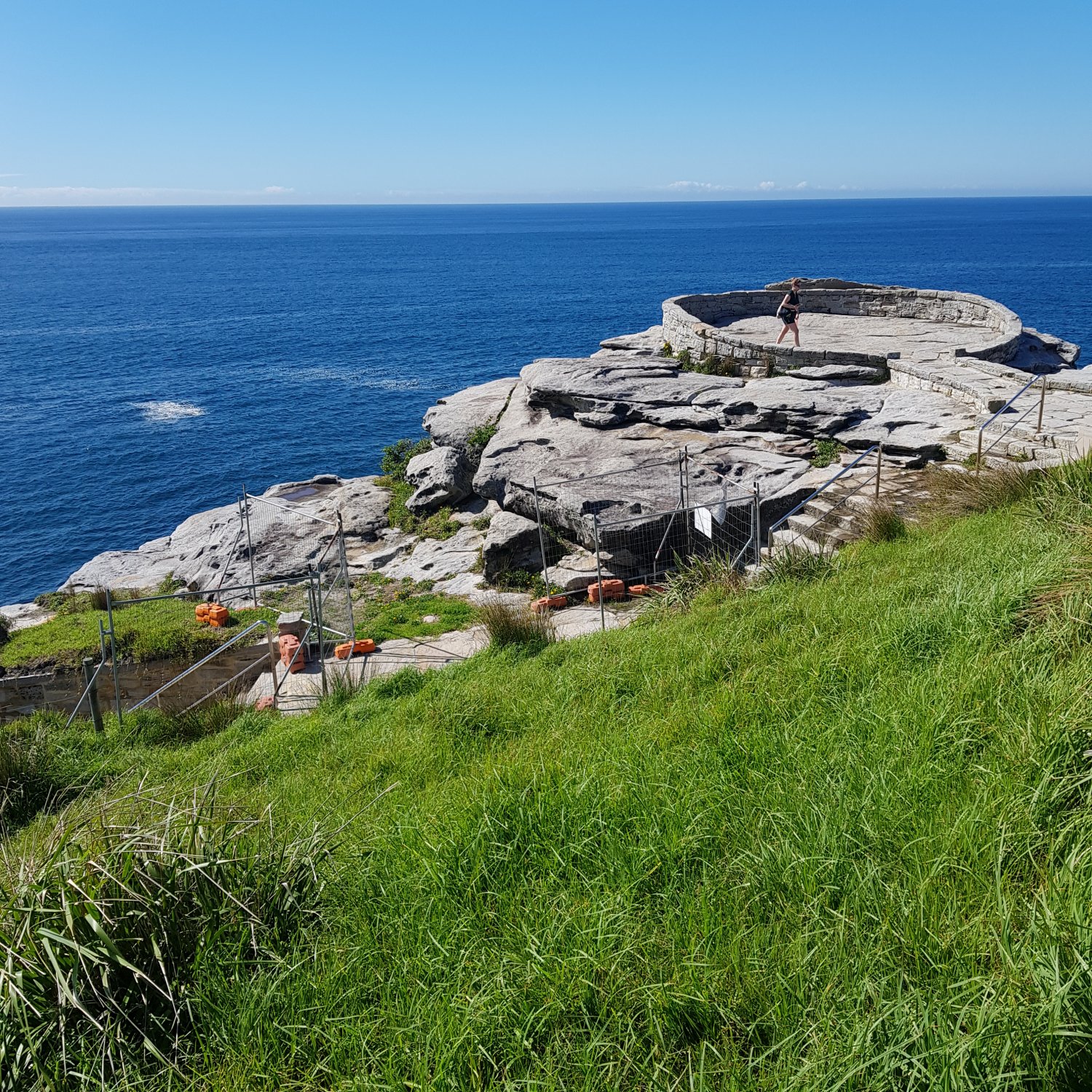
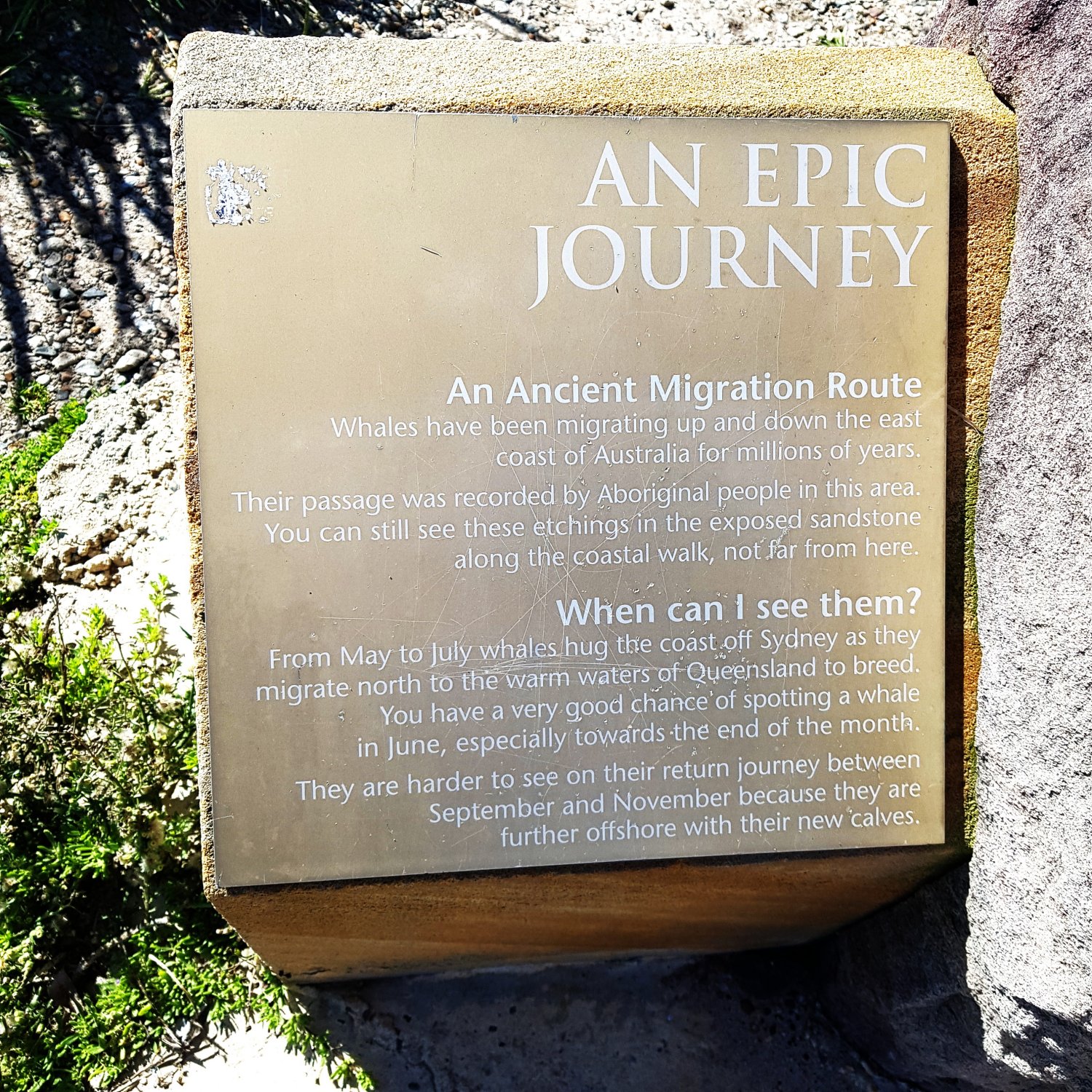
A choice spot for Whale Watching is the old coastal gun site, at Mackenzie’s Point near Tamarama (top image shows the walkway under repair during 2025); about 75 metres further along the trail is a rock engraving, most probably a whale, and thought to be around 2000 years old; there are also similar engravings at North Bondi.
The nearby Marks Park was made a Military Reserve in 1885, which was when there was a “Russian Scare” across Australia, with fears of Russian navy ships arriving unannounced into Australian ports
Note :
Whale watching can often be combined with a coastal walk
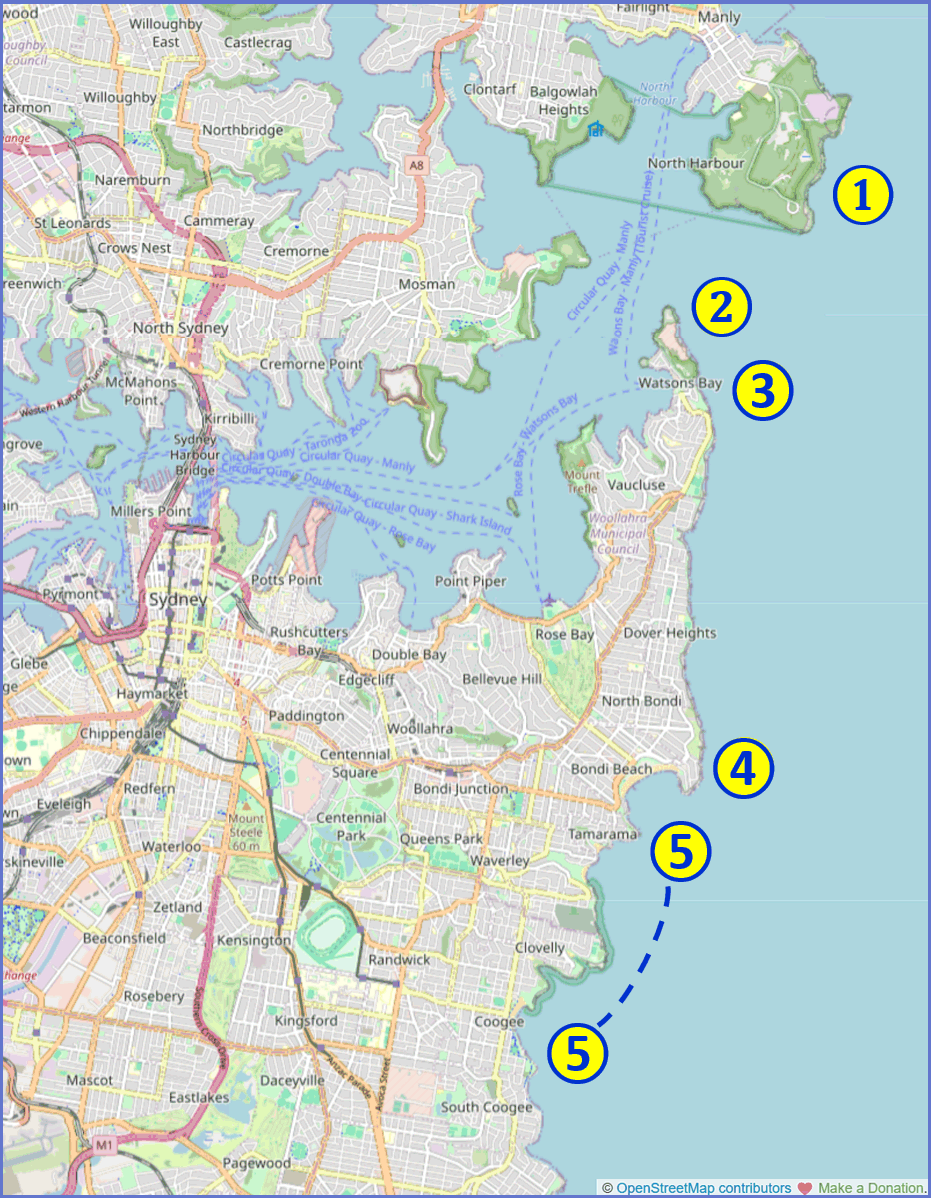
Showing the relative locations of whale watching spots along the Sydney coastline:
1. North Head
2. South Head
3. The Gap
4. Ben Buckler Point
5. Bondi – Coogee coastal walkway
Coastal Walking
Note :
Getting to and from most coastal and harbour walks will involve some form of public transport
- Manly to North Head walk (±10 km) – this is a loop route on the northern side of the entrance to Sydney Harbour; ferry services run between Circular Quay and Manly
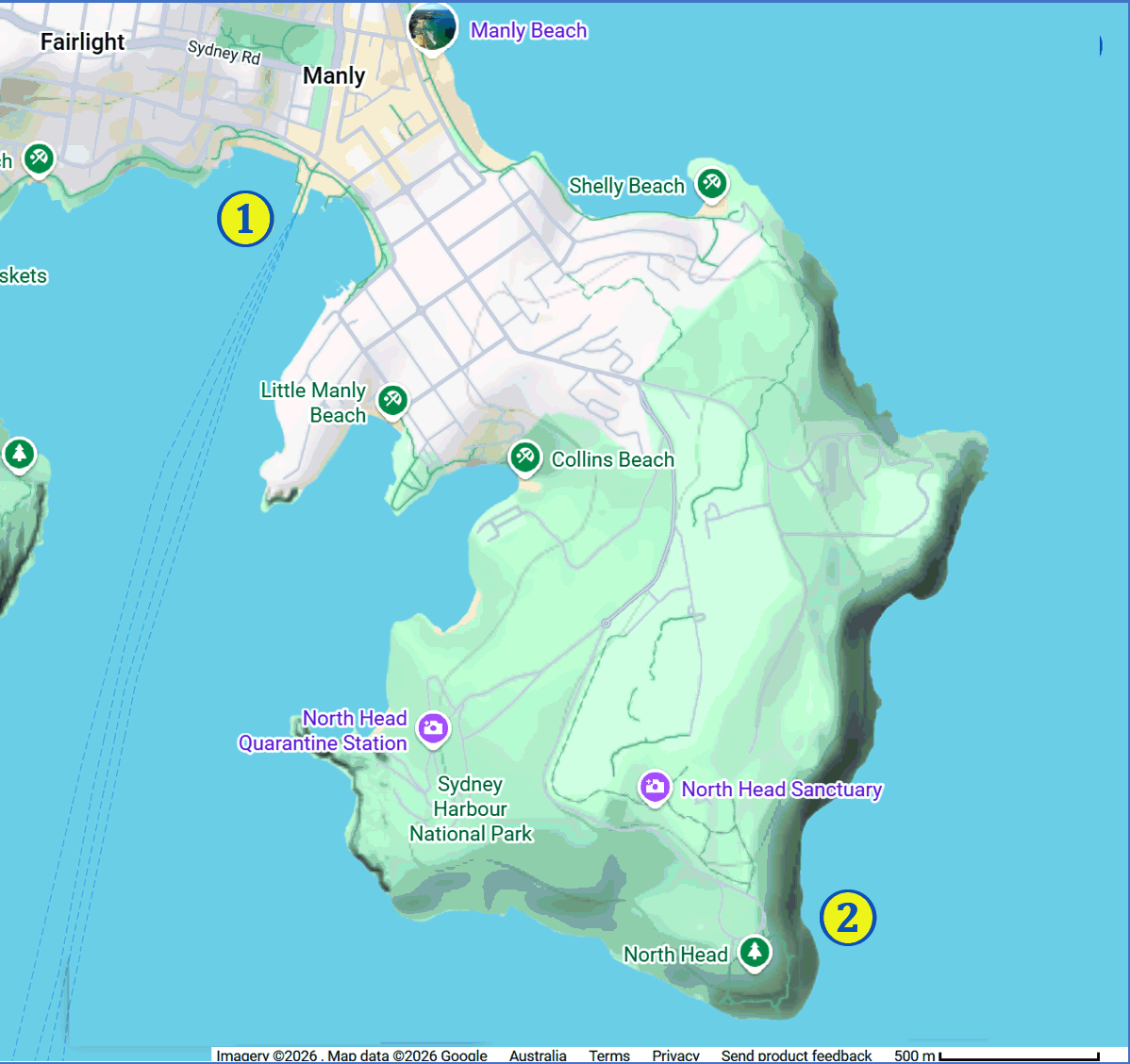
Google map showing the relative locations of ① Manly Wharf and ② North Head – Sydney’s North Head offers a number of walking trails – find map details at
The Walking Volunteers page
North Head Circuit
- Watson’s Bay to South Head harbour foreshore walk (±4½ km) – the route follows the foreshore from Watson’s Bay to Camp Cove, to Lady Bay, and then to the Hornby Lighthouse (and return), on the southern side of the harbour entrance; ferry services run between Circular Quay and Watsons Bay
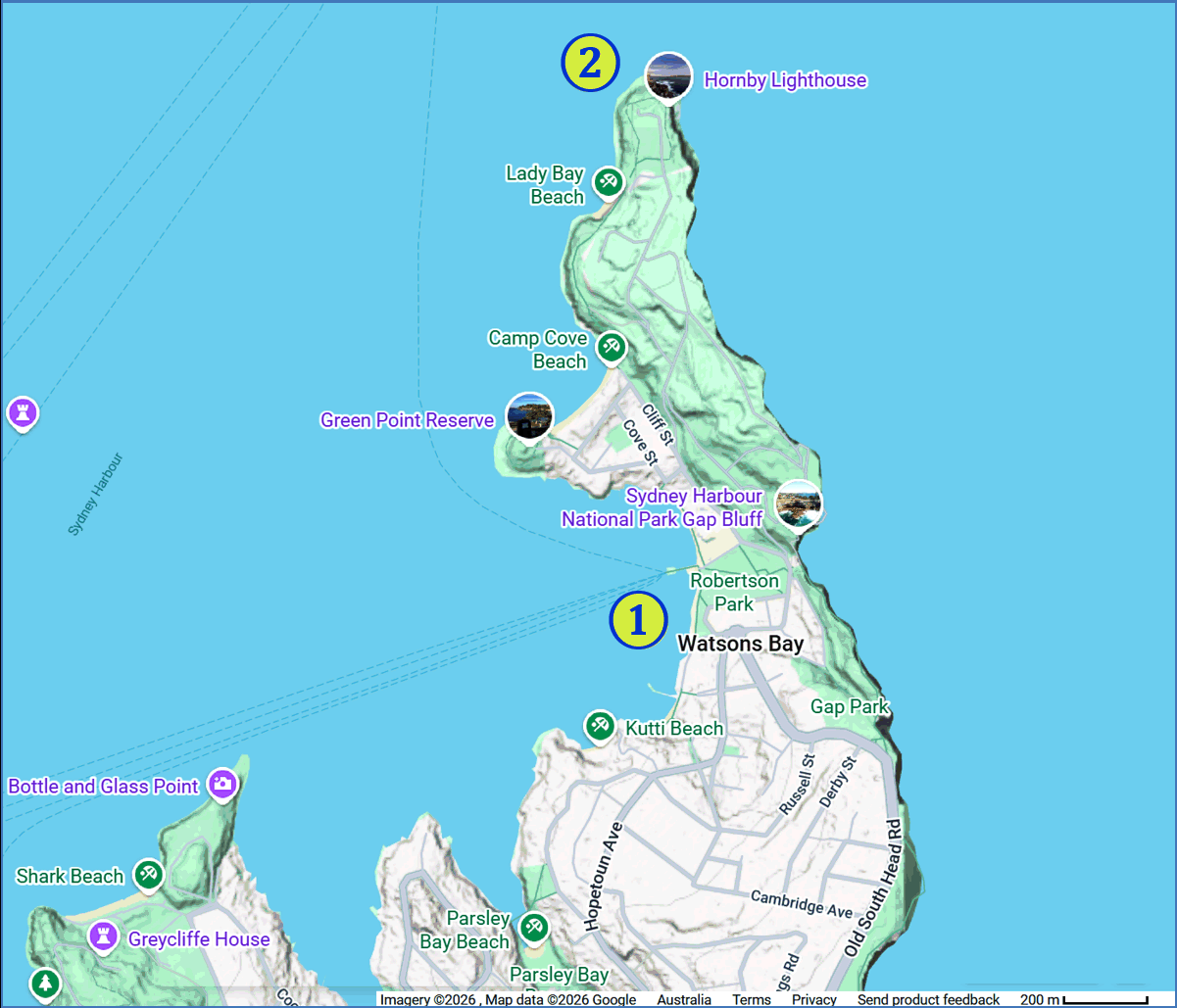
Google map showing the relative locations of ① Watson’s Bay and ② South Head – Sydney’s South Head offers a number of walking trails – find map details at
The Walking Volunteers page
South Head Circuit
- Eastern Suburbs Cliff walk (±9 km) – a coastal trail from Watsons Bay to North Bondi, via The Gap, the Macquarie Lighthouse, Diamond Bay, Dover Heights, Ben Buckler Point; ferry services run between Circular Quay and Watsons Bay; buses run between North Bondi and Circular Quay (via Bondi Junction)
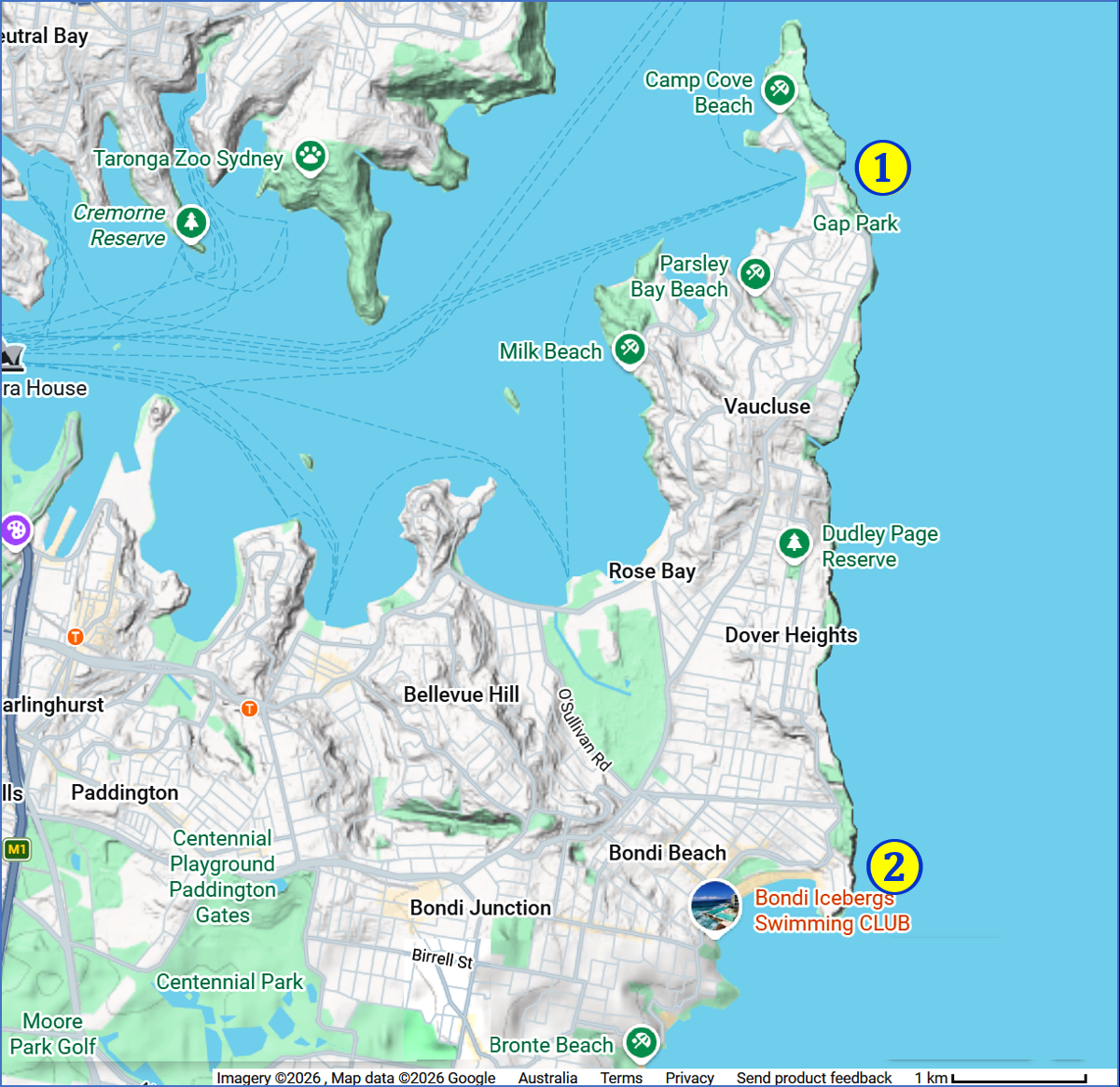
Google map showing the relative locations of ① The Gap (Watson’s Bay) and ② North Bondi – Sydney’s Eastern Suburbs coastline offers a number of walking trails – find map details at
The Walking Volunteers page
Eastern Suburbs Cliff Walk
- Bondi-Coogee coastal walkway (±6 km) – an oceanfront walk with clifftop views, which can be taken in either direction; alternately, the walk can be shortened as Bondi-Bronte (2½ km) or Coogee-Bronte (3½ km); buses from Circular Quay service Bondi and Coogee; for Bronte, make a transfer at Bondi Junction; trains run between Bondi Junction and the Sydney CBD.
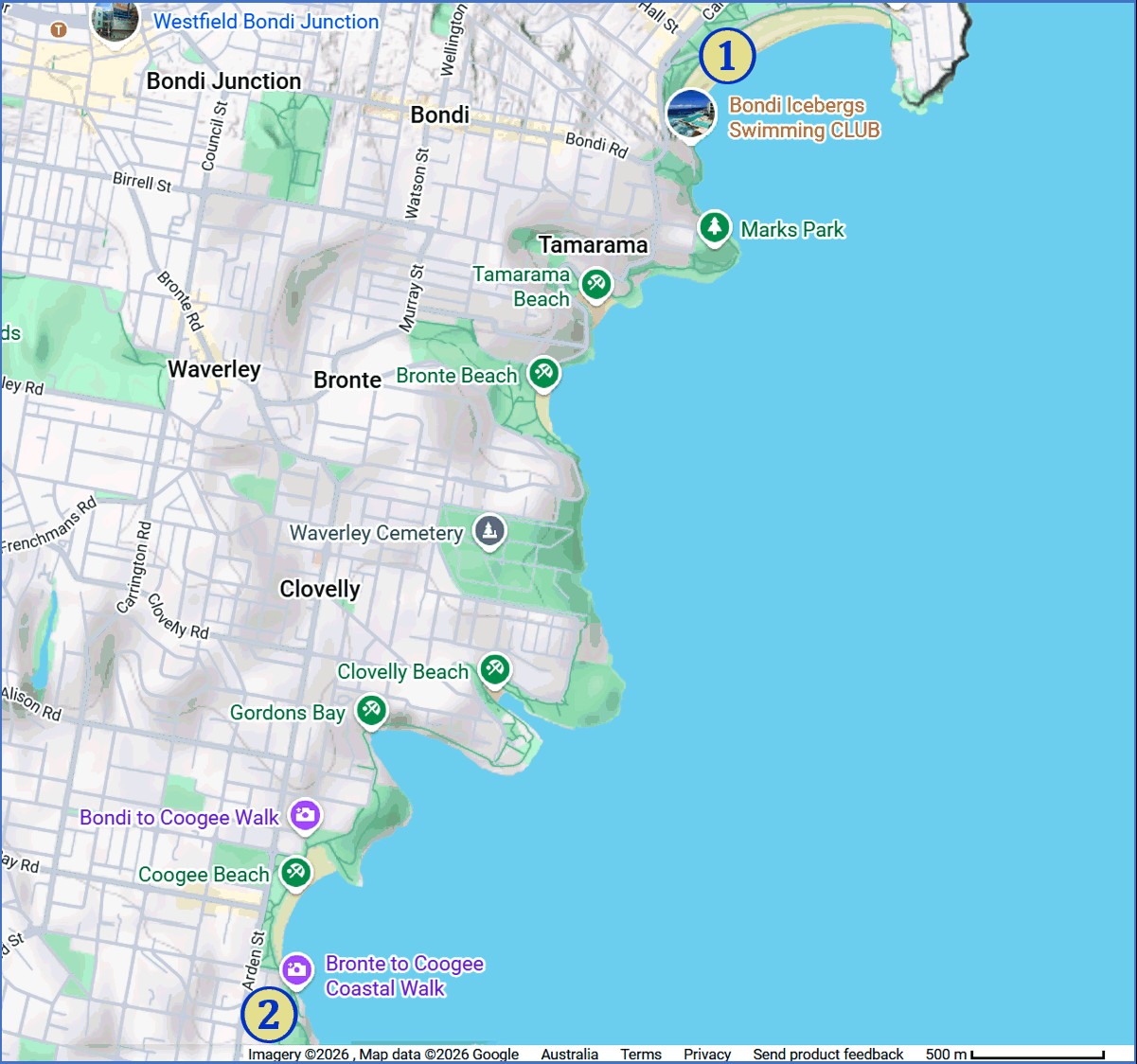
Google map showing the relative locations of ① Bondi Beach and ② Coogee Beach – The Bondi-Coogee coastal walk can be taken in either direction – Find map details at the
Waverly Council page
Bondi to Coogee Coastal Walk
Harbour Foreshore Walks
Popular options for harbour foreshore walks include:
- Spit Bridge to Manly harbour foreshore walk (±10 km) – the walk can be taken in either direction: Spit to Manly, or vice versa; bus services run between Wynyard Station and Spit West Reserve; ferry services run between Manly and Circular Quay
For advice about how to get to (or from) The Spit Bridge Walk using public transport, see my Post:
How to Get to The Spit Bridge Walk (Using Public Transport)
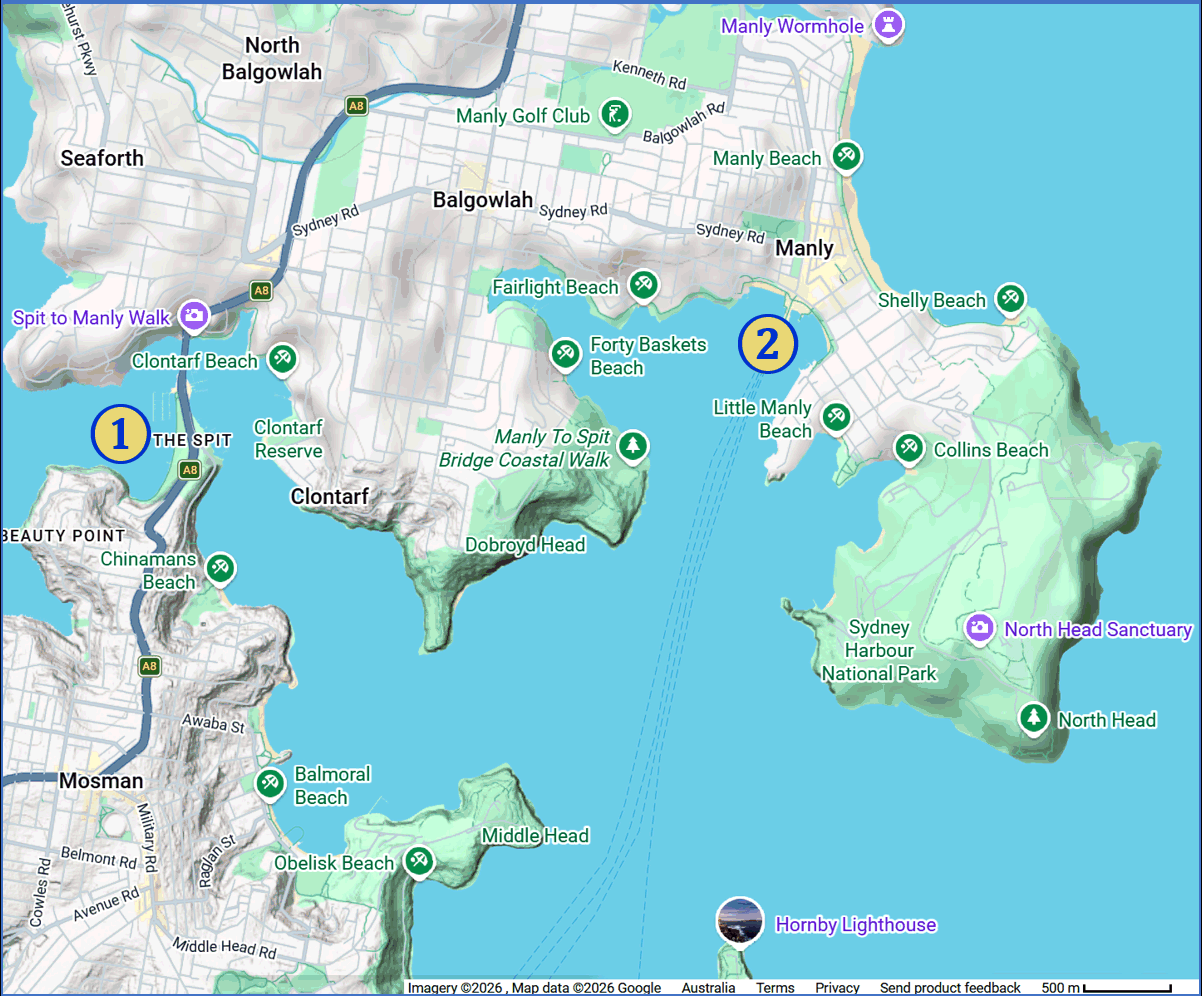
Google map showing the relative locations of ① The Spit and ② Manly Wharf – The Spit to Manly Walk is one of Sydney’s Gems – find map details at
The Walking Volunteers page
Spit to Manly Walk
- Rose Bay to Watson’s Bay harbour foreshore walk (±7½ km) – the route follows the harbour foreshore from the Rose Bay ferry wharf, along Rose Bay, and passing Hermit Point, Milk Beach, Nielsen Park, Shark Beach, Bottle and Glass Point, the Vaucluse War Memorial, Parsley Bay, Kutti Beach, and Gibson’s Beach; this walk can be taken in either direction; ferry services run between Circular Quay and both Rose Bay and Watson’s Bay
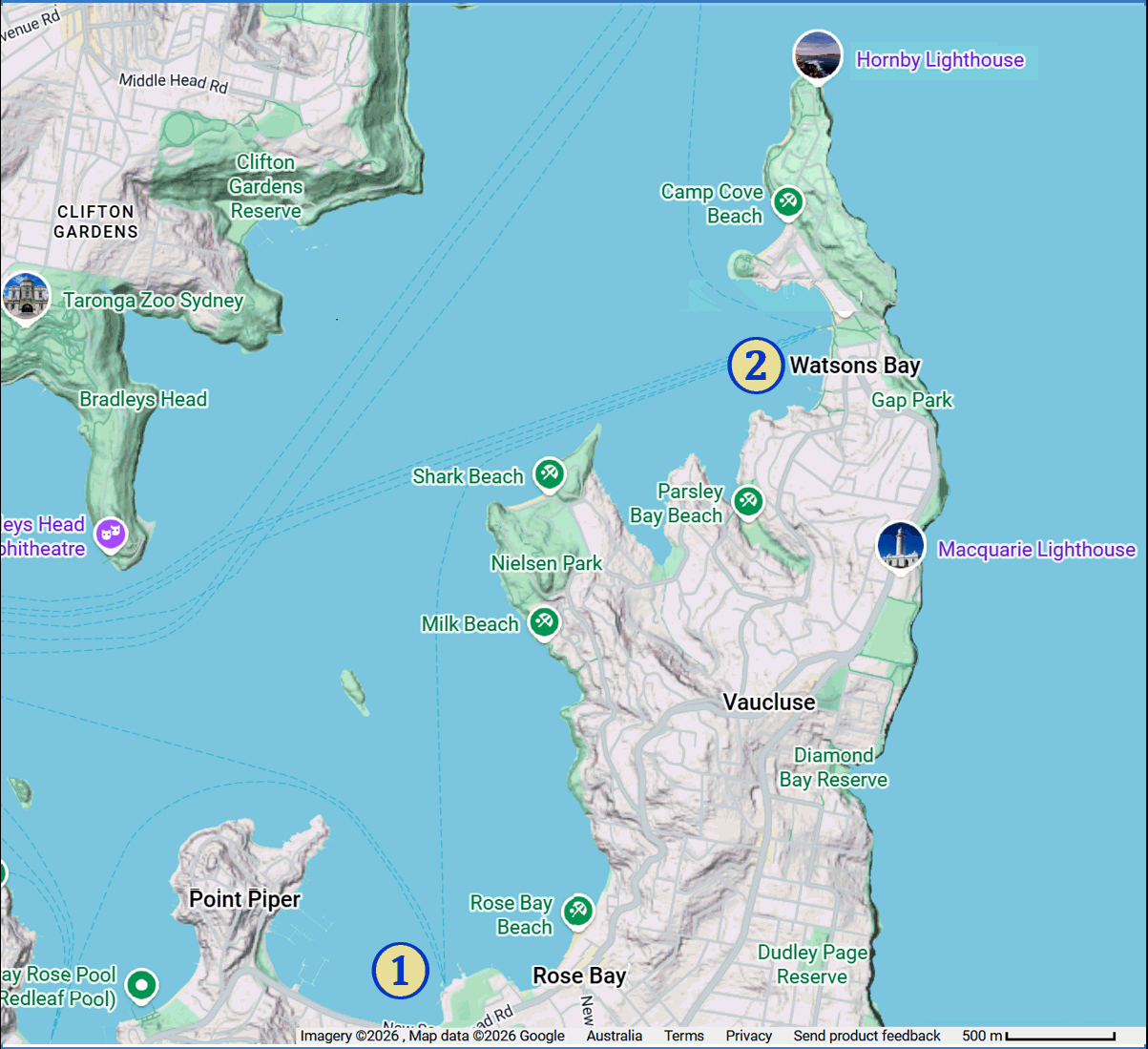
Google map showing the relative locations of ① Rose Bay and ② Watson’s Bay – the walk can be taken in either direction – for map details see
The Walking Volunteers page
Rose Bay to Watsons Bay Walk
- Circular Quay to Mrs Macquarie’s Chair harbour foreshore walk (±2½ km each way – via Sydney Royal Botanic Garden) – follow the shoreline from Circular Quay towards the Opera House at Bennelong Point; enter the Sydney Royal Botanic Garden via the Queen Elizabeth Gate (Gate J, near the Man O’War Steps); follow the shoreline pathway around Farm Cove, exit the Garden via the Yurong Gate (Gate K); continue along the shoreline pathway past the Fleet Steps; go past the sandstone Rock Shelter to the steps on the right; the nearby pathway up the slope leads to Mrs Macquarie’s Chair; return via the same route, or detour once inside the Garden.
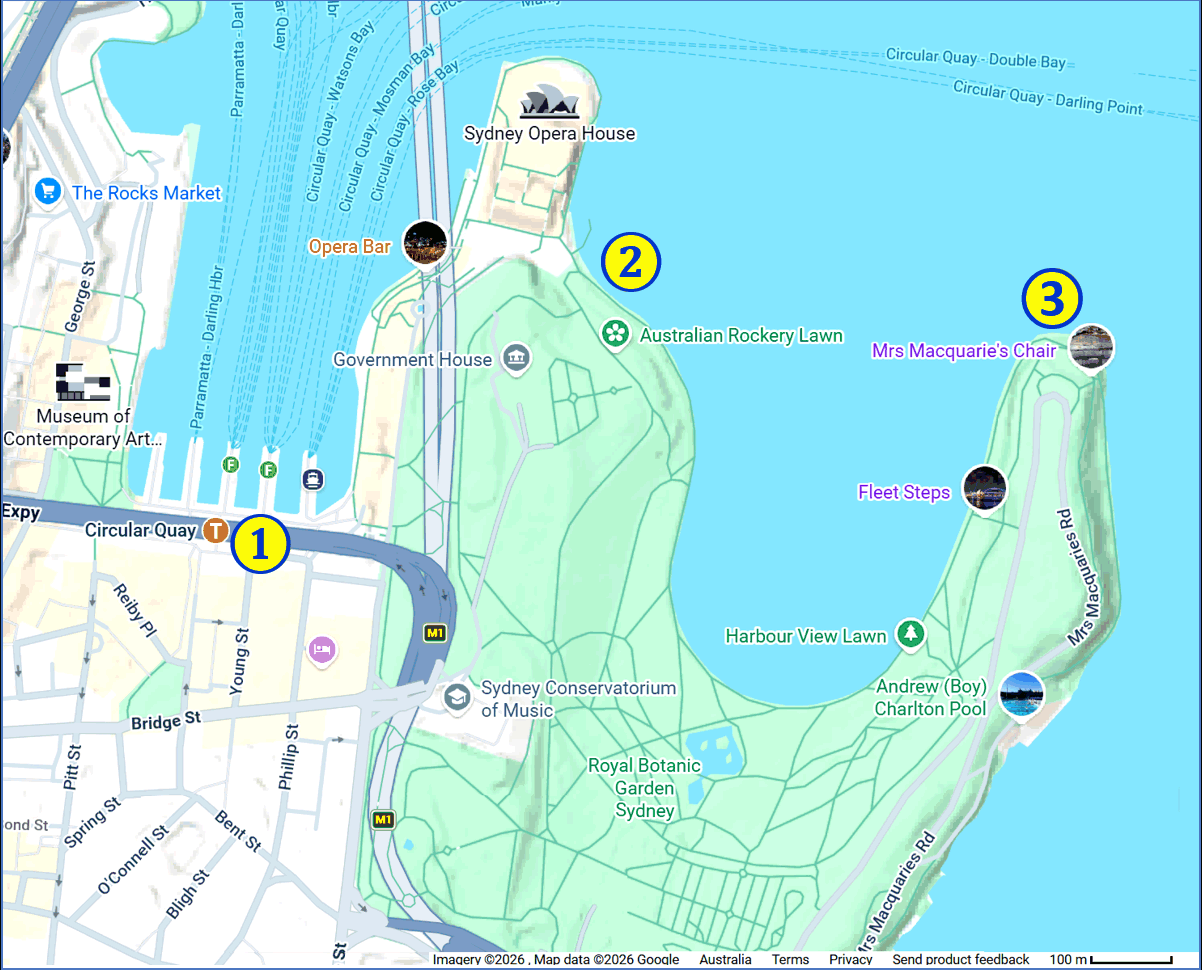
Google map showing the relative locations of ① Circular Quay, ② Sydney Royal Botanic Garden, and ③ Mrs Macquarie’s Point. (Note : during Autumn [March-April] the shoreline pathway may be blocked near the Fleet Steps by Handa Opera on Sydney Harbour)
- Circular Quay to Barangaroo Ferry harbour foreshore walk (±3½ km, via Dawes Point, Barangaroo Reserve) – follow the shoreline from Circular Quay towards Dawes Point (via Campbells Cove); continue past the Finger Wharves along Hickson Road towards Barangaroo Reserve; the trail follows around the Reserve to Nawi Cove, before running along the side of Darling Harbour to the Ferry wharf
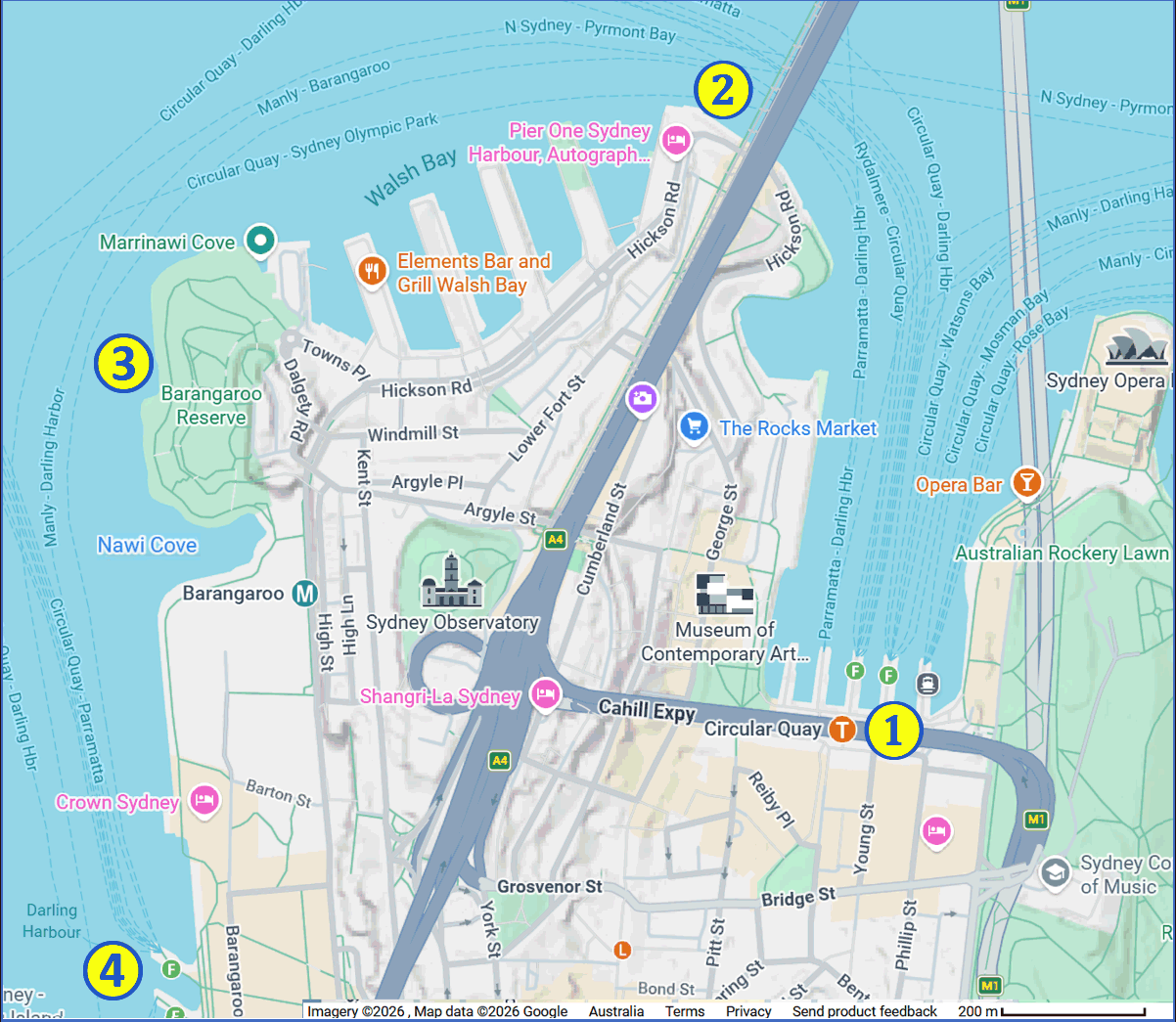
Google map showing the relative locations of ① Circular Quay, ② Dawe’s Point, ③ Barangaroo Reserve, and the ④ Barangaroo Ferry wharf
Shopping & Leisure
Retail therapy in all of its forms, wellbeing, health and beauty sessions, plus free-time interests, e.g. sun-bathing.
In this section we cover:
- Shop 'til You Drop
- Sydney Markets
- Bathing at Sydney’s Beaches & Pools
Shop 'til You Drop
Retail therapy opportunities include:
- Queen Victoria Building (QVB) – originally built to replace the Governor Macquarie-era Sydney Markets, this five-level Victorian-era shopping centre offers high-end boutiques, designer brands, unique specialty stores, and diverse dining options. Opened in 1898, it occupies an entire block of George Street, next to the Sydney Town Hall, with an underground connection to the Town Hall train station, and a light-rail (tram) stop outside.
- Westfield Sydney – this large, upmarket shopping centre straddles the Pitt Street Mall, with around 250 stores offering luxury fashion, homegrown Australian brands, and some of Sydney’s finest food. Airbridges at Level 1 span Pitt and Elizabeth Streets, the latter giving access to David Jones. Street access is from George, Pitt, Castlereagh, and Market Streets. The Sydney Tower Eye stands aloft above Westfield Sydney.
- Boutique shopping: Strand Arcade, Dymocks Building
The Strand Arcade is described as Sydney’s last surviving Victorian-era shopping arcade in its original form. Completed in 1892, across its six levels the Strand Arcade offers a range of speciality shops, including fashion, beauty, lifestyle and dining. Access to the arcade is from Pitt and George Streets.
The Dymocks Building, also known as The Block, was built in the late 1920s to house specialty businesses offering a range of unusual services. After being used for government offices during World War 2, The Block was not returned to its original speciality purpose until the 1980s. Today it houses over 120 specialty boutiques and offices across its 10 levels. Access is via the foyer on the right side of the Dymocks bookstore, at 428 George Street.
- Westfield Bondi Junction – this is my personal favourite amongst Sydney’s premier shopping centres (in spite of the tragic 2024 stabbing attack). Perhaps it is its proximity to Bondi Beach, and also the nearby public transport hubs (bus, train). Westfield Bondi Junction offers top-end luxury brands, along with retail chains, cafes, dining and major supermarkets.
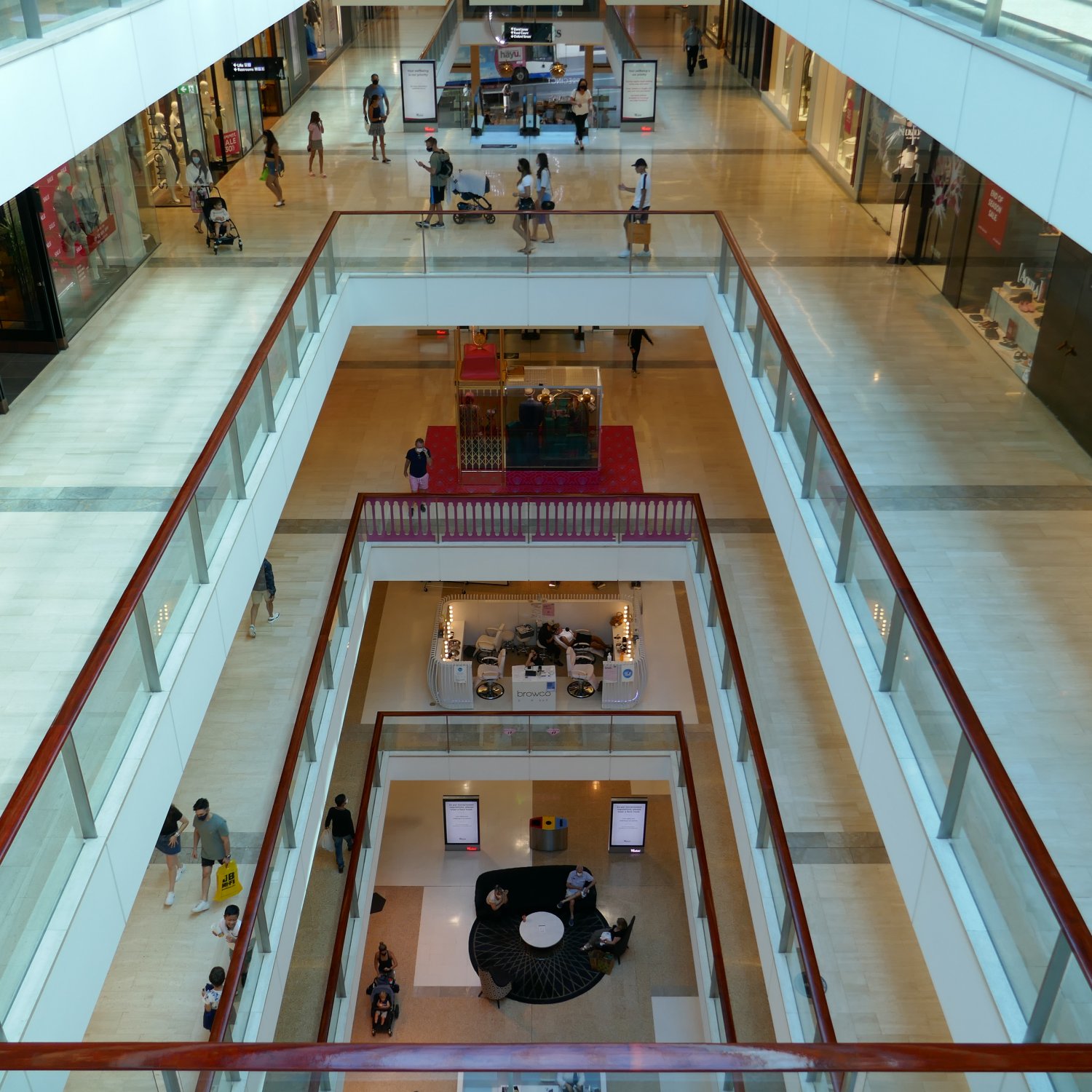
Westfield Bondi Junction – Bondi Junction came about after soldiers built the road to South Head, now called Oxford Street, in 1811. After trams started running to Bondi Beach in 1884, a tram stop at what was called the Tea Gardens was renamed Bondi Junction
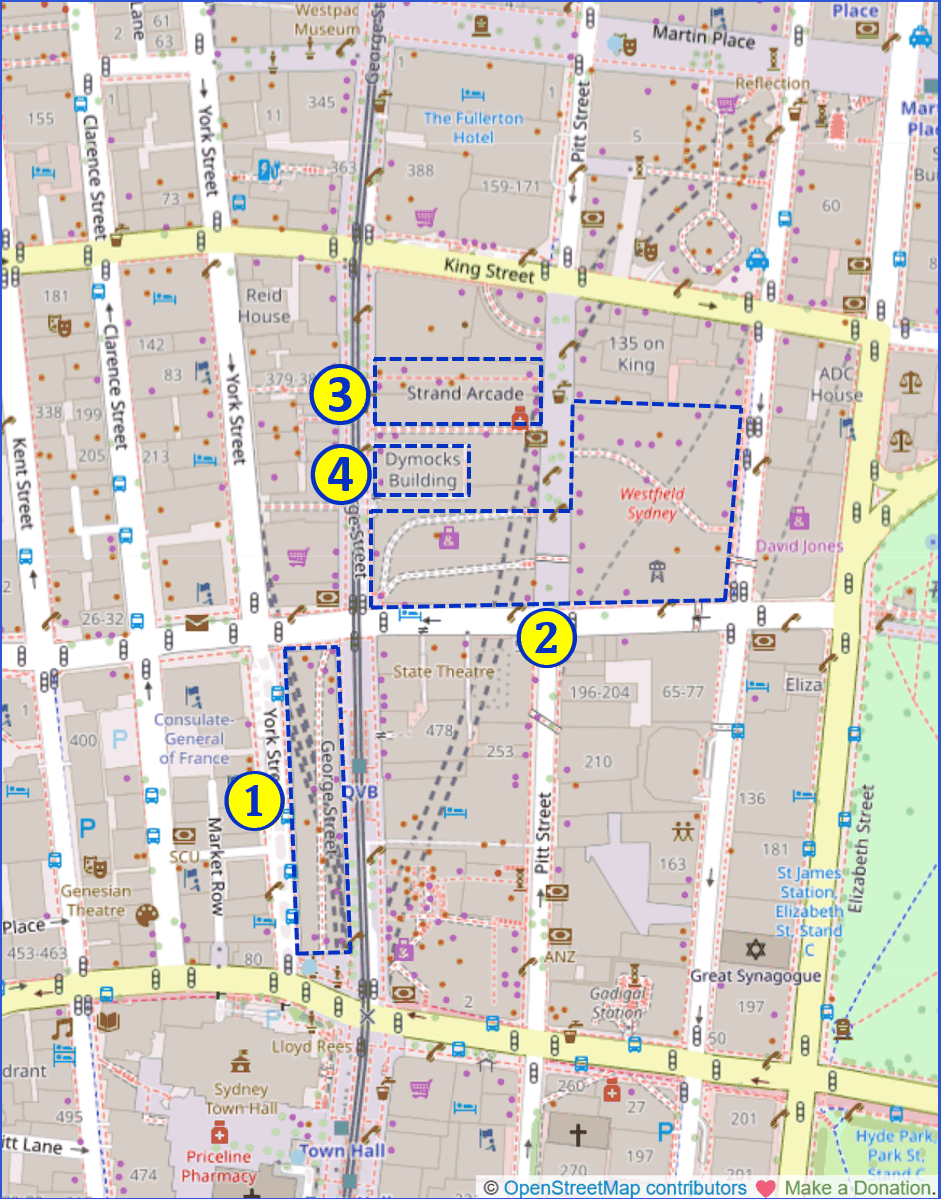
Showing the relative locations of CBD retail therapy sites:
1. QVB – Queen Victoria Building
2. Westfield Sydney
3. Strand Arcade
4. Dymocks Building
Sydney Markets
Popular markets in Sydney include:
- Paddy’s Market, Haymarket – The origins of Paddy’s Market can be traced back to the 1830s, when a separate market area was set up for cattle, hay and grain, in what has become known as Haymarket. Today’s Paddy’s Market was redeveloped and reopened in the 1990s, as Market City. Situated adjacent to Chinatown, Paddy’s Market has a wide variety of stalls, from gifts and gadgets, to clothing and fashion, to fresh produce (fruit, vegetables, meat, fish) and dining (eat in, or out). Paddy’s Markets are closed Mondays and Tuesdays.
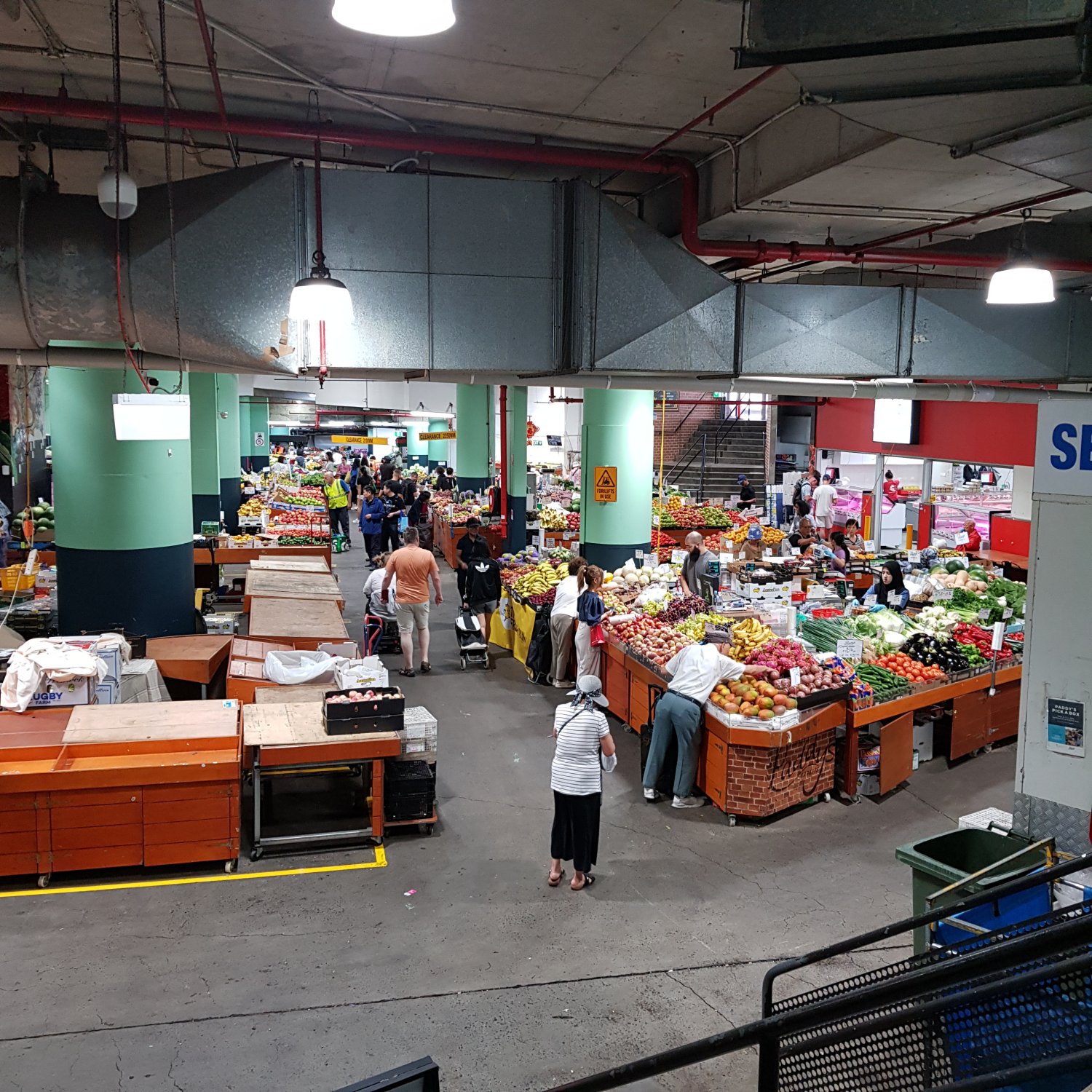
Fruit and vegetables stalls at Paddy’s Market; the original Sydney Marketplace was established in 1806 at Sydney Cove, near today’s First Fleet Park; prior to that an informal market area had grown beside the Hospital Wharf, where traders from Parramatta and Kissing Point sold produce and bartered goods; one of the features of the market place was the public stocks, where settlers and convicts who commited offences were placed for periods time; in 1810, Governor Macquarie moved the market to a new “Market Square” (Market and George Streets – now the site of QVB), where public punishments continued to be a common sight
- Sydney Fish Market – The ‘new’ Sydney Fish Market, at Pyrmont’s Blackwattle Bay, was opened in January 2026. As one of the world’s largest fish markets, the Sydney Fish Market offers the opportunity to treat yourself to some of the freshest seafood delights that can be found anywhere, with opening hours Sun-Thurs: 7am-10pm; Fri & Sat: 7am-12am. The Fish Market can be reached by Light Rail on the L1 Dulwich Hill Line (from Central Station).
- The Rocks Markets – The Rocks Markets are centered around Playfair and George Streets, and are full of life. Visiting The Rocks Markets is not just about shopping; it’s also about listening to artisan stallholder’s stories, enjoying the various wafting aromas, and experiencing the range of new flavours. You may even be lucky, and arrive when a live band is playing, adding to the atmosphere of this local event. The artisan vibe, the wonderful creativity on display, and the general fun of being there, all make for an enjoyable visit.
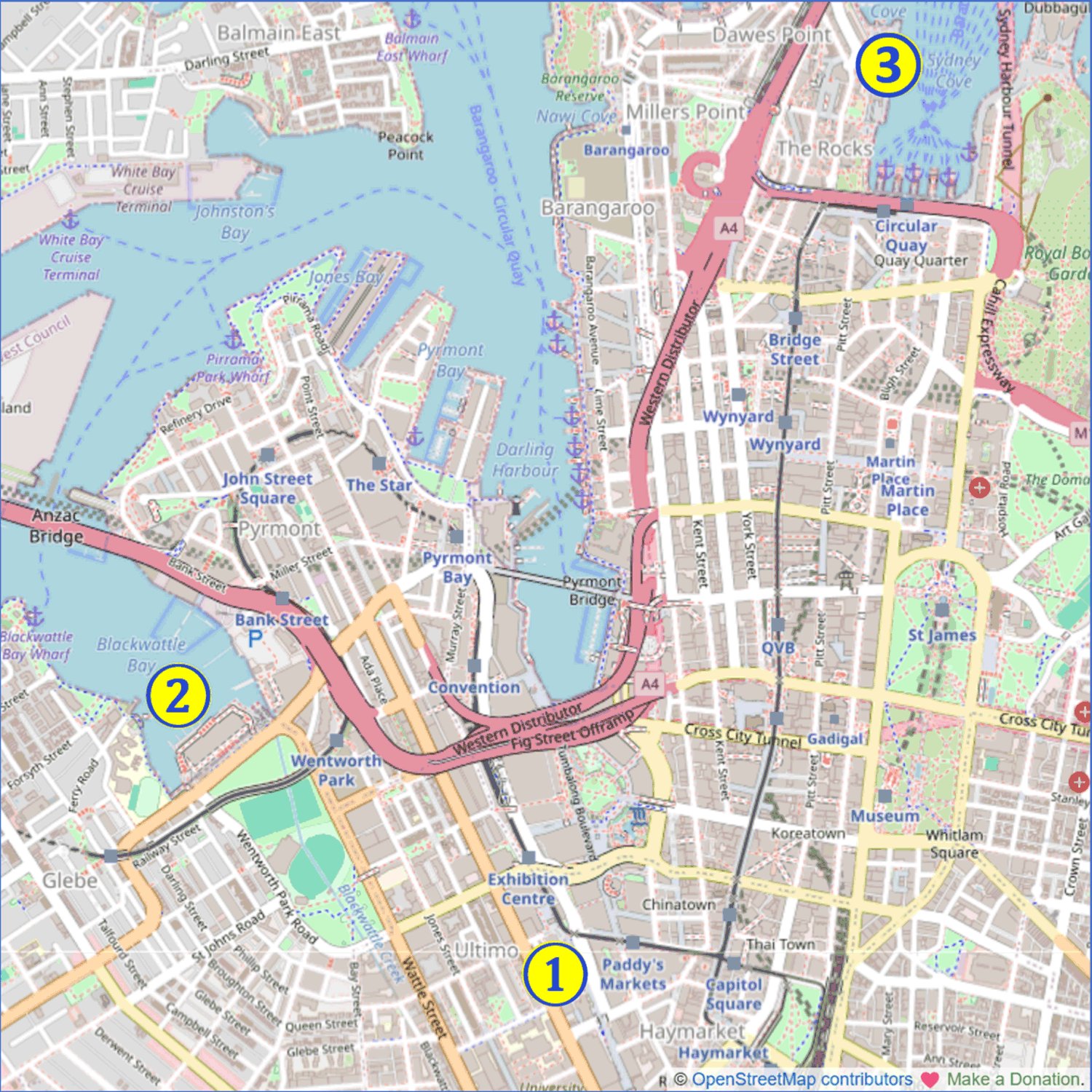
Showing the relative locations of three inner-city markets:
1. Paddy’s Market
2. Sydney Fish Market
3. The Rocks Markets
- Paddington Markets – The Paddington Markets are held from 10:00 am to 4:00 pm every Saturday, in the grounds of the Paddington Uniting Church, which is on Oxford Street. The Markets can be reached by bus from Circular Quay (±20 mins). Known as Sydney’s oldest weekly community markets, Paddington Markets offer over 100 stalls featuring designers, artists, craftspeople, and food. While in Paddington, the nearby Paddington Reservoir Gardens are a 5-minute walk away along Oxford Street towards the CBD.
- Bondi Markets: Bondi Farmers Market and Bondi Market
The Bondi Farmers Market offers everything you would expect at a farmers’ market. Located at the Bondi Beach Public School, the Bondi Farmers Market is just a stone’s throw away from the iconic Bondi Beach (the School is across Campbell Parade from the Bondi Pavilion). Go, and you will find yourself wandering among stalls laden with the freshest fruit and vegetables, the most tantalizing gourmet eats, and other specialty items. Bondi Farmers Market is open Saturdays, from 9am to 1pm, throughout the year.
The Bondi Market, also at the Bondi Beach Public School, is open on a Sunday, from 10am to 4pm. The Bondi Market has a different kind of allure. Whether you are looking for vintage clothing, a piece of speciality jewellery, or a handmade item, then this market is for you! And, of course, there’s also a selection of good market food.
- Other Weekend Markets: Manly Markets, Kings Cross Market, Glebe Markets, Kirribilli Markets
The Manly Markets are held on Saturdays and Sundays at The Corso
The Kings Cross Market is held each Saturday in the Fitzroy Gardens (near the El Alamein Fountain)
The Glebe Markets are held at Derby Place each Saturday
The Kirribilli Markets, at Milsons Point, are held monthly on the first and second Sundays (art, design, fashion), and fourth Saturday (general, fashion)
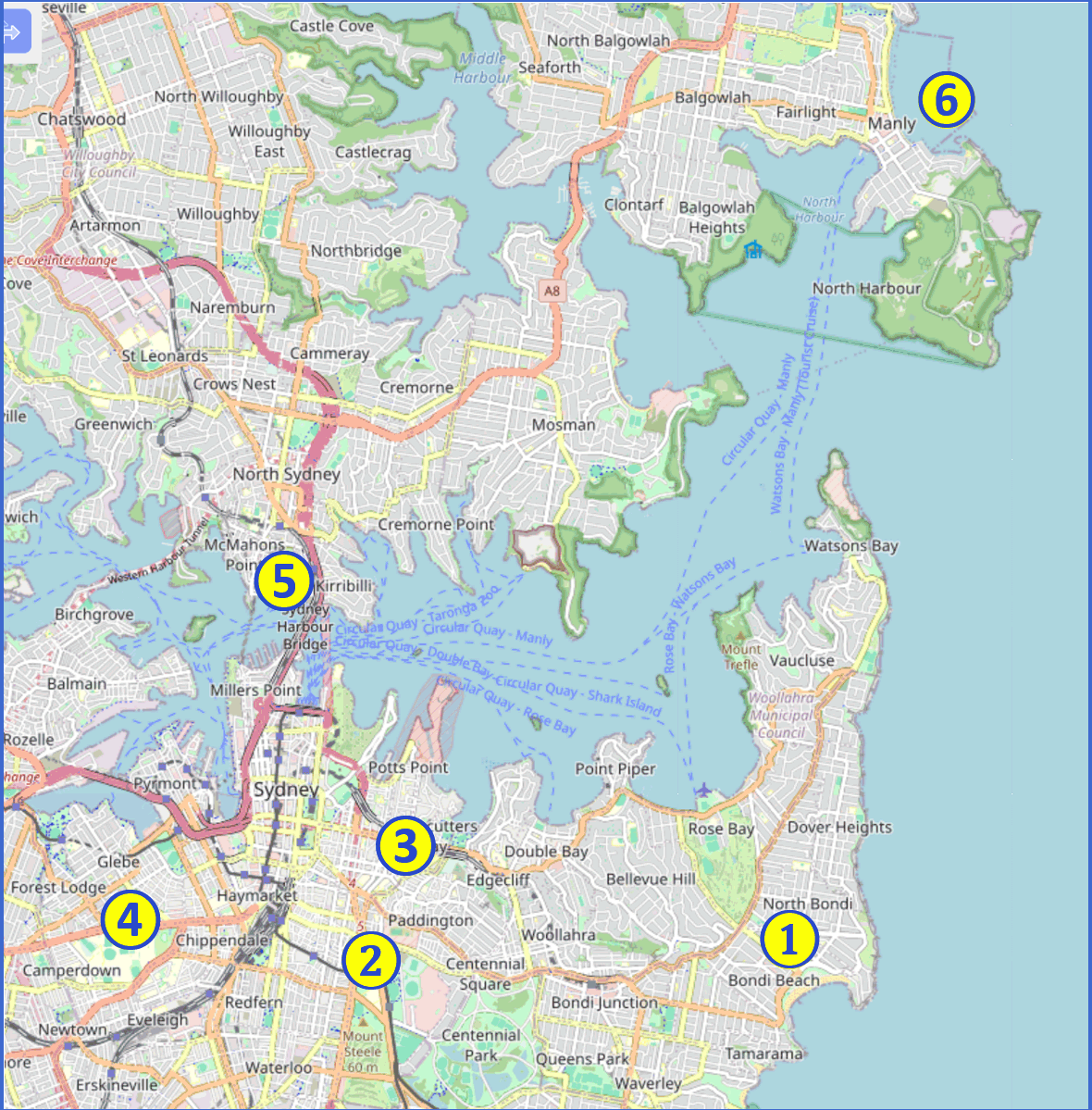
Showing the relative locations of weekend markets:
1. Bondi Markets
2. Paddington Markets
3. Kings Cross Market
4. Glebe Markets
5. Kirribilli Markets
6. Manly Markets
Bathing at Sydney’s Beaches & Pools
Sydney’s popular beaches generally remain open during winter, with council Lifeguards on patrol. Many locals opt to wearing of wetsuits when swimming and surfing during winter.
Amongst Sydney’s ocean pools which offer free entry are the Bronte Baths ocean pool, at Bronte Beach, and the Giles Baths rockpool, at Coogee Beach.
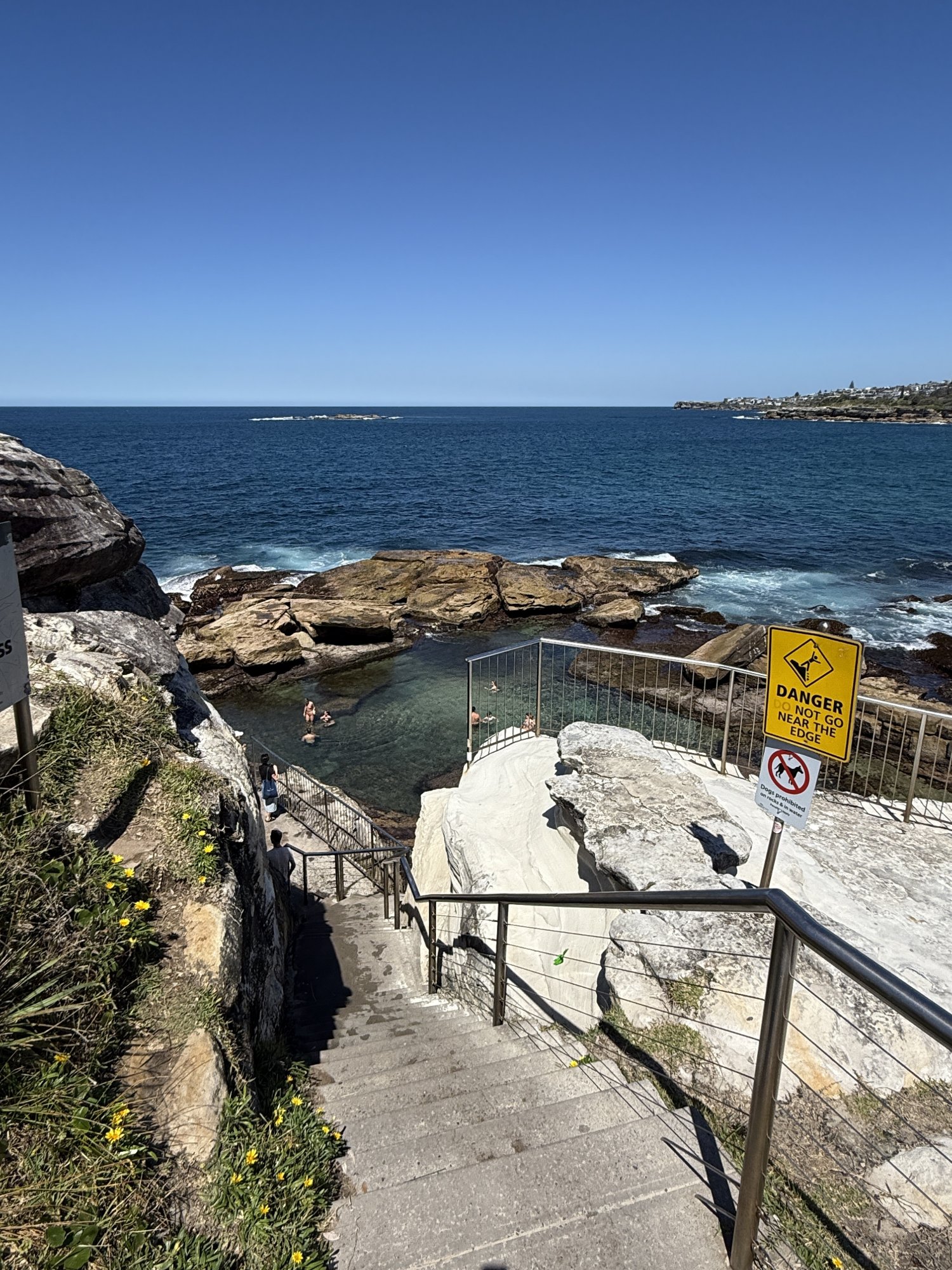
The Giles Baths rockpool, on the north side of Coogee Beach, can be reached from the Coastal Walkway; once a male-only facility, this natural rock pool is also known locally as the ‘Bogey Hole’; entry is via an archway portico that reads ‘Baths’, and once lead to a building that stood above the pool throughout much of the 20th Century: the iconic Giles Gym and Baths; the building was condemned in 1974 due to catastrophic storm damage; nearby is the Bali Memorial, which honours victims of the 2002 Bali Bombing, including 6 members of the Coogee Dolphins rugby league football club
Sports & Events
Organised sports, festivals, exhibitions, and other events.
In this section we cover:
- Winter Sports
- Winter Festivals
Winter Sports
Sydney’s 2026 winter sporting calendar (June–August) is highlighted by rugby union, and domestic winter sports, with key events including the Wallabies v Ireland test match on July 4, 2026, along with regular NRL and AFL competition matches.
The annual City2Surf 14km Fun Run (CBD to Bondi Beach) is set for 9 August 2026.
Winter Festivals
The following festivals are scheduled for Sydney during winter 2026:
Note :
NSW Winter School Holidays :
Monday 6 July – Friday 17 July 2026
- Vivid Sydney Light Festival 2026
(Friday 22 May – Saturday 13 June)
- Sydney Film Festival 2026
(3 – 14 June)
- Darling Harbour Winterfest 2026
(dates yet to be confirmed – usually coincides with school holidays)
- Bondi Winter Festival 2026
[free and ticketed] (3 – 19 July)
- Bastille Festival Sydney 2026
French food, wine, and art extravaganza (16 – 19 July) – at Circular Quay and The Rocks
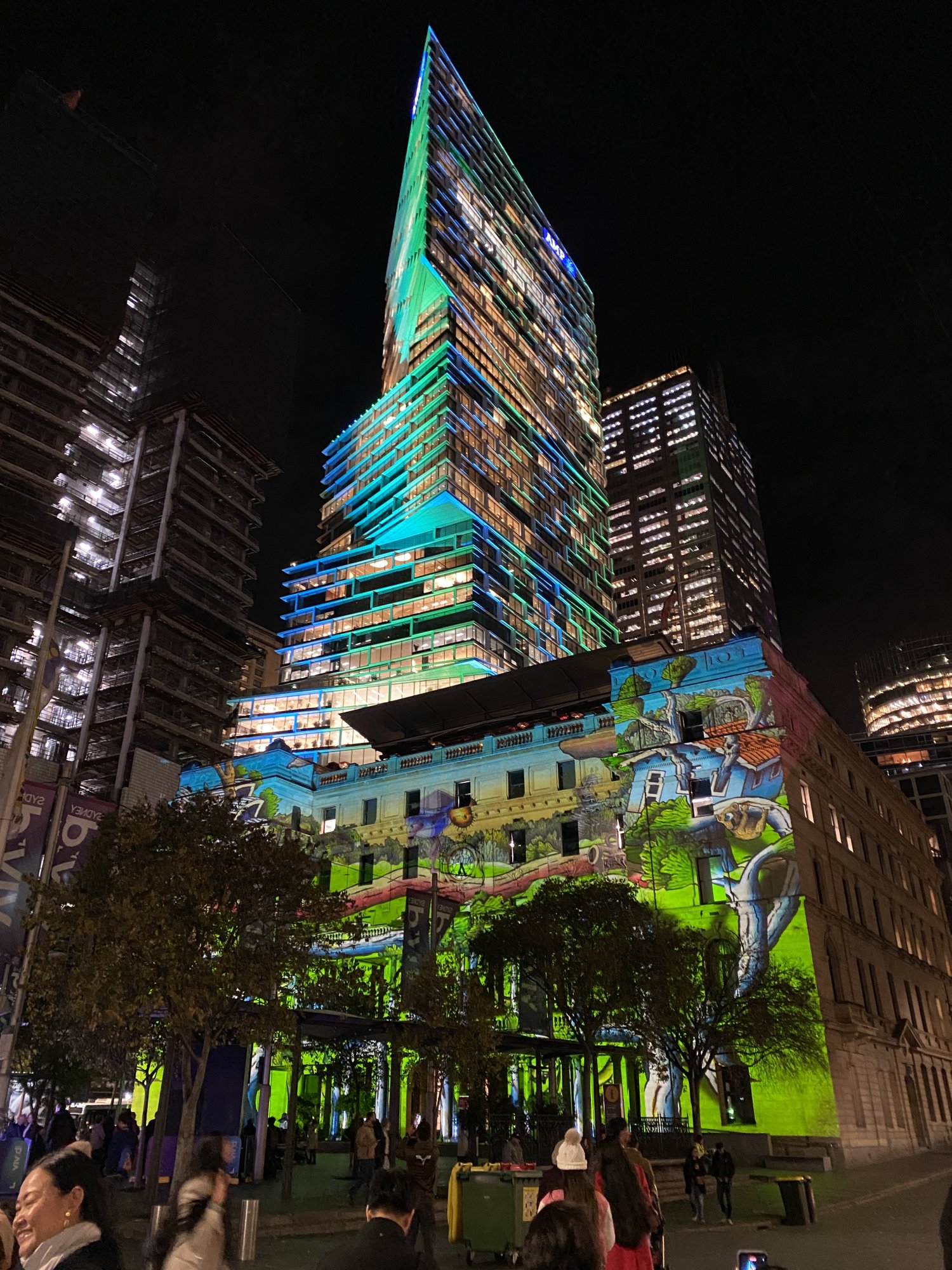
A scene of light projections onto the Customs House and Quay Quarter Tower during the Vivid Light Festival
Weird & Wonderful
Every destination has some things that are unique, the trick is to be able to find them!
I have a complete separate Post about some of Sydney’s Weird and Wonderful attractions:
11 Weird and Wonderfully Unusual Sights in Sydney’s CBD
This includes a Free Tour Guide for your very own Self-Guided Walk, which will visit the following:
1.
Wood Block Street Paving – 1880
2.
Antique Cast-Iron Urinal – 1880s
3.
Sirius Building – 1980, 2024
4.
Tank Stream Fountain – 1981
5.
Quay Quarter Tower – 1976, 2022
6.
Macquarie Place Park – 1810
7.
Underwood Ark – 2017
8.
Australia Square – 1967
9.
Wynyard Station Interloop – 2017
10.
Angel Place Forgotten Songs – 2012
11.
Youngsters of Barrack Street – 2012
12.
Not [Yet] a Coat of Arms – 1874
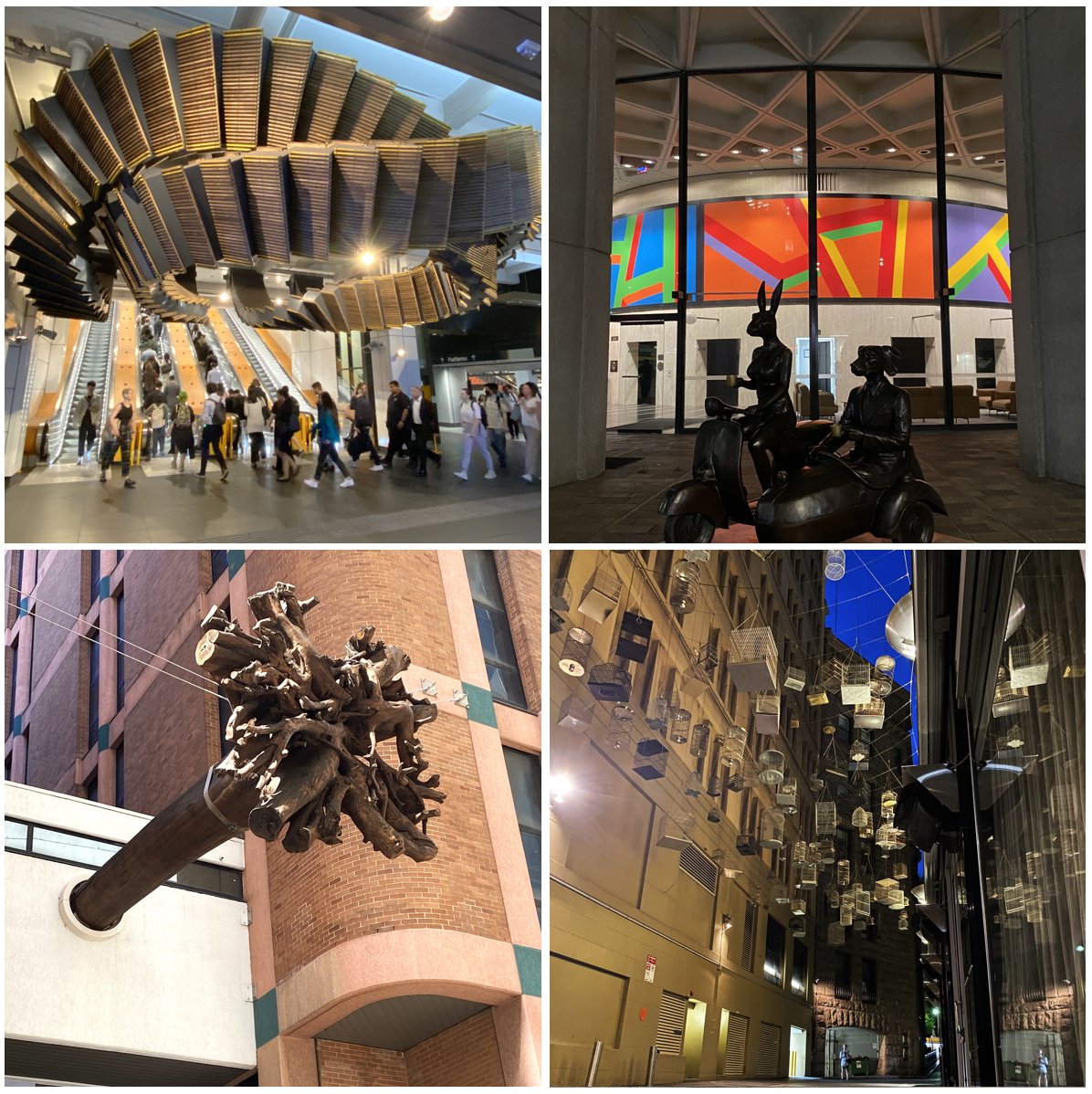
A quick taste of some of the curious attractions to explore on my 11 Weird and Wonderfully Unusual Sights in Sydney’s CBD
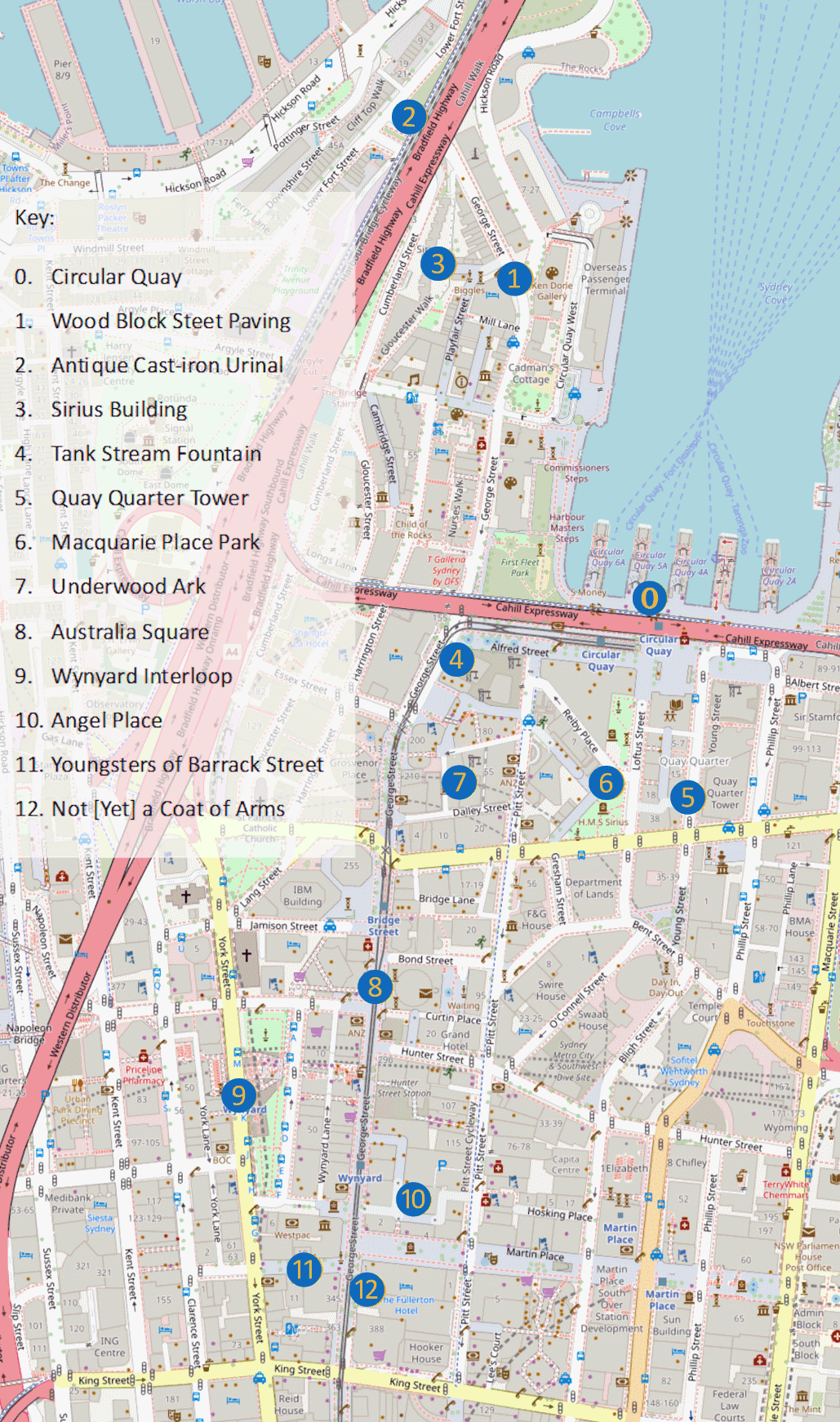
The 11 Weird and Wonderful attractions lie in some of the earliest parts of the colonial settlement, established soon after the First Fleet’s arrival in 1788
Note: ⓬ is a bonus item – some more weirdness
Also available, as a companion to your Free Tour Guide, is My fully curated eBook, "11 Stories of Some Weird and Wonderful Shit in Sydney’s CBD"
You can download this for $10.00 USD
Final Thoughts: Why Winter in Sydney is a Great Time to Visit
Apart from the NSW Winter School Holidays (6-17 July), and the Vivid Sydney Light Festival (22 May – 13 June), Winter is usually Sydney’s quietest season for tourism, making it also the most affordable season.
Sydney’s weather patterns during the Winter season have also been more predictable than for either Spring or Autumn, with August known to be the month with the least number of rainy days.
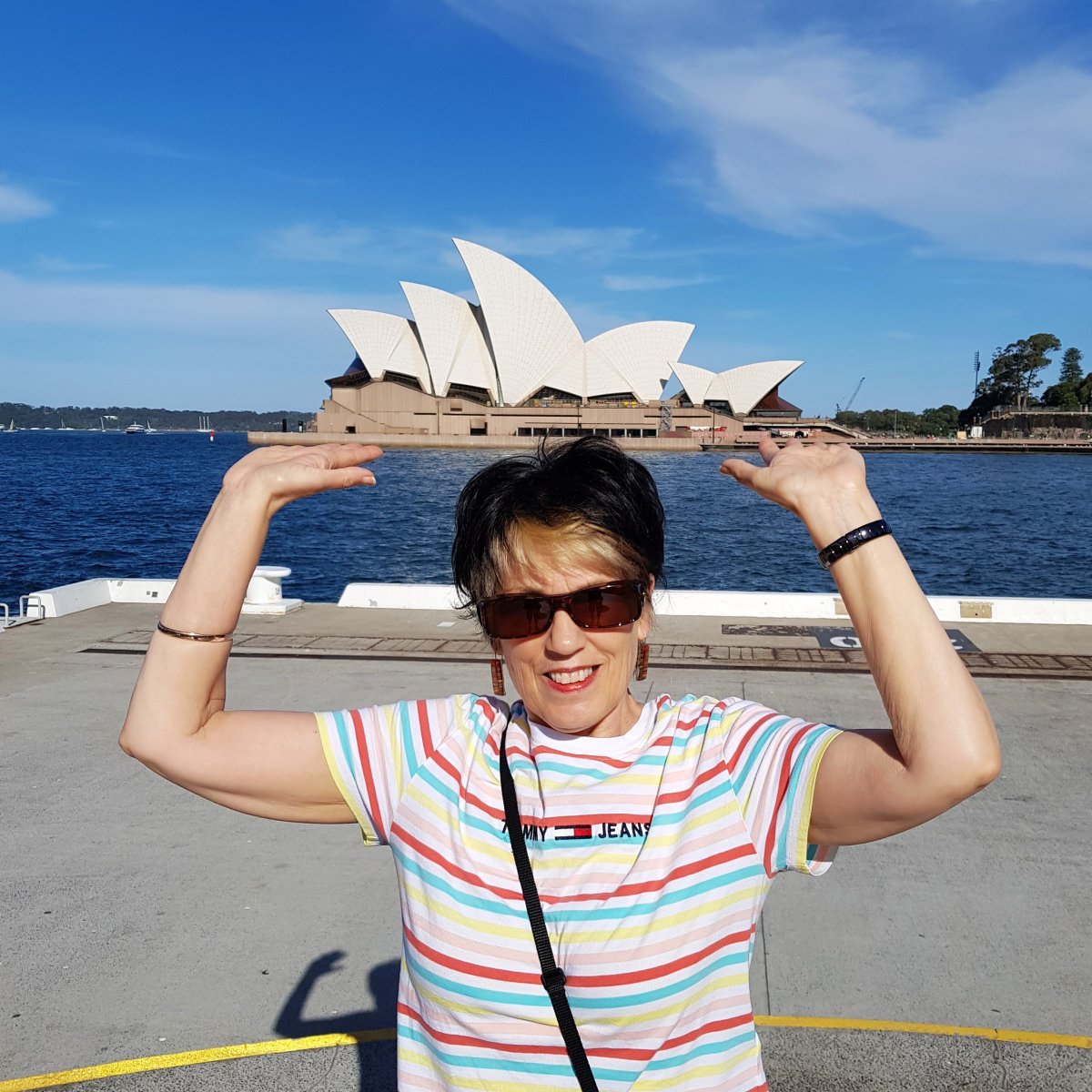
While the Sydney Harbour Bridge was symbolic of Hope during the years of the Great Depression of the 1930s, the opening of the Sydney Opera House in 1973 was symbolic of Australia’s arrival on the world stage as a nation embracing innovation and cultural ambition
Winter Weather is Changing for Sydney
The Sydney region has its own microclimate. This means the weather can be both variable across the region, and also quite changeable, even on the same day.
Features which can bring extreme weather to Sydney include Antarctic cold air masses from the Southern Ocean, desert-warmed air masses from central Australia, ex-tropical cyclone remnants, and the infamous ‘East Coast Lows’.
Traditionally, the winter months of June, July, and August in Sydney include both the wettest month (average June rainfall = around 132 mm [5.2 inches]), and the coolest temperatures (July being the coldest month – maximum of around 17°C [62.6°F]).
In all of that, curiously, on average Sydney’s winters tend to be sunnier than its summers.
However, weather and climate scientists are telling us that changes to Sydney’s climate will result in less rainfall in winter and spring, but an increase during the autumn. Winters will also be warmer, perhaps by up to 1°C.
While much of Sydney’s winter rainfall comes from the infamous ‘East Coast Lows’, the latest scientific projection is for fewer of these to occur in the future.
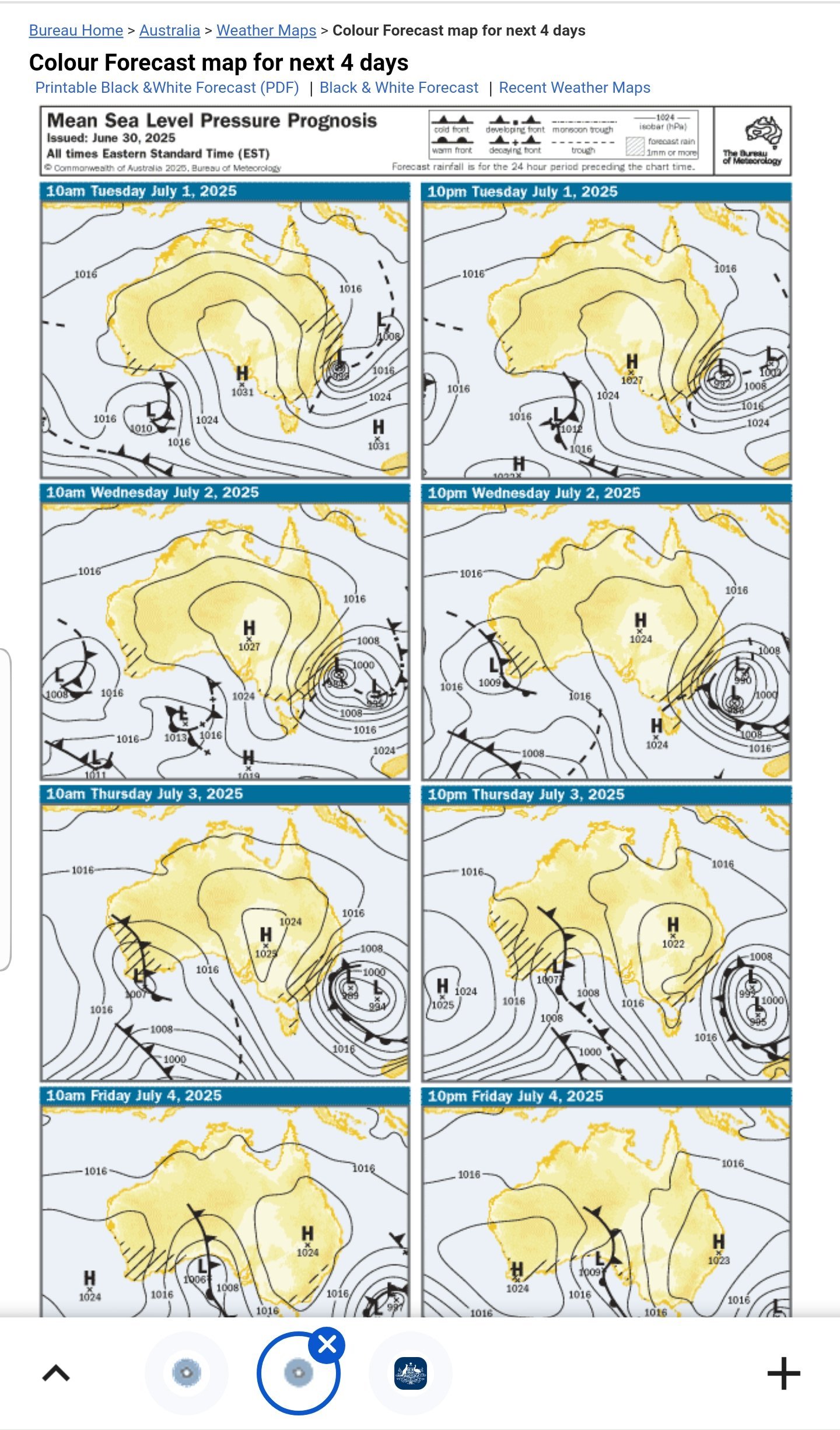
A severe East Coast Low hit Sydney and the NSW coast between June 30 and July 3, 2025, bringing damaging winds over 100 km/h, heavy rain, and dangerous 6-13 meter waves. The system deepened off the coast on Tuesday, July 1, impacting Sydney and the Illawarra intensely before moving into the Tasman Sea on Thursday, July 3.
Image credit: Bureau of Meteorology
Recent Sydney Winter Weather Patterns
Winter 2021 (Mild & Wet): A mild, wet winter, particularly in August, which saw high rainfall from coastal lows and a generally mild climate.
Winter 2022 (Cool & Wet): A notable outlier that was cooler than average, with many sites reporting their lowest maximum temperatures in 20 years. However, this year was part of the ongoing wet period, leading to high annual rainfall.
Winter 2023 (Very Warm): A very warm winter characterized by unseasonably warm weather in July and low rainfall.
Winter 2024 (Record Warm): One of the hottest winters on record. August 2024 experienced extreme, unseasonable warmth with temperatures reaching up to 28°C on the east coast, with 2024 overall having above-average temperatures and sporadic rainfall.
Winter 2025 (Wet & Warmish): One of the wettest on record for Sydney, with August 2025 recording four times the average rainfall, ending as the wettest winter in 18 years. It was the 25th warmest winter on record, though it was the second coolest this decade behind 2022.
Sydney is a City in a Playground…
…ALL Year Long…
Your Feedback, please…
Firstly, my thanks to you, for reading my post.
Now, the really BIG question is:
“What value has this Post offered you? “
Has it helped you, or do you need more information?
If you wish to offer some feedback, or to read the feedback from others, please follow the link below to the Feedback Page:
Your Feedback Page
Why Your Feedback is Important to Me
In real life, I am an agile Change Manager, so I know that feedback is an essential part of the improvement process.
Your feedback can help me improve both the content of this Post, and also of future Posts.
If you have a thought, or a question, about the post content, or if you would like to provide feedback about something else, please follow the link to the Feedback Page.
Your Feedback Page
I do look forward to hearing from you, especially if we can make improvements that will help fellow travelers on the road.
Marlene
Adventure Ready? Always!
P.S.
Please note, before any feedback is posted, it will be moderated. When I am moderating, I may need to contact you, which is why I ask for your email address.
Your email address will not be published, nor will it be used for any other purpose (unless you have already joined my Newsletter, ‘afootwego, In the Loop!’, that is).
Here is a link to the my afootwego.com CONDITIONS for POST FEEDBACK (2½ mins to read).
Should you wish to peruse them, here are links to my afootwego.com PRIVACY POLICY and Website TERMS and CONDITIONS of USE.